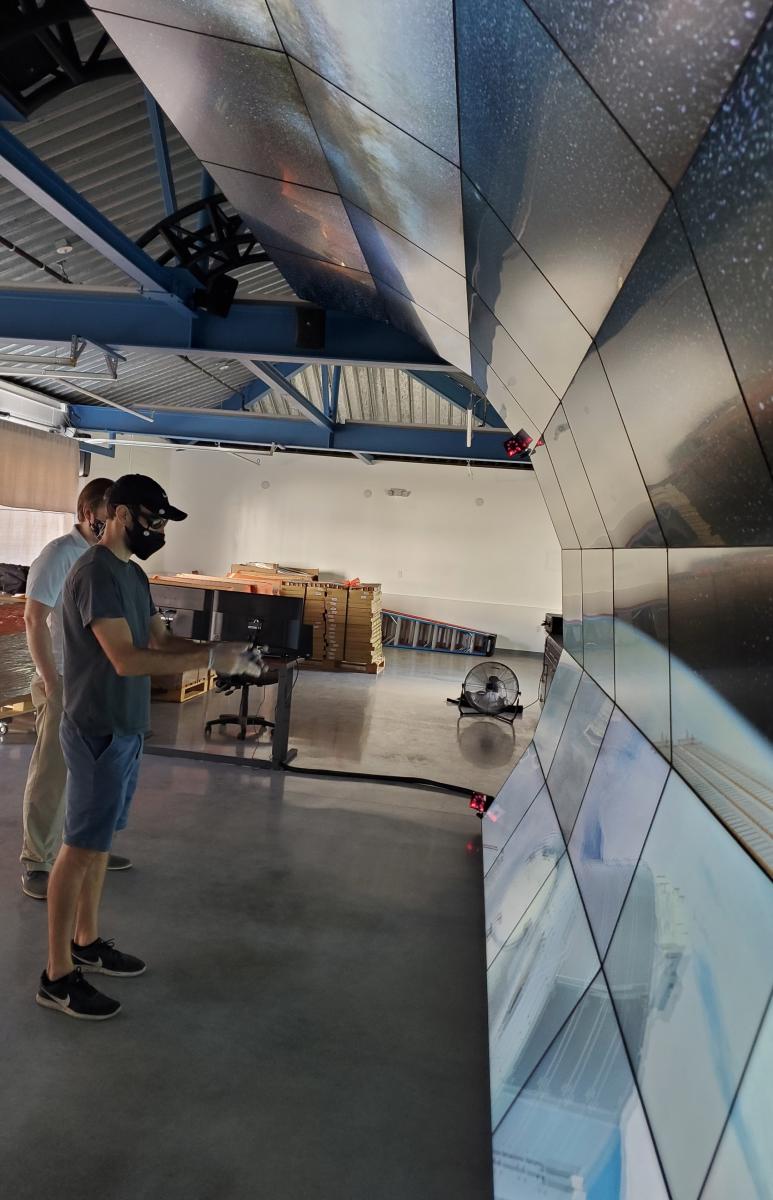
A galaxy looks rather different when it is hanging over your head. At Carnegie Observatories in Pasadena, a wall of screens bends upward like a wave about to break. In the photograph, astrophysicist Anthony Piro stands beneath it with a controller. There are exposed beams, boxes, and a floor fan nearby. The universe has arrived, but the room still has errands to do.
Mechdyne designed and integrated that display. The photograph captures something useful about the company: extraordinary imagery rests on ordinary practical work. Somebody must build the structure, connect the computers, program the controls, and make the next research session possible. The screens get the photograph. The workflow gets the job done.
- It builds the whole environment: displays, computing, software, controls, and support.
- Its customers have difficult data: scientists, engineers, government organizations, and enterprise teams.
- The useful lesson travels: watch people use the system, then remove the awkward steps.
A galaxy needs a front door
The Carnegie installation, completed in 2020, uses 35 specialized LCD panels in a curved, 12-foot-high arrangement. It supports stereoscopic viewing and tracks the navigation controller. A researcher can examine spatial relationships while colleagues look on. That is an appealing proposition for astronomy, where a flat chart can make a three-dimensional question feel like an argument conducted through a letterbox.
Then came the less photogenic question: how easily could scientists bring their own datasets into the room? Mechdyne’s account describes software architect Chris Scharver watching an end user during an on-site event and developing automation for data loading. Training and a source-code handover accompanied the work. Researchers retained familiar controls while gaining a simpler route from dataset to display.
Consider the purchasing lesson. A demonstration often begins with everything prepared. A working day begins with a file somebody has just produced. Those are different tests. The Carnegie follow-up suggests asking to see the second one before declaring the first a success.
The customer who changed the company
Mechdyne began in 1996 with three Iowa State graduates: Chris Clover, Jim Gruening, and Kurt Hoffmeister. Their experience came from the university’s Virtual Reality Applications Center. Their first project was a virtual firefighting simulator for the U.S. Navy. Training someone for a dangerous environment is a fairly concrete reason to build a convincing artificial one.
The subsequent expansion is more interesting than a tidy founder prophecy. Mechdyne says its enterprise VR customers brought it challenges outside VR. The business widened accordingly. Today the portfolio spans audiovisual integration, managed IT, software engineering, display structures, manufacturing, and building-system integration. An existing relationship can expose a problem that no product roadmap anticipated.
That breadth gives Mechdyne a particular place in the market. A display manufacturer supplies an important component. A software developer may supply the application. Mechdyne can take responsibility for the connections between them, including the physical environment and continuing technical service. Buyers are paying for a working arrangement of technologies, as well as the technologies themselves.
“Scalability and flexibility are key to ROI because they expand use cases and utilization.”Chad Kickbush, Mechdyne
A room old enough to have a history
At King Abdullah University of Science and Technology in Saudi Arabia, CORNEA surrounds its users with projected imagery on six sides. KAUST lists seven simultaneous users and an effective resolution of 96 megapixels per eye. The installation is a research instrument for exploring complex datasets together. The appeal is spatial understanding, with room for a conversation.
Mechdyne’s September 2026 account says the environment remains in active use after maintenance, computing upgrades, and screen refreshes. That matters because an installation’s working life is part of its economics. A room that can absorb changes has a different ownership proposition from one whose original components define its expiry date.
An earlier maintenance account supplies the unglamorous detail. A two-person service team typically visited twice a year, sometimes for up to two weeks. Projector alignment, color calibration, diagnostics, hardware, and software all required attention. A designated lead technician provided continuity. Someone who remembers the room’s peculiarities is an asset that does not appear in a resolution specification.
For a prospective buyer, upkeep deserves a named owner and a scheduled budget. The purchase commits an organization to operating a specialized facility. The same reasoning applies to much smaller systems: repairs become easier when responsibility has been settled before anything needs repairing.
Seventy-two screens, one shared problem
Manchester’s Data Visualisation Observatory offers another version of the idea. Opened at Alliance Manchester Business School in 2019, it arranges 72 screens around a 320-degree cylindrical space. The university wanted a facility usable across departments. Mechdyne coordinated with architects, facility managers, and IT, including integration with existing high-performance computing.
The distinction is social as much as visual. A shared display lets a group point, compare, and question together. The available space and the arrangements for bringing information into it matter alongside image quality. A spectacular room that fits the wrong meeting is merely an expensive place to be uncomfortable.
Manchester also makes the buying process visible. Requirements included research use, group work, support, and compatibility with the building. Those conditions helped determine the installation. A useful technology brief starts with the people, tasks, and constraints. The equipment list follows.
- 01 / PrepareMake the data usable.
- 02 / RenderCompute the visual scene.
- 03 / ShareDisplay and navigate together.
- 04 / MaintainKeep the next session possible.
The products behind the spectacle
Mechdyne’s software addresses several points along that chain. getReal3D connects Unity content to immersive systems, including CAVEs and head-mounted displays. viewReal3D offers a more direct model-viewing route: load supported GLB or glTF files into a getReal3D-based viewer without requiring a Unity developer. That lowers one barrier for a team interested in examining a model rather than building a custom application.
TGX tackles a different problem: reaching a powerful graphics workstation remotely. Its intended workloads include CAD, simulation, and demanding video applications. Lenovo publishes TGX deployment guidance, while Leostream supports it as a connection option. Here the display may be an ordinary desktop, but the underlying concern remains access to difficult information.
The business model consequently has several parts: scoped engineering and integration projects, software licenses, professional services, and continuing support contracts. TGX offers annual subscriptions or perpetual licenses with maintenance options. Custom installations require a scope-specific quote. A sensible comparison includes room infrastructure, content preparation, computing, training, and upkeep in the ownership budget.
Buy the second demonstration
The approach has conditions. An immersive room earns its place when scale, spatial relationships, or shared examination improve the task. A simple report may be perfectly legible on a laptop. Unsupported data formats and an inconvenient loading process can consume the time a larger display was meant to save. Remote graphics software likewise needs testing on the buyer’s own network and applications.
Mechdyne’s stated values include community responsibility and paid volunteer time. Its technical work makes another kind of responsibility visible: staying with the system after the opening photograph. The company marked its thirtieth anniversary in 2026. The enduring question across its projects is refreshingly practical. Can the next person bring in new information and do useful work with it?
Copy the method at whatever scale you can afford. Observe a real session. Identify the slow step. Simplify it. Decide who will support the result. Then repeat the demonstration with an ordinary user and tomorrow’s dataset. The room can be magnificent. It still has to open for business.
Take a closer look
Explore Mechdyne’s systems, product demonstrations, and project stories.
Company website ↗Project stories ↗TGX and trial information ↗Watch: introducing viewReal3D ↗YouTube demonstrations ↗LinkedIn ↗Twitter / X ↗Facebook ↗