The shortest JetBuy demo is four words long. “Hey Siri, JetBuy lunch.” A confirmation follows. Somewhere, a familiar order begins moving toward a familiar address. No menu unfolds. No restaurant search becomes an evening referendum. The phone can stay locked. Ryan Holmes has arranged an entire company around the belief that a repeated decision should eventually stop feeling like a decision.
This is an almost comic reduction in scope for a founder whose previous product was supposed to leave the planet. Holmes founded SpaceVR in 2015 to capture immersive views of Earth from orbit. Its early camera was a thicket of modified GoPros around a 3D-printed core. JetBuy is software for ordering coffee, sushi, salad or dinner. Yet the distance between the two companies is smaller than their nouns suggest. Both try to collapse a long journey into one immediate sensation.
SpaceVR wanted the view from an astronaut’s window to appear inside a headset. JetBuy wants a favorite order to appear at the door after a sentence. One chased perspective; the other chases convenience. Both depend on an interface becoming quiet enough for the experience to take over.
Tampa Hackerspace
SpaceVR
JetBuy
First, build the place where things get built
Before the satellite renderings and Palo Alto demos, Holmes studied electrical engineering at the University of South Florida and worked there as a web developer. His early resume moved briskly through direct sales, outsourced management, marketing, design and software. In Tampa, he also founded Tampa Hackerspace, a community workshop organized around a plain idea: people should be able to learn by using serious tools together.
The projects that followed kept mixing software with physical experience. E5 Engineering, the design agency Sphr and dealership tool UpValet sat at different points between engineering and interface design. Public biographies credit several of his products with reaching the top position on Product Hunt. More revealing than the ranking is the pattern. Holmes kept building things that could be demonstrated, handled or entered.
Then he watched Overview, a short documentary about the shift in perspective astronauts describe after seeing Earth from space. Political borders vanish. The planet looks shared and vulnerable. Holmes decided the view should not remain the private privilege of the few people trained and launched into orbit. Virtual reality, he thought, might carry a version of it back.
A car, a camera and a smaller second ask
Space hardware is not a gentle hobby. At 24, Holmes said he scraped together the first $15,000 by selling his car, combining birthday money and taking an advance on an inheritance from his great-grandmother. The resulting startup imagined a 360-degree camera aboard the International Space Station. Its first crowdfunding campaign asked for $500,000 and fell short.
The team narrowed the plan and returned with a $100,000 goal. That campaign raised $113,310 from 1,382 backers in 2015. The reset is worth lingering over. SpaceVR did not make outer space cheaper. It made its first promise smaller. The camera concept shifted from twelve GoPros to a more compact rig, while the route to orbit kept changing.
In April 2016, SpaceVR announced a $1.25 million seed round led by Shanda Group, with Skywood Capital participating. The plan grew into a free-flying camera satellite with twin 4K sensors, communications equipment and a six-month working life. The risk list Holmes gave at the time was bracingly practical: the rocket could fail, the payload could fail, the radio could fail. A founder may sell the heavens, but the engineer still has to worry about a switch turning on.
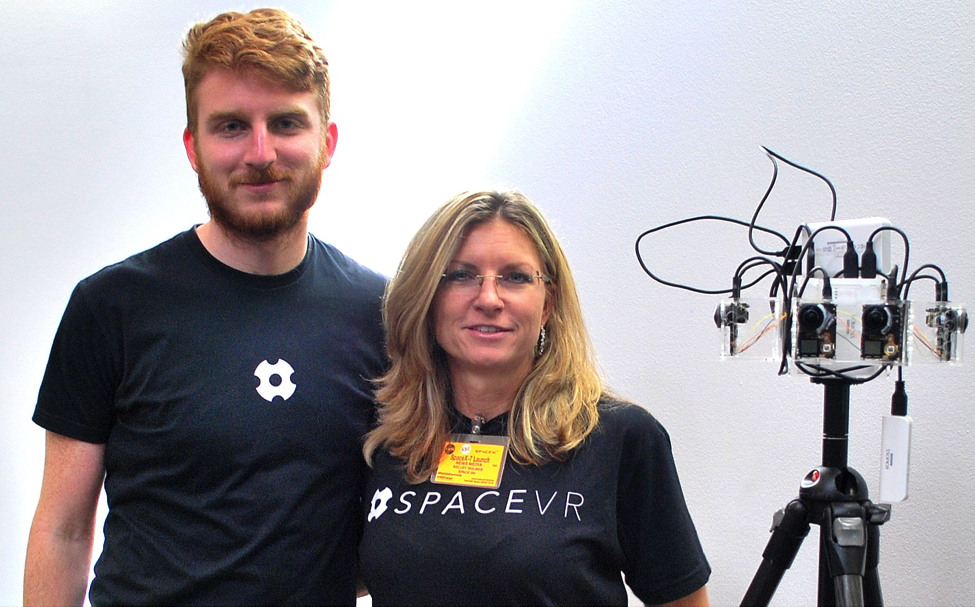
The project attracted advisers and partners from the space industry. Holmes pitched Elon Musk impromptu at an ISS research conference. SpaceVR considered cameras on the station, its own satellite and, later, an immersive installation that paired VR footage with spatial sound. In public, Holmes could sound both grand and disarmingly candid. He called the work important. He also admitted that some investment money had gone toward what he described as his own “stupid mistakes.”
His wardrobe occasionally matched the premise. At a 2018 conference in Vienna, he discussed consciousness in loose robes decorated with fresh red roses. Silicon Valley has never lacked for costumes, but this one at least suited a company trying to turn orbital footage into a communal experience.
The screen gets smaller until it disappears
JetBuy began in 2023 and appeared in an AI-focused hackathon the following year. Its Devpost page described the inspiration without ornament: people should be able to buy with their voice without touching their phone. The iOS app reached version 1.0 in September 2024. Curiously, the App Store lists its developer as SpaceVR Inc., leaving a corporate thread between the orbital camera and the takeout order.
The setup asks a user to save favorite orders under words they can remember: coffee, lunch, dinner, sushi. After that, Siri can place one for delivery or pickup. JetBuy says the process turns as many as twenty taps into zero and can place an order in under a second. The underlying idea is not that customers lack choices. It is that they have already made many of the same choices before.
Most shopping software treats the catalog as the attraction. JetBuy treats it as something to cross once. This makes the product less like a voice-operated marketplace and more like a collection of personal buttons with names. Holmes has also discussed a broader buying-club model: enough recurring demand could create leverage for discounts or bundled offers. For now, the cleanest proposition remains the saved favorite.
The release history supports him. JetBuy’s updates are an unglamorous inventory of the work beneath “one second”: revised onboarding, checks for Siri and Shortcuts, American Express support, multiple quantities, subscriptions, promo codes, Canadian postal codes and small speed gains. Magic, in a consumer app, is often a tidy stack of edge cases wearing good manners.
Let someone else order the pizza
Holmes has made the product legible through live demonstrations. Tim Draper ordered Papa Johns with Siri. Andrew Ng ordered pizza and called it his first food order with AI. Gary Tan ordered a Coca-Cola at YC Demo Day 2025. Eric Yuan ordered udon during an event at Zoom’s headquarters. In Robert Scoble’s home, Holmes triggered a pizza order during an interview and let delivery provide the closing argument.
These are celebrity testimonials, certainly, but they are also compact pieces of product theater. Voice software is difficult to photograph. An arriving pizza is wonderfully cooperative. Each demonstration has a beginning, a command and a consequence. No diagram is needed.
The useful lesson is not to borrow famous people. It is to design a demonstration short enough that the audience can retell it accurately. “Gary ordered a Coke with Siri” fits. So does “a camera made from twelve GoPros was built for space.” Holmes gravitates toward products with a visible verb: make, see, say, receive.
The ambition survived. The altitude changed.
It would be easy to frame JetBuy as a retreat from satellites to salad. Holmes’s career reads more coherently from the customer’s side. Tampa Hackerspace gave members access to machinery. SpaceVR sought access to a rare perspective. JetBuy offers access to a transaction without the usual screen ritual. The recurring project is proximity.
There is also a productive tension between Holmes the dreamer and Holmes the operator. The dreamer talks about a billion people seeing Earth from orbit, a million stores and a billion items. The operator ships Canadian postal-code support. One supplies direction; the other keeps the app from rejecting Toronto.
JetBuy still has a young product’s modest public footprint. Its App Store listing showed six ratings when reviewed, and its latest listed version arrived in May 2025. The available facts describe an experiment in progress, not a settled change in how people shop. What Holmes has already made clear is the wager: voice becomes useful when it stops narrating and starts completing.
SpaceVR wanted to change a person by changing the view. JetBuy wants to return a few minutes by changing the path. Holmes has traded the blackness around Earth for the bright confirmation of an order placed. The interface is smaller. The appetite for immediacy is intact. Somewhere between orbit and dinner, his career has settled on a durable question: how little technology can the user see while something complicated still happens?