Tobias Lütke wanted to sell snowboards. Before he could do that, he had to persuade the internet to take somebody’s money. One of the chores involved sending notarized copies of his passport to American Fork, Utah, to obtain the keys needed for credit-card payments. Entrepreneurship had supplied its first joke: an online business could still require a small expedition through paperwork.
Snowdevil, the shop he started with Scott Lake and Daniel Weinand in 2004, offered an unusually useful education. A programmer could see the machinery behind the storefront. Lütke built the software he wanted to use. The shop became a working demonstration of another possible business, one whose inventory would never need waxing.
By 2006, the founders had launched Shopify. The product had moved one step backward in the chain: from selling a thing to helping other people sell their things. That small shift explains much of Lütke’s subsequent career. He keeps returning to the effort required before a person can begin.
The checkout came before the company
There is a temptation to tidy an origin like this into foresight. A founder spots the future, writes the necessary code, and waits for the world to catch up. Snowdevil offers a more useful sequence. Lütke encountered a problem because he was attempting something ordinary. The ambition grew out of the attempt.
A shop owner needs a place to display goods, accept payment, and manage the transaction. Doing those jobs badly can consume the energy meant for the actual business. Software that removes some of that effort changes who can afford to try. The person with an idea for a product no longer has to become equally interested in every technical obstacle between the product and its buyer.
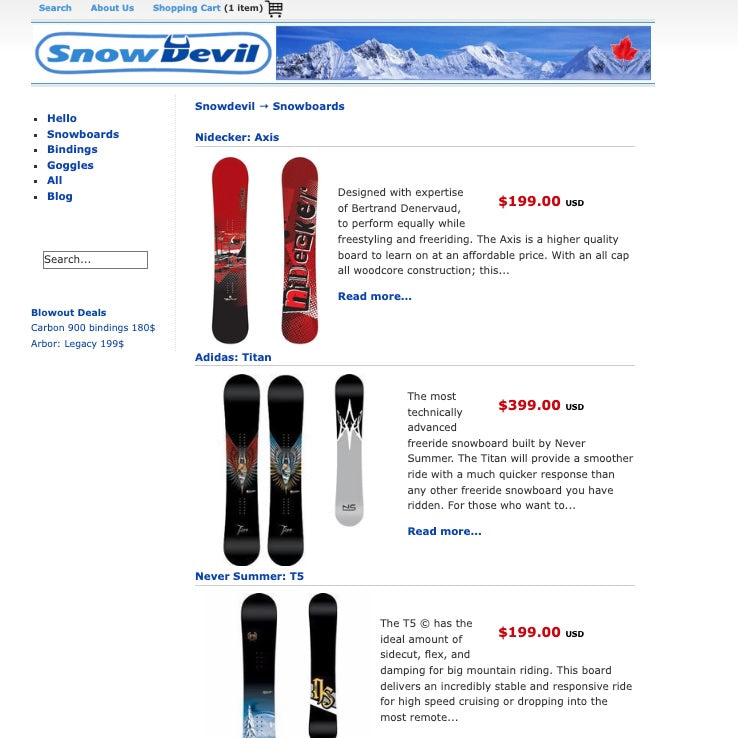
Shopify eventually opened its platform to outside developers, giving them room to build applications for merchants. Lütke could provide a common foundation while other people supplied answers to needs his own team would never anticipate. A business built from one merchant’s inconvenience began making space for other merchants’ particularities.
An education with a red pen
Long before Ottawa, Lütke had chosen Germany’s vocational route. At sixteen, he left school for a programming apprenticeship at BOG Koblenz, a Siemens subsidiary in his hometown. His early duties included cafeteria work. Between coffee runs, he studied Delphi manuals. The favored team worked in a basement, an appropriately modest address for an education that would later become part of a public company’s culture.
His mentor, Jürgen, marked up yesterday’s code in red. Lütke learned to separate his pride from the program. Better abstractions and clearer structure mattered more than preserving the first attempt. He later wrote that he wanted to recreate that learning environment at Shopify.
The mentor also assigned responsibility. When a dealership needed software installed, Lütke prepared for a trip with Jürgen. Then Jürgen said he could not go. The apprentice went alone and made the installation work.
Years later, talking about this relationship, Lütke described a teacher who kept moving him beyond what felt comfortable. The assignments gave him a reason to reconsider what he knew. Learning happened in contact with a real customer and a real system, where a persuasive explanation could only get him so far.
That is a demanding kind of kindness. A mentor who fixes every difficulty can leave the student dependent. A mentor who withdraws at the right moment creates the possibility of competence. Lütke’s account gives his later enthusiasm for craft a recognizable beginning: someone had taken his work seriously enough to improve it.
“You earn your job by making great decisions when you don’t know what to do.”
Tobias Lütke, 2013
Leave room for somebody else’s idea
The programmer did not disappear when the company acquired a CEO. Lütke became chief executive in 2008, after serving as its chief technology officer. Shopify went public in 2015. Those milestones changed the scale of his responsibilities, but software remained a practical language for the business.
Consider Liquid, the template language created for Shopify and released as open source. Its purpose includes letting merchants shape a storefront while keeping customer-facing code within a controlled system. Flexibility has to coexist with reliability. A platform that promises personal expression also needs boundaries that let many different businesses operate on shared infrastructure.
The same balancing act appears in the developer ecosystem. A platform gains possibilities when it lets outsiders contribute. It also acquires obligations to those outsiders. The toolbox becomes useful partly because someone else can pick it up and make something the original builder never had in mind.
A compass, then a difficult turn
In 2013, Lütke described a weekly company routine built around growth in committed monthly recurring revenue. The team received a Monday email showing whether it had met its target. A Thursday meeting asked what people had learned and what they would change the following week. The feedback loop was short enough to influence the next piece of work.
The arrangement is revealing because it gives measurement a job. A number should direct attention toward a decision. A dashboard can otherwise become an expensive way of observing that time has passed. Lütke’s account joined the measure to a recurring conversation about action.
His writing about executive judgment makes a related point. An executive admitted feeling out of his depth. Lütke responded that the job required good decisions under uncertainty. A growing company regularly exceeds yesterday’s understanding of it. Experience matters, but it cannot promise that the next problem will resemble the last one.
The consequences became especially visible in May 2023. Lütke announced that Shopify would become smaller by about twenty percent and that Flexport would buy Shopify Logistics. He framed the decision through the company’s “main quest”: making commerce easier. Logistics would become somebody else’s central task.
The gaming vocabulary made the strategy easy to picture. The consequences were harder. Employees were losing jobs, and Lütke acknowledged the impact in the same message. Focus, when applied to a large organization, rearranges people’s lives. The appealing story of a programmer solving a checkout problem has to hold that later chapter too.

The new tool on the workbench
In April 2025, he published an internal memo about AI. Using it effectively had become an expectation at Shopify. Teams seeking more people or resources were asked to demonstrate why AI could not accomplish the work. The policy moved a technological preference into the everyday decisions of an employer.
There is a recognizable continuity with Snowdevil: examine the work, inspect the tool, reconsider the obstacle. There is also a difference in power. A founder experimenting on his own project chooses the terms of the experiment. An employee works within terms set by somebody else. The usefulness of a tool and the consequences of an employment policy deserve separate scrutiny.
Lütke’s interest in machines and human achievement predates that memo. In a 2018 essay, he recalled watching the Kasparov-Deep Blue chess matches and argued that superior computer performance had not extinguished interest in human players. People care about the effort behind a performance, the practice, and the constraints of being a person.
Read alongside his later enthusiasm for AI, that argument leaves an interesting question. If making a first version becomes easier, where should the human effort go? Choosing the problem, judging the result, and earning another person’s trust still require attention. A tool can shorten the route to an attempt without deciding whether the attempt deserves to exist.
His public code supplies a smaller, tangible example of his continuing interests. QMD, a repository under his GitHub account, is an on-device search engine for notes and documents. It combines keyword and semantic search with local model-based ranking. The CEO still has uses for a workbench of his own.
Two programmers, four wheels
There is another place to find Lütke working with systems: a racing cockpit. He competed in IMSA’s LMP2 class with Era Motorsport in 2025. For 2026, TDS Racing announced a lineup including Lütke and David Heinemeier Hansson, the creator of Ruby on Rails. The pair appeared together on the Rolex 24 at Daytona entry list.
The connection has a pleasing circularity. Rails belongs to the software history behind Shopify; its creator now shares a racing program with Shopify’s co-founder. Two programmers have found a setting where feedback arrives at considerable speed.
It would be easy to turn the car into a metaphor for every business decision. Better to let it remain a car. The detail enlarges the person in the profile. Lütke has a demanding pursuit outside the company, with rules and teammates of its own. A title cannot explain an entire calendar.
A company with a century in mind
“I want Shopify to be a company that sees the next century,” he wrote as it prepared to go public. In 2019, he returned to the thought while arguing for investment in carbon removal. Shopify committed to a sustainability fund spending at least US$5 million annually. His proposal included paying high early prices to help create predictable demand for an emerging industry.
The logic followed his familiar interest in removing a barrier. Suppliers need demand before they can build more efficient production; buyers want lower prices before they create demand. A willing early customer can help break the circle. It was an attempt to apply a merchant’s understanding of markets to a much longer horizon.
US dollars. Merchant sales flowing through the platform and revenue earned by Shopify measure different things.
By the second quarter of 2026, Shopify reported US$115.567 billion in gross merchandise volume and US$3.583 billion in revenue. Those figures describe very different flows: the activity of merchants and the money earned by the platform. Keeping them distinct preserves the relationship at the center of the business.
For all the distance traveled, the beginning remains useful. A prospective shop owner had something to sell and found the path unnecessarily awkward. He improved the path. Other people could then use it for purposes of their own. The next entrepreneur may have no interest in snowboards, programming apprenticeships, or prototype racing. Lütke’s work gives that person a chance to begin anyway.