YC W25
B2B
AI • ECOMMERCE • GENERATIVE ENGINE OPTIMIZATION
Wildcard
Your products, inside the AI that recommends them.
Your products, inside the AI that recommends them.
For two decades, "getting discovered online" meant Google rankings. You hired an SEO agency, optimized your title tags, and competed for the top blue link. That playbook worked - until the day ChatGPT started answering "best running shoes under $150" with specific product recommendations, bypassing your entire search funnel.
That day is now. And most e-commerce brands are not ready for it.
Enter Wildcard. Founded in 2025 by Kaushik Mahorker and Yagnya Patel, Wildcard is the infrastructure layer that gets your products discovered, ranked, and purchased inside AI shopping assistants - ChatGPT Shopping, Google Gemini, Amazon Rufus, Walmart Sparky, Perplexity, and whatever comes next. They call it Generative Engine Optimization, or GEO. It's the discipline that replaces SEO for a world where the search bar is a conversation.
"The brands that win the next decade of commerce won't be the ones with the best ad spend. They'll be the ones whose products AI actually knows how to talk about."
- The Wildcard thesis, in one sentenceThe core insight is brutal in its simplicity: 67% of products on the internet lack the structured attributes - material composition, sizing context, use-case descriptions - that AI engines need to confidently recommend them. If an AI can't understand your product, it won't suggest it. Wildcard makes sure it can.
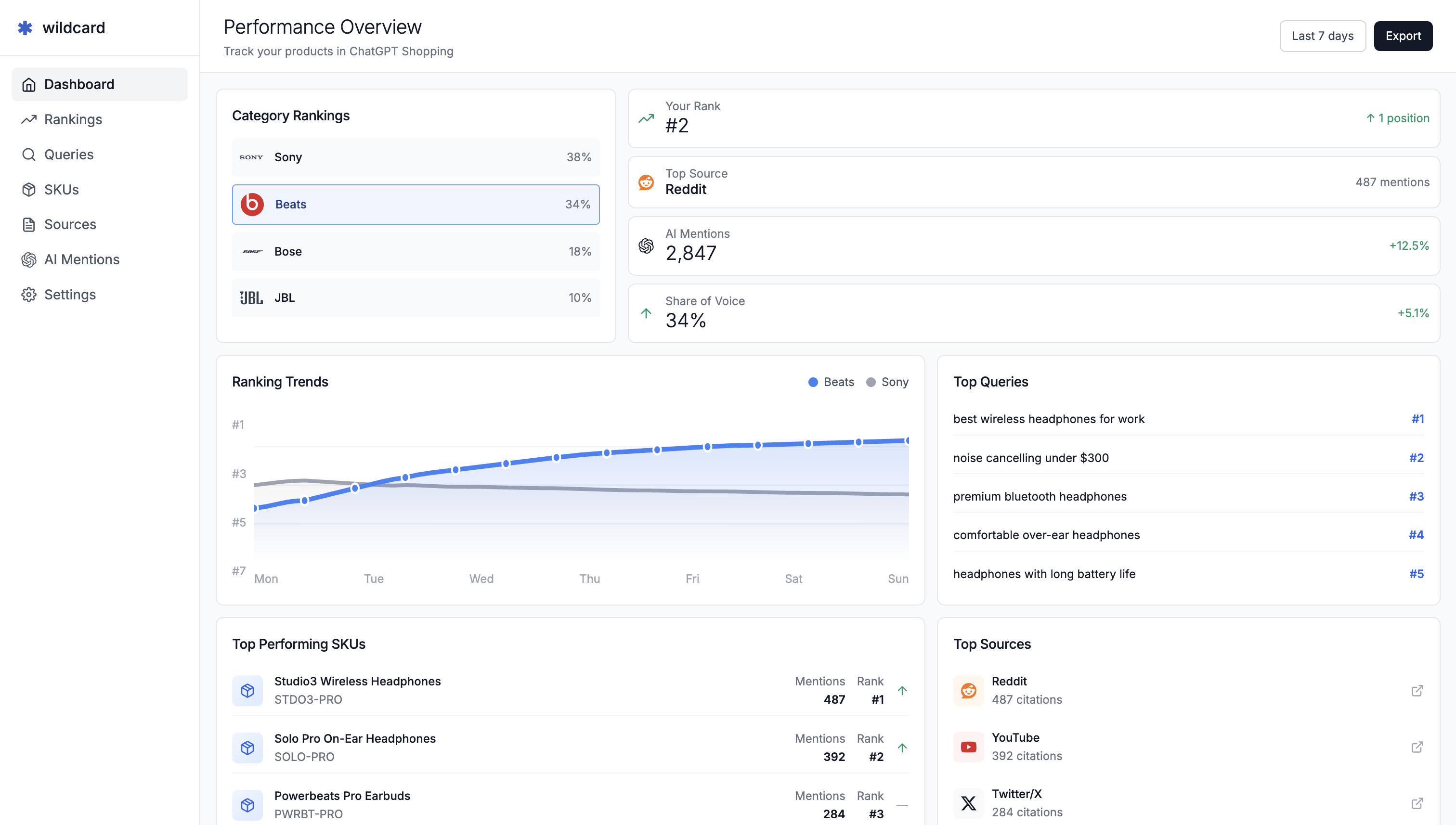
Wildcard tracks your brand's presence and product rankings across the AI assistants your customers are already using.
Track exactly how your brand, SKUs, and product collections appear inside AI shopping responses. Know your ranking. Know your competition.
Enrich your product data with the structured attributes AI engines need to recommend with confidence. Turn invisible SKUs into recommended ones.
Build FAQ pages, collection narratives, and blog content calibrated to be cited by AI systems when shoppers ask relevant questions.
ACP (Agentic Commerce Protocol) for ChatGPT and UCP (Universal Commerce Protocol) for Gemini - so the AI doesn't just recommend. It buys.
An open specification that lets AI agents discover and call any API in natural language. The OpenAPI standard, reinvented for the agent era.
Kaushik and Yagnya met as undergraduates. Eight years of building - at scale, in production, on problems that mattered - before they built Wildcard together. That shared history is not incidental. It's the product's foundation.
Before Wildcard, Kaushik was an Engineering Manager at Scale AI, where he led the GenAI Allocation team and built the e-commerce enrichment engine for Scale's largest pilot - 2.4 million product attributes enriched across 400,000 SKUs. Before that, AWS Elastic File System. UCLA CS grad. He understands e-commerce data at a level that most founders spend years trying to reach.
SCALE AI AWS UCLA CSYagnya is an NLP and Knowledge Graphs specialist who shipped production AI at Tesla, Amazon, and Truveta before co-founding Wildcard. His computational neuroscience background gives Wildcard's technical architecture a distinctive edge in understanding how language models process and surface product information. The person who makes agents.json actually work.
TESLA AMAZON NLPThe agentic AI market is projected to hit $93 billion by 2032, growing at 44.6% annually. AI shopping channels are the first major commercial surface area. Wildcard is early.
Bar widths reflect relative AI shopping channel maturity, not exact revenue data. Wildcard tracks all of them.
Alongside their GEO platform, Wildcard released agents.json - an open specification for how AI agents discover and call APIs using natural language. Think of OpenAPI, which standardized how developers describe REST APIs. agents.json does the same thing for the agent era.
Instead of a developer manually integrating an API into an agent's workflow, agents.json lets any AI agent query a gateway in plain language ("send a transactional email to this user") and receive back the right API call, parameterized correctly. Wildcard launched with 10 curated integrations including Resend and Alpaca, and has demonstrated a 60% reduction in API maintenance overhead for teams using the specification.
It's freely available on GitHub. That's intentional: they want agents.json to become the standard, because a standard they helped create is an advantage that no competitor can replicate.
Eight years before founding Wildcard, the two meet on campus. Their paths diverge into Scale AI, Tesla, Amazon, and AWS - each collecting expertise that will eventually converge.
The market shift Wildcard is built for begins. AI assistants start recommending specific products. Most brands have no idea this is happening to their catalogs.
Kaushik and Yagnya incorporate Wildcard and begin building the GEO platform. Apply to Y Combinator.
Wildcard joins the YC Winter 2025 cohort - a batch where nearly 50% of companies are building AI agents. $500K in initial funding from YC.
Open specification for AI-native API interactions launches publicly. Early press coverage from American Bazaar and tech outlets.
Rootly signs on as Wildcard's first paying enterprise customer. Platform traction begins.
Kaushik and Yagnya met as undergrads, 8 years before co-founding Wildcard. The patience of people who know what they're waiting for.
67% of e-commerce products can't be found by AI shopping assistants because they lack the structured attributes AI needs. That's most of the internet's commerce, invisible.
agents.json is Wildcard's open-source play to become the OpenAPI of the agent era - a standard they helped invent, which is a moat competitors can't easily replicate.
Nearly 50% of YC's W25 cohort is building AI agents. Wildcard launched during peak agent mania - and targeted the commercial layer everyone else was ignoring.
Direct-to-consumer brands running Shopify or WooCommerce who need their products visible in the AI-first shopping discovery layer.
Large retailers managing thousands of SKUs who need systematic catalog enrichment and AI channel monitoring at scale.
API companies (like Resend and Alpaca) who want their services discoverable and callable by AI agents via the agents.json gateway.