The new office came with a car wash. Phil Hagerman, touring the former General Motors Great Lakes Technology Center in Flint in 2010, had inherited a small monument to executive convenience: a place where the cars could be detailed while their owners attended to larger matters. His growing company needed offices and distribution space. The car wash was surplus to requirements. “We’re the only pharmacy that has a car wash on site,” he joked. Even expansion has its little absurdities.
It is a useful opening image for a career that keeps returning to the same question: what else could this place become? A General Motors facility became a headquarters. A former fur store became a home for inventors. An alumnus’s gift became a university center where students could try out business ideas. Hagerman’s projects give the question an address, a budget and, eventually, someone responsible for opening the door.
Today he is founder, chairman and CEO of Forum Health, with a parallel record as an investor and philanthropist. But his Flint story is easier to understand at street level. It involves the awkward stretch between having an idea and knowing what to do with it. He has spent money on that stretch, bought buildings around it, and helped create organizations to make it easier to cross.
The family business, before the ticker symbol
In 1975, two weeks before Hagerman graduated from college, his father delivered a confusing piece of news. Dale Hagerman had sold his interest in a small chain of drugstores. Then he had bought a store back. More precisely, he had exchanged his stake in the group for one newer location that father and son could operate together. Graduation was approaching. So was a job.
Phil had wanted to work with his father. He earned his pharmacy degree at Ferris State University that year and joined him in the enterprise that became Diplomat. Its name came from Diplomat Plaza, where the store stood. Before it was a stock-market name, it was a place name. The beginning was local, familial and quite practical.
There was a long apprenticeship between that beginning and the company’s later scale. Hagerman became CEO in 1991. In his account of the business, annual revenue had reached about $10 million by 2000 and $25 million by 2005. Those dates matter. The familiar shorthand of a small shop becoming a national company can compress decades into a sentence. He spent those decades inside the business.
Diplomat went public on the New York Stock Exchange in October 2014. Revenue exceeded $4 billion in 2015. He stepped down as CEO in 2018, after 27 years in that role. These are substantial changes of scale, yet the family connection remained a useful reference point: the enterprise began with two people agreeing to work together, long before there was a public market to impress.
Making more room in Vehicle City
The move into the former GM complex put a growing business inside an enormous reminder of Flint’s industrial past. Hagerman bought a significant portion of the Great Lakes Technology Center in 2009. The company’s move involved a jump from roughly 40,000 square feet to 550,000. An empty room was one thing. An extra half-million square feet required a considerable appetite for tomorrow.
For Flint, the timing gave the purchase meaning beyond a property transaction. Automotive contraction and the financial crisis had made employment an urgent subject. Hagerman’s expansion put another kind of employer into an automotive building. It also drew him further into the city’s civic life. The business could grow there; the city had reasons to want it to.
SkyPoint Ventures extended his activities into early-stage investment and real estate. The two interests have a natural meeting point in a city with both aspiring founders and buildings waiting for another use. Money can finance a business. Space gives it somewhere to arrive on Monday. Neither automatically supplies customers, but both can make an otherwise abstract ambition a little more workable.
The fur store gets a different clientele
The Ferris Wheel building had previously housed furniture and fur businesses. Phil and Jocelyn Hagerman bought it in 2013. Four years later, the renovated property opened to the community. A building that had spent decades vacant was being asked to accommodate a different kind of commerce: businesses still finding out what they were going to be.
The project’s name retained a trace of the old fur business. Inside was 100K Ideas, the nonprofit Hagerman developed with inventor and entrepreneur David Ollila. Their connection brought together a property project in Flint and experience helping inventors in Michigan’s Upper Peninsula. The organization traces that introduction to 2016.
Its purpose is specific: help people assess ideas and work out the steps toward a business, regardless of their previous experience. Student professionals contribute to the work alongside its leadership team. That makes the arrangement useful in two directions. An aspiring founder gets assistance. A student gets to work on a problem whose answer will have consequences beyond a grade.
There is an appealing lack of ceremony in the premise. A person can have a product idea without already knowing the vocabulary of financing, development or markets. The assistance begins before the polished presentation. For a project backed by someone who built a public company, that is a consequential choice of starting point.
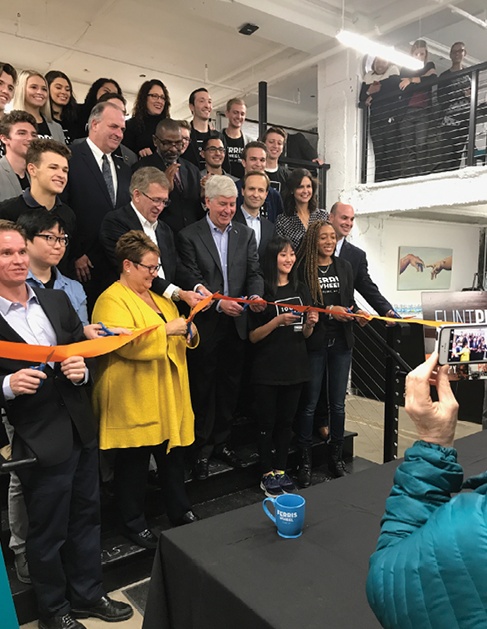
A former fur store gets a new crowd. Hagerman joins the Ferris Wheel ribbon cutting. Photo: LEADERS.
A gift with people attached
In January 2015, Phil and Jocelyn made a $2 million gift to the University of Michigan-Flint’s School of Management. The plan included an entrepreneurship and innovation center, an endowed professorship, scholarships and support for student activity. The gift made room for several kinds of work at once, from faculty research to students helping other students.
The Hagerman Scholars were designed to participate in the center’s operations, assist with the business plan competition and work with high school students. The arrangement put recipients inside the work the funding made possible. A scholarship could help someone study entrepreneurship while giving that person a practical role in encouraging it.
At Ferris State, the family connection ran through three generations: Dale graduated in 1951, Phil in 1975 and Phil’s daughter Jennifer in 2003. His sister Deborah was also an alumna. In 2015, Phil, Jocelyn and the Hagerman Foundation gave $5 million to Ferris, supporting scholarships, facilities and an endowed chair. The building carrying the Hagerman name reflected a relationship much older than the lettering.
A further $5 million planned gift followed in 2021. “Planned” is an essential part of that description; it is a future commitment, distinct from the earlier gift. Together, the commitments show education occupying a persistent place in his giving. The institutions that helped prepare one generation were being equipped to receive another.
Entrepreneurship & innovation
Facilities, scholarships & an endowed chair
When the tenant outgrows the incubator
Buildings change owners. Organizations move. A revival story has to survive both. In 2023, 100K Ideas relocated next door from the Ferris Wheel to the Dryden Building. Hagerman had sold the Ferris Wheel to Dave Forystek, whose Premier Security Solutions needed more space. The security business had itself come through 100K Ideas. A former beneficiary was now large enough to need the building.
That is a more interesting milestone than a ribbon cutting. The incubator’s home had become useful to an expanding company, and the incubator needed to adapt. The Dryden move included the reopening of the Shops on Saginaw and room for additional business resources. Ownership of the Dryden also changed in 2023, with a lease protecting the nonprofit’s occupancy.
The episode keeps the story honest about how places work. A building’s opening is an event; keeping an organization useful is ongoing labor. Hagerman’s investments created settings in which other people could make decisions, grow companies and change the arrangements. Once that starts happening, the original floor plan is unlikely to remain sacred.
“What drives me the most is being a catalyst to get something started.”
Phil Hagerman · 2018
Twenty-two students, and the next question
In June 2024, the university’s Summer Entrepreneurship Institute brought together 22 incoming high school juniors and seniors. They visited the Flint Farmers’ Market, developed venture ideas and went to 100K Ideas, where Hagerman spoke with them. The visitors came from several Michigan counties and as far away as Florida and New Jersey. His name was on the university center; he also appeared in person.
The center had received the 2024 Excellence in Co-Curricular Innovation Award from the United States Association for Small Business and Entrepreneurship. Its activities include Zillion Solutions, an innovation competition, a summer program, scholarships and support for the Entrepreneurs Society. These are several doors into the subject. A student need not arrive with a company already formed to take part.
In 2023, the University of Michigan awarded Hagerman an honorary Doctor of Laws degree at UM-Flint’s commencement. It recognized a record of business and community service. The student visit the following year offers a less formal picture of the same relationship: a working founder talking to young people who were still deciding what they might attempt.
Still at the starting line
Hagerman continues to lead Forum Health Enterprises, whose organization includes Inwell Biosciences and Power2Practice. His responsibilities include oversight and helping the leadership team connect with investors. Alongside that role are SkyPoint Ventures and his involvement in the Hagerman Foundation. The work has several institutional homes, but the recurring interest is in giving an enterprise the resources to proceed.
“What drives me the most is being a catalyst to get something started,” he said in 2018. That ambition fits the buildings, scholarships and early business support better than a simple account of accumulated success. Starting something useful also means depending on the people who will run it after the first enthusiasm has passed.
The car wash is the comic detail that lingers. It belonged to the building’s previous life, an amenity left behind for someone else to assess. Hagerman needed room for a different business. Later, other people needed room for theirs. Across Flint, that has become a practical way to read his career: open the door, find out what the space can hold, and leave enough room for another person’s idea.