Before Steve Case took investors on the road to look for startups, he went looking for pizza. His job at Pizza Hut involved developing new products, and he wanted to see what franchisees around the country were trying. The test kitchen in Wichita could only tell him so much. Somewhere beyond headquarters, someone might already have a better idea.
It is an unexpectedly useful place to begin a life associated with modems, chat rooms and a merger that became a business-school warning. Case’s career keeps returning to a question familiar to anyone who has ever been stuck in the wrong meeting: what are we missing by staying in this room?
Today, as co-founder, chairman and CEO of Revolution, he asks it about the geography of American investment. Silicon Valley has plenty of people looking for the next company. His attention goes to founders who have chosen another address. There is a pleasing consistency here. The former pizza scout still thinks a road trip can improve the menu.
An island, a brother, a customer
Case was born in Honolulu in 1958 and grew up in Hawaii. His father was a lawyer; his mother was a teacher. The household supplied examples of work and community involvement. His early business partner was closer at hand: his older brother, Dan.
In his account of their childhood, Steve describes a competitive relationship that became cooperative around business. They tried selling things before either had a professional vocabulary for what they were doing. Steve liked imagining an enterprise; Dan helped turn the idea into something that could actually operate. Even a small business requires someone willing to attend to the small print.
Williams College came next. Case graduated in 1980 with a political science degree, then worked at Procter & Gamble in Cincinnati before moving to Pizza Hut in Kansas. This was an education in customers and distribution. A product has to find a place in an ordinary person’s day. Being interesting to the person who invented it is an insufficient qualification.
He later acknowledged that he had never been especially drawn to the technical side of computers. In an interview with Sarah Lacy, he recalled disliking a college computer class. That makes an appealing detail in a technology biography, but it also helps explain his approach. He could recognize the bewilderment of someone being asked to use an unfamiliar machine.
The attraction was other people
Alvin Toffler’s writing helped spark Case’s interest in an electronically connected world. In 1983, he moved to the Washington area to join Control Video, whose GameLine service used Atari consoles and telephone connections to deliver games. The venture failed. Its successor story required several people, a different service and another attempt.
In 1985, Case joined Jim Kimsey and Marc Seriff in founding the business that became AOL. Its original name was Quantum Computer Services. Case brought marketing experience to a company trying to make an unfamiliar activity feel worth the trouble.
The problem was substantial. Getting online demanded equipment, patience and a reason to bother. Case’s answer put people near the center: conversations, shared interests, messages from someone you knew or might like to know. A computer could become a place to spend time with others. The appeal was social before social media became an industry category.
“the killer app of the Internet was going to be people”
Steve Case, in conversation with Walter Isaacson, 2013
AOL offered content and services, but its community functions gave subscribers reasons to return. A useful way to understand Case is to take that word, community, seriously. He was selling access to a network whose value depended on who else arrived. Every new user could make the service more interesting for someone already there.
The company became America Online, and Case became its CEO in 1991. AOL went public in 1992. Its subsequent growth made the service a familiar doorway to the internet for American households. For a marketer who had worked on consumer products, the task had become teaching a new consumer habit.
A deal is easier to sign than to live inside
In January 2000, AOL and Time Warner announced their merger. It joined an internet company with an established media business and carried an enormous promise about their combined future. Case agreed to give up the CEO role when the transaction closed, becoming chairman of the combined company.
The promise did not survive contact with the operation. The internet bubble burst, advertising weakened and the companies struggled together. Case announced in January 2003 that he would step down as chairman. AOL was eventually separated from Time Warner in 2009.
His later explanation included forces beyond the company, but also internal failures. At Stanford in 2010, he described a clash of cultures, the loss of entrepreneurial energy and an unwillingness to persist with innovation. Those were his judgments about what went wrong. They also put uncomfortable weight on the human side of a transaction celebrated for its strategic logic.
That episode complicates the familiar founder story. A person can be right about the importance of a technology and still help arrange a combination that fails. The same career can contain a successful consumer business and a deeply disappointing corporate marriage. Case’s subsequent arguments about partnerships are more interesting with that experience left in view.
Four cities, four days, actual money
Case founded Revolution in 2005. The Washington-based investment firm gave him a way to work with other entrepreneurs, and its activities grew to include venture investing, growth investing, real estate and hospitality. His second act would involve choosing and supporting founders as well as being one.
Rise of the Rest gave the geographic argument a memorable vehicle. The first bus tour, in June 2014, ran from Detroit to Pittsburgh to Cincinnati to Nashville. Each city hosted a pitch competition, with a $100,000 investment for one winning company. The itinerary turned an opinion about overlooked places into appointments with the people building businesses there.
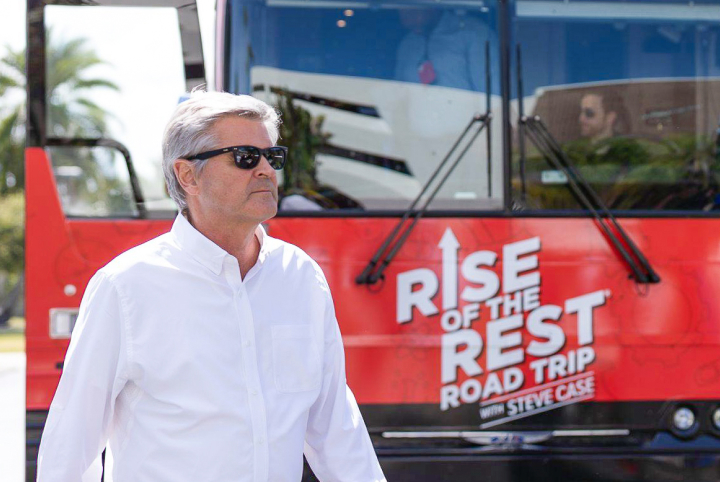
A bus is a wonderfully unsubtle announcement of attention. It arrives somewhere, occupies a noticeable amount of space and requires everyone aboard to leave the office. For a city accustomed to hearing that talented people should move away, a visiting group of investors offers a different conversation.
The financial proposition is practical. A founder may know an industry because it operates nearby. Local employers, universities and experienced workers can provide knowledge that is difficult to acquire from a distance. Lower operating costs can help too. Case’s argument asks investors to treat those conditions as business advantages.
It also asks them to examine their own routines. Capital travels through relationships. If the relationships repeatedly lead to the same cities, investors can mistake the limits of their acquaintance for the limits of the opportunity. Taking a meeting somewhere else is a modest intervention. Repeating it across years becomes an investment practice.
A founder’s address can tell you what they know. It cannot tell you how far the company will go.
A longer route to the next company
Case gave the argument book-length treatment in The Rise of the Rest, published in 2022. His earlier book, The Third Wave, appeared in 2016 and explored an internet economy extending further into established industries. Together, the books connect a technological prediction with a geographic one: industry knowledge exists in many places, so useful new businesses can emerge in many places too.
He has carried that position into public policy. In 2011, he became founding chair of the Startup America Partnership and served on President Barack Obama’s Council on Jobs and Competitiveness. On March 25, 2025, he testified before the House Financial Services Committee at a hearing on expanding access to capital beyond Silicon Valley.
There is a difference between celebrating entrepreneurship and attending to the conditions that let someone attempt it. Case’s policy interests include access to investment and attracting talent. Those subjects are less photogenic than a bus. They matter to founders who need permission, funding or a colleague before they need applause.
His work with Jean Case adds another strand. They established the Case Foundation in 1997 and joined the Giving Pledge in 2010, committing to give away most of their wealth. The business and philanthropic projects have different obligations, but both give the Cases a role in deciding which ideas get a chance to develop.
Now the internet pioneer is buying places to meet
By September 2026, Case was explaining another investment interest at the Skift Global Forum: physical destinations and travel experiences. His reasoning was that increasingly digital lives could make encounters with real places and people more valuable. Revolution’s hospitality activities give that view a concrete financial expression.
The turn has an agreeable irony. Someone associated with bringing people onto screens now sees opportunity in getting them out into the world. Yet the underlying interest remains recognizable. Technology changes the available means of connection. It leaves people with the persistent wish to be somewhere, with somebody.
There is no need to make every stop in Case’s career part of a tidy master plan. GameLine failed. The merger disappointed. Revolution is an investment business, with the judgments and risks that entails. What recurs is a habit of looking past the immediate setting: beyond the test kitchen, beyond the technical enthusiast, beyond the cities where investors already congregate.
On the road, that habit gets a fair test. A founder can explain the business. Case can ask questions. Someone has to decide whether to write a check. After all the speeches about opportunity, a person in a particular place still needs another person to take the idea seriously.
Keep following the road
BOOKS, CONVERSATIONS & THE NEXT STOP
- Steve Case’s website and books ↗
- Revolution: Case’s work and biography ↗
- Read: the Walter Isaacson conversation ↗
- Watch: Case on the merger at Stanford ↗
- YouTube: investing in Middle America ↗
- YouTube: Do startups still need Silicon Valley? ↗
- Read: the September 2026 travel investment conversation ↗
- Read: the opening of The Third Wave ↗