Mike Collins has a generous explanation for Michael Jordan’s success: he helped. In 1983, playing basketball for Dartmouth against North Carolina, Collins found himself guarding Jordan. The result did little to threaten the established hierarchy of college basketball. Decades later, he could still enjoy his contribution to it. “I was a huge confidence booster for sure,” he joked.
It is a useful opening to a career in venture capital, a profession whose participants are seldom accused of understating their role in someone else’s success. Collins is comfortable being the supporting player in this particular story. His business, Alumni Ventures, has made a strategy of participating alongside other investors, pooling money and relationships rather than insisting on the starring credit.
The basketball story also contains something less financial: an enduring attachment to Dartmouth. Collins studied engineering science there, met his wife, and came away with friendships that lasted. Years afterward, a community formed in college would become the starting point for a company. The familiar face would turn out to have commercial uses beyond the reunion photograph.
The passengers were the product
Collins began his investment career at TA Associates in 1986, then earned an MBA at Harvard Business School. But his route back to venture ran through the toy business. At Pleasant Company, the maker of American Girl dolls, he met Beth Obermiller. They subsequently worked together on Just Pretend, a catalog business selling dress-up clothes and wooden vehicles.
The vehicles needed passengers to look better in photographs. Children at a shoot became more interested in the bendable figures than in the cars. Collins noticed. “Screw the vehicles,” he said. The figures became Bendos, and the business became Kid Galaxy. A supporting prop had elbowed its way into the leading role.
There is an appealing lack of ceremony about this discovery. No child was obliged to admire the original business plan. Their attention supplied an answer the adults had not arranged to receive. Collins’s response was to follow it. That small episode offers a more tangible introduction to his approach than any polished declaration about innovation could manage.
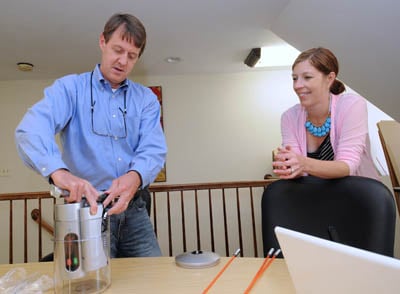
Before the fund came the tinkering. Collins with longtime collaborator Beth Obermiller.Photograph: Jodie Andruskevich / NH Business Review
An inventor needn’t have a laboratory
At Big Idea Group, Collins built a business around finding ideas outside conventional product-development departments. Inventors could bring their concepts to industry experts through public idea hunts. The arrangement gave people with an observation, a prototype, or an everyday frustration somewhere to take it. A useful product could begin well away from a corporate research budget.
In a 2002 column, Collins described three collaborators, Susan Kern, Deborah Milam, and Jill O’Banyel, whose work led to Tiny Totes, a miniature handbag product. What interested him was their working method: many ideas, collaboration, attention to users and manufacturers, and a willingness to seek fresh inspiration. He admired their ability to keep inventing without making a single idea sacred.
That interest reached beyond the toy trade. Researchers studying entrepreneurial behavior included Collins among the founders they interviewed. His contribution concerned observation: successful inventors keep watching and questioning the ordinary world. Discovery, in this account, is repeated work rather than a special appointment with inspiration. It suits someone whose toy customers had already demonstrated how easily a business can misunderstand its own attractions.
He also wrote The Million-Dollar Idea in Everyone, published by Wiley in 2008. Its subject was making something commercially useful from personal interests, insights, and inventions. The title offered a broad invitation. Long before Alumni Ventures, Collins was interested in people who had something to contribute but needed a route into the business around it.
“Screw the vehicles.”
Mike Collins, when the passengers stole the show
A venture fund, discussed in a living room
Alumni Ventures launched in 2014, with Green D Ventures serving the Dartmouth alumni community. Collins’s own account of those early days is domestic rather than grand: he met potential customers in their living rooms, working through their questions and refining the pitch. The first fund took a year to raise. His July 2024 recollection puts its close just below $1 million.
“They thought I was crazy,” he wrote. The objections concerned the mechanics: serving individual accredited investors, co-investing with established firms, and allowing customers to own a stake in the management company. None was an argument likely to be settled by enthusiasm alone. The company would have to make the arrangement work repeatedly.
The early Dartmouth proposition combined financial capital with access to people. By January 2015, Collins was explaining that alumni could contribute mentoring, advice, and introductions as well as money. The college connection supplied a reason to gather. What happened after the gathering determined whether the connection was worth anything.
There is a distinction here between affection and affiliation. Alumni Ventures and its funds are independent of the universities around which their communities form. The model draws on relationships among graduates; it does not turn the university into the fund manager. A shared sweatshirt can start a conversation. It cannot conduct due diligence.
- 1986TA Associates
Learning venture investing - 1995The toy business
Following the customer - 2014Alumni Ventures
Gathering a community - 2026Global Bridge Funds
Connecting across borders
Making room beside the lead investor
Collins’s operating choice was cooperation. Alumni Ventures co-invests alongside lead venture firms rather than leading financing rounds itself. It does not price the rounds or compete for board seats. That leaves it with a clear job: assess an opportunity, obtain an allocation, and bring something useful through its network.
The resulting business depends on systems as much as acquaintances. In September 2025, Collins described roughly 40 investment professionals arranged in 10 teams. Opportunities passed through a standardized evaluation, a team decision, an investment committee, and the Office of Investments. A relationship might open the door; the investment still had to survive several conversations inside.
The alumni premise also changed through experience. Collins said the firm once insisted on an alumni connection in its investments. Customers proved more interested in investing together and holding a good portfolio than in requiring every company to share their educational pedigree. The community remained useful even when it stopped being the boundary around the investments.
It is a revealing revision. A founder can become so fond of a company’s origin that the origin starts writing the rules forever. Collins allowed the customer’s preference to modify the model. The familiar names helped assemble the group; they did not have to appear on every founder’s diploma.
Simplified process, not a representation of investment returns.
The fine print became part of the story
Growth brought a consequential failure of disclosure. On March 4, 2022, the SEC entered a settlement order involving Alumni Ventures Group and Collins. It found misleading fee descriptions during 2016-2020 and improper inter-fund transactions. The firm had described its fees using the industry’s “2 and 20” shorthand while typically assessing ten years of management fees upfront.
The order found Collins approved and used the misleading language. It imposed civil penalties of $700,000 on the firm and $100,000 on Collins. The respondents settled without admitting or denying the findings, subject to the order’s stated exceptions. The order also recorded that the firm had repaid affected funds approximately $4.79 million associated with the accelerated fees.
Alumni Ventures says it subsequently strengthened compliance controls and formalized disclosures. For a company whose appeal depends heavily on trust among individuals, the episode belongs close to the center of its story. An introduction can establish confidence quickly. Clear terms and consistent administration are what allow that confidence to endure after the introduction is over.
Starting again at 49
Collins has publicly described himself as having started Alumni Ventures at 49. He used the experience in a September 2025 essay arguing against the fixation on very young founders. By then, his own working life already included investment analysis, consumer products, invention networks, and the less photogenic business of selling things that other people might decline to buy.
His argument gives experience an active role. A long career can furnish people to call, patterns to recognize, and mistakes one would rather avoid repeating. In Collins’s case, beginning a new company meant drawing on several previous occupations. The venture investor and the toy entrepreneur did not have to take turns occupying the same biography.
He has said that Alumni Ventures brings together work he enjoys, work he believes he does well, and work he considers useful. He also hosts conversations on Tech Optimist, moving between founders and emerging technologies. The curiosity is continuous with the earlier inventor business: find out what someone is making, ask how it works, and consider where it might fit.
The age Collins says he was when he started Alumni Ventures.
The alumni circle gets a passport
In June 2026, Collins announced the Global Bridge Fund series, extending the network idea across national borders. Each proposed fund would connect a country or region with American and global startup markets. The intended participants now included institutions, corporations, universities, and government-linked innovation organizations. A business built around individual alumni was making room for a different kind of partner.
The Japan-U.S. Bridge Fund had held its first close on March 31, 2026, with KDDI and UTokyo IPC as anchor partners. Collins described plans for further bridge funds, typically around $100 million, and at least one new fund a year over the following three years. Those were plans, with the work of building the connections still ahead.
By his October 2026 Startup Project conversation, Collins was discussing the firm’s offices in London and Tokyo alongside its U.S. locations. He returned to pooled relationships, diversified portfolios, and patience. He was skeptical of the habit of checking investments constantly on a phone. His preferred timescale is measured in years, an awkward fit for a screen designed to demand another glance.
The arc is recognizable without being tidy. A Dartmouth basketball player became an investor, sold toys, worked with inventors, and returned to venture with a community as his organizing idea. There have been revisions and regulatory consequences along the way. Now the circle is widening again. Collins keeps looking for people who have something worth contributing, then working on the arrangements that might let them do it together.
Keep the conversation going
Read Collins’s essays and biography, follow him on LinkedIn or X, and explore Tech Optimist.