In February 2002, Marc Miller took charge of a newly acquired business in Lansdale, Pennsylvania. UHS had renamed North Penn Hospital as Central Montgomery Medical Center, and Miller became its CEO and managing director. His surname already belonged to the company’s founder. The appointment came with something less ornamental: a local operation to run.
He arrived from Wellington Regional in Florida, where he had been chief operating officer. Before that, he had worked in administration at The George Washington University Hospital in Washington, D.C. There were plans for buildings, equipment and expansion in Lansdale. There were also colleagues who would have to turn those plans into a functioning workplace. A name on an appointment announcement could only do so much of that.
It is a useful place to begin the story of UHS’ current president and chief executive. The family connection is obvious. The sequence of assignments is easier to overlook. Miller joined UHS in 1995 and became CEO in January 2021. Twenty-six calendar years sit between those dates. Even a generous corner office takes less time to decorate.
The education before the title
Miller’s education supplied two different ways of looking at institutions. At the University of Vermont, he earned a bachelor’s degree in political science. At the Wharton School of the University of Pennsylvania, he earned an MBA. One field examines power and organizations; the other trains people to make decisions inside them. His eventual work would involve plenty of both.
The route between university and UHS included software consulting, teaching users how to work with financial management systems. He has recalled finishing Vermont without a settled plan. Business school followed. Joining his father’s company was a way to find out whether the work suited him.
That detail gives the career a more recognizable beginning. Plenty of people leave university with a degree and a rather less complete answer to the question of what to do on Monday. Having a founder in the family changes the available opportunities. It does not automatically settle the matter of interest.
His early operating jobs supplied a test. An organization looks different when a decision has to survive contact with the people who carry it out. A financial model can accommodate a tidy assumption. A workplace may have objections, history and a meeting already scheduled to discuss both.
He has recalled one early Washington assignment as a period of friction around a newly acquired operation. The resistance interested him. It helped him recognize that he wanted to keep learning the work. The admission gives the apprenticeship a welcome rough edge: the job became appealing before everything became agreeable.
A wider patch of the map
By 2003, Miller was vice president of his division’s Eastern Region. In June 2007, UHS named him and Mike Marquez as divisional co-heads. The announcement paired two executives with local operating experience and responsibility for different regions. Miller had then spent twelve years with the company.
Read as a list, those promotions sound like administrative housekeeping. Read as changes in responsibility, they describe a widening field of view. A local leader has a particular building and team to understand. A regional leader must compare operations without assuming that every place works identically. A divisional leader has to decide which differences matter.
The geography gives Miller’s biography some texture: Washington, Florida, Pennsylvania, then a regional remit. It also helps explain why an executive career can be both deeply rooted in one company and varied in its daily work. Staying with an employer does not necessarily mean staying in the same job.
Responsibility, one step at a time
- 2002Local CEOLansdale, Pennsylvania
- 2003Regional VPEastern Region
- 2007Divisional co-headWith Mike Marquez
- 2009UHS presidentCompany-wide remit
- 2021UHS CEOSuccession takes effect
Twelve years as president
In May 2009, UHS elected Miller president. He was 39. The announcement pointed to his regional experience and his role in the division’s growth. His father, Alan B. Miller, retained the chairman and CEO positions. Marc’s promotion expanded the job without completing the succession.
This distinction matters. The two dates, 2009 and 2021, are sometimes absorbed into a general impression of longevity. They describe different stages. Miller spent roughly twelve years as president before becoming chief executive. At the time of his 2009 appointment, he spoke about the management team’s integrity, long service and dedication.
There is an unglamorous advantage to that interval: colleagues get to see a leader across more than an introductory speech. Plans are made, revised and lived with. Decisions acquire consequences. An executive’s reputation has time to become something other than a promise.
The formal CEO transition was announced in September 2020 and took effect on January 1, 2021. Alan continued as executive chairman. Marc retained the presidency. The announcement described a long-standing succession plan, giving the change a history that preceded the press release.
For a founder’s son, the relationship can dominate the description of the job. It is central here. But the chronology resists a version in which the only relevant event was a family handover. By the time the chief executive title changed, Marc had already spent a quarter-century inside the organization.
A competitive streak, with homework
Miller describes himself plainly: “I am competitive and want to win.” His account of management also emphasizes accountability, openness to colleagues’ views and a measured response to difficulties. Competition, in that formulation, comes with an obligation to manage one’s own reaction.
He also reads widely about leadership, looking beyond his own company and field for useful ideas and avoidable mistakes. This gives the long tenure an interesting counterweight. Institutional memory can answer how something has always been done. Reading other people’s experiences can suggest an additional question.
The combination is familiar to anyone who has stayed in a job long enough to become competent at it: experience is valuable, and experience can become a very comfortable chair. Keeping a reading habit is one way of occasionally standing up.
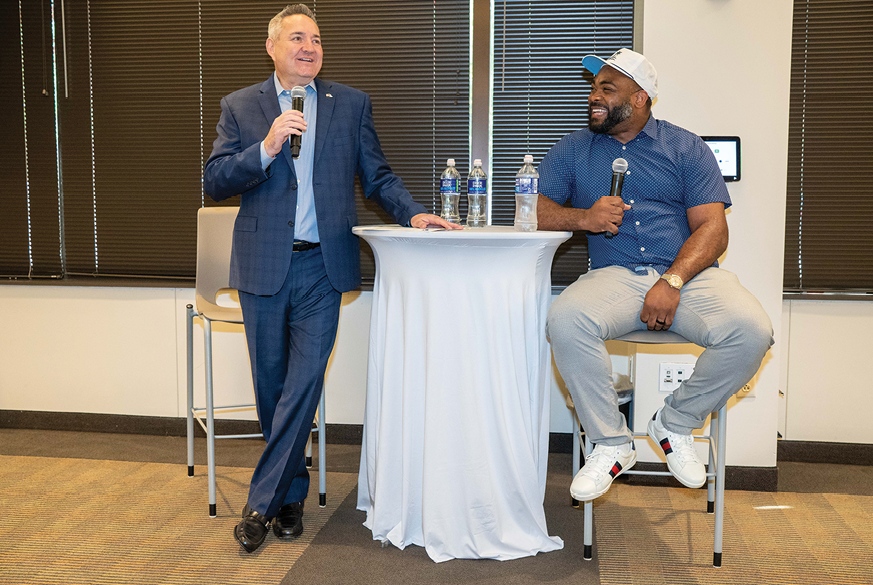
A photograph published in October 2025 offers a less formal scene. Miller stands beside a small round table, microphone in hand. Brandon Graham, the Philadelphia Eagles player, sits alongside him with another microphone. They are hosting a town hall for employees at the King of Prussia headquarters.
The photograph is a useful interruption to the executive portrait. There is a table, a conversation and a room to address. Whatever the size of an organization, somebody still has to make the encounter work at that scale. The microphones help. The annual report would be a cumbersome substitute.
“I am competitive and want to win.”
Marc D. Miller
Signing the tree
Another documented visit produced a smaller gesture. At Rancho Springs in Murrieta, California, Miller signed the Vision Tree, an employee display representing commitment to the organization’s mission, vision and values. UHS shared the visit publicly while he was president; the scene also appeared in a later interview feature.
Corporate values can have a difficult life on walls. They are installed with conviction and risk becoming part of the furniture. A visit and a signature do not prove that a workplace lives up to its declarations. They do make a particular executive’s participation visible.
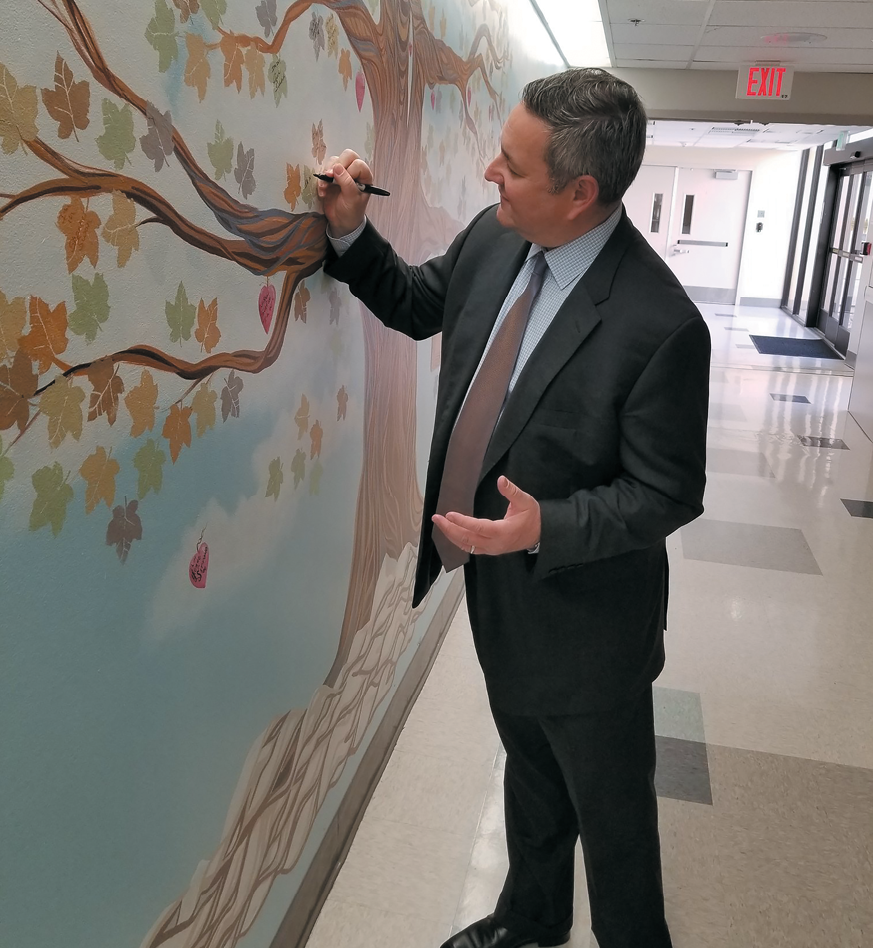
It is an apt image for a career built through operating assignments. The local workplace remains there, with its own people and customs, after the visitor leaves. The photograph catches the brief point where the corporate role and that local life occupy the same patch of wall.
The apprentice becomes the teacher
Miller’s responsibilities extend into governance. He serves on UHS’ board and its Executive and Finance committees, and on the board of Universal Health Realty Income Trust. His Premier board service ran from 2015 to 2025. He has also served as chair of the Federation of American Hospitals.
Those roles add a different kind of work to the operating career. Boards examine oversight, capital and accountability across an organization. They require a leader to consider both the immediate decision and the structures through which decisions are reviewed. The scale changes again.
A joint feature with Alan, published in July 2026, brought the family succession back into view. Marc discussed developing the next generation of leaders through training, mentoring, responsibility and promotion from within. He described giving emerging leaders meaningful work and holding them accountable for the results.
The connection with his own progression is clear enough to be useful. A company cannot reproduce a particular father-son relationship. It can decide whether people get opportunities to learn, whether responsibility increases with experience and whether the next promotion has enough preparation behind it.
This is where Miller’s long apprenticeship becomes an ongoing managerial question. Having benefited from years in which the remit grew, how does a leader create that possibility for others? The answer has to appear in assignments and decisions. A program’s name will only carry it so far.
Return to Lansdale in 2002: an acquired operation, a new name and an executive arriving from Florida. Miller’s later titles were still in the future. The work in front of him had its own demands. That is the part of the story worth keeping in view when the chronology reaches the corner office. Somebody had to run the place on Tuesday.