Dan Carestio had spent more than twenty years at STERIS when his predecessor began explaining why he should have the top job. The explanation contained a detail that deserves a place in any account of corporate succession: the company had been preparing him for years. By the time the announcement arrived in February 2021, the appointment was the public end of a long private process.
Walt Rosebrough, the outgoing chief executive, wrote to employees of Cantel, the company STERIS was preparing to acquire. They were being asked to absorb two substantial changes at once: a new corporate owner and an impending change in that owner's leadership. Rosebrough offered them Carestio's career as reassurance. Here was someone who had entered in a junior role, taken on more work and kept progressing.
For a future colleague wondering who would be in charge, that was a more useful introduction than a collection of adjectives. Carestio knew the business from several sides. He had worked in marketing, sales and general management. Since 2018, as chief operating officer, he had been responsible for its operating businesses. The new name on the chief executive's door would belong to someone already familiar with the machinery behind it.
The first title was associate
Carestio joined STERIS in September 1997. His starting position was associate product manager for Life Sciences sterility assurance products. It is a precise, unshowy beginning to a career that would eventually put him in charge of a global company. There is something pleasing about the word associate surviving in the account. Every later promotion has to make room for it.
His academic route ran through North Carolina State University, where he earned a bachelor's degree in zoology. His LinkedIn education entry lists 1991 to 1995 and Phi Delta Theta among his activities. The degree makes an unexpected opening line for a chief executive's biography, though Carestio's subsequent career took him into businesses where scientific products and commercial decisions meet.
By 2011, his responsibilities included sales and marketing for Isomedix Services and general management of Life Sciences. Isomedix was a predecessor of the Applied Sterilization Technologies business, usually shortened to AST. The combination placed him across two different kinds of management work: finding and serving customers, and running a business that had to deliver what those customers bought.
Those distinctions matter in a long career. A list of promotions can make every move look like a slightly larger desk. Carestio's record instead shows changes in the work itself. Product management became commercial leadership. Commercial leadership broadened into responsibility for operating units. Eventually, the units were gathered under the remit of a chief operating officer.
A promotion with an integration attached
In August 2015, Carestio became senior vice president for AST and Life Sciences. That year STERIS acquired Synergy Health. Rosebrough would later single out Carestio's leadership of the Synergy AST integration when explaining the succession. This was a consequential part of his preparation: an acquisition brings businesses together on paper before anyone has finished bringing them together at work.
Integrations ask practical questions that announcements can leave unanswered. Who reports to whom? Which working methods carry over? How will customers experience the combination? Carestio's responsibility for the Synergy AST work gave the board a specific example to consider when judging his readiness for broader leadership. His candidacy had an operating history attached.
February 2018 brought another expansion, to senior vice president for Sterilization and Disinfection. That August he became COO. In January 2021, the board appointed him a director; the following month, it announced his succession to Rosebrough. He became president and CEO on July 29, 2021, STERIS's fourth holder of those titles.
The spacing is revealing. Joining the board and becoming chief executive were separate steps. The announcement and the handover were separated by months. Rosebrough would remain available as an adviser for two years. For all the appeal of a dramatic entrance, this succession was arranged to give people time to adjust. The calendar was doing some management of its own.
“We prefer promoting from within”
Walt Rosebrough, in his 2021 letter to Cantel employees
The colleagues in the conversation
Rosebrough's letter also widened the frame around Carestio. He described a senior team whose members had often spent more than fifteen years at STERIS or businesses it had acquired. His definition of an insider included people who arrived through acquisitions. That is a useful detail in a company built partly by bringing other companies into its orbit: continuity could have more than one point of origin.
Carestio later appeared with finance leader Mike Tokich in a conversation about accountability for STERIS's fortieth anniversary. The topic could have drifted into the comfortable language of company values. Instead, Tokich discussed promises made during acquisitions: looking after employees, understanding communities and respecting what an owner had built. Carestio opened the exchange by asking for a story about a successful outcome.
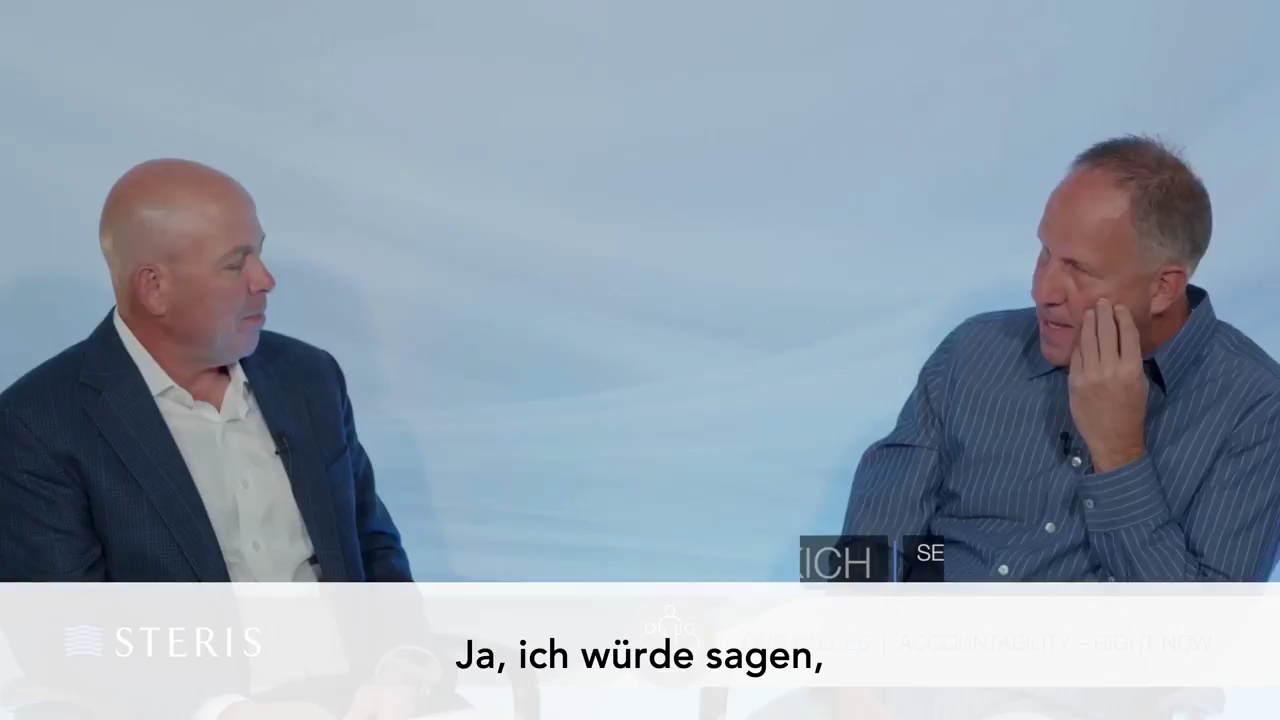
The exchange fits his own history with integration. A buyer inherits relationships along with equipment and revenue. The people entering the organization have commitments to judge, and they can judge them against what happens afterward. An executive who has overseen an integration has had to work in that gap between a promise and its delivery.
There are other responsibilities in Carestio's record that reach beyond the usual promotion list. As COO, he led a small project team examining additional sustainability practices and how STERIS should communicate its existing work. The team's remit included reviewing achievements and developing material covering business ethics, conservation, people and communities. It was another assignment requiring a view across the organization.
His message introducing the company's code of business conduct gives employees responsibility for understanding the rules and speaking up about departures from them. On supplier diversity, his stated position extends inclusion to the supply chain. These are public commitments with practical audiences: employees deciding whether to raise a concern, and suppliers deciding whether there is room to compete.
Carestio also serves on the board’s Compliance and Technology Committee. The combination places questions about the company’s conduct alongside questions about its technical direction. His position as a director adds oversight duties to his management responsibilities, extending the job beyond the operating decisions that marked his earlier career.
Six hundred million reasons to look ahead
Five years after the CEO handover, Carestio put his name to a decision with a much longer physical life than an announcement. In August 2026, STERIS set out plans to invest $600 million in a manufacturing and distribution campus in North Carolina. The proposed site in Sanford would cover 600,000 square feet and bring together manufacturing, research and development, distribution and operations.
The project would consolidate existing chemistries operations in St. Louis, Missouri, and Plymouth, Minnesota. STERIS described it as its largest manufacturing investment at a single site. It expected a phased opening over two to three years, beginning with distribution. Approximately 335 North Carolina jobs were planned. Those are commitments about a future operation, with construction and transition work still to come.
600,000square feet planned
335jobs expected
North Carolina's economic development announcement adds another set of measures. The expected average annual salary was $68,704, above the Lee County average of $59,903. A state grant authorized potential reimbursements of up to $3.213 million over twelve years, subject to annual verification of job creation and investment targets. The public contribution came with conditions that would be tested after the celebration.
The state also projected a potential annual payroll contribution of more than $23 million from the new positions. These estimates explain why the project matters outside STERIS. A campus becomes part of a local economy, with a workforce and infrastructure around it. Its progress will be watched by people whose interest in the company begins with Sanford.
For Carestio, the location creates a geographical echo. His university years were in North Carolina; a major manufacturing commitment now leads back to the same state. STERIS cited technical skills and the region's talent base among its reasons for choosing it. The connection is biographical. The investment case rests on the people and capabilities available there.
The scale also changes what continuity means. An executive can spend decades learning an organization and still have to move parts of it. Consolidating two existing locations into a new campus involves a different set of obligations from preserving the current arrangement. The investment promises capacity and a revised distribution network; carrying it through requires managing the transition that makes those benefits possible.
The next chapter needs a floor plan
Carestio's company entered this period with fiscal 2026 revenue from continuing operations of about $5.9 billion, up 9 percent. In the following first quarter, ending June 30, 2026, revenue rose 7 percent to about $1.5 billion. Those figures describe STERIS's results under his leadership and the work of its wider organization. They provide the financial setting for the campus decision.
His career now stretches across twenty-nine years at STERIS. The associate product manager became a commercial leader, then an operating executive, then the person responsible for the whole company. Along the way, colleagues became predecessors, businesses became part of the group, and preparation for one role became evidence for the next.
The Sanford project gives that history an unfinished ending. Its floor space, staffing plans and phased opening will have to become an operating site. Carestio spent years demonstrating that he could take on more responsibility inside an existing company. A substantial part of his next assignment is to build somewhere for its future work to happen.