There is a license plate on the wall beside Frank Sullivan in an archival office photograph. It reads 168. Most executives would be content to put the company name on the wall. The Sullivans have put up a deadline.
One hundred and sixty-eight is the number of hours in a week. Sullivan’s grandfather used it on his car; his father followed; so did he. “It’s the number of hours in the week,” Sullivan explained in 2022. The family’s arithmetic has made its way into RPM International’s corporate philosophy. Everyone gets the same weekly allowance. Nobody gets a refund.
For Sullivan, chairman and chief executive officer, the number also frames a question that has occupied much of his working life: what should a leader preserve, and what should he change? His grandfather founded RPM’s predecessor. His father expanded it. Sullivan has had to keep its inherited habits useful while running a public company whose investors expect more than an agreeable family resemblance.
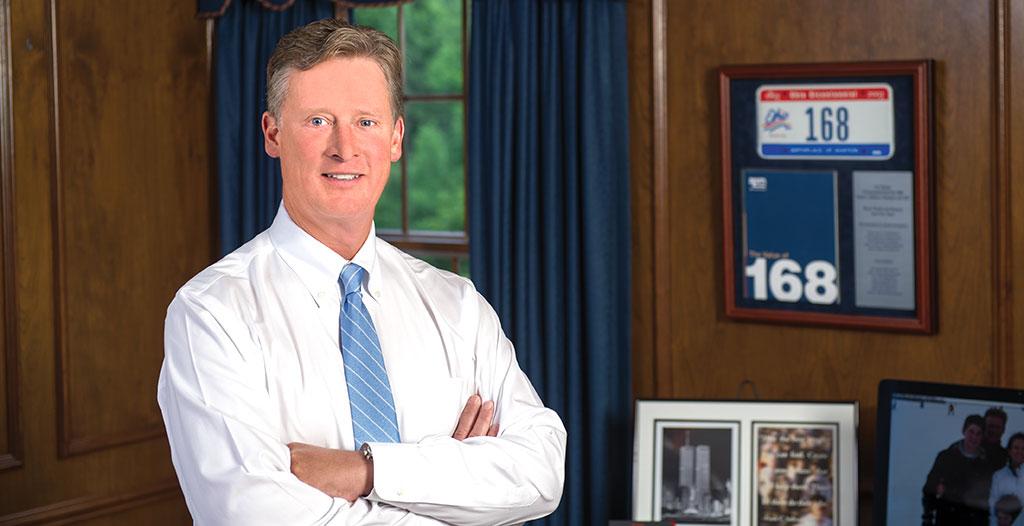
The number on the wall
The original business was wonderfully specific. In 1947, the elder Frank C. Sullivan founded Republic Powdered Metals to sell a heavy-duty aluminum roof coating called Alumanation. First-year sales were $90,000. It was a company built around the unglamorous proposition that a roof ought to last longer. The name RPM eventually became attached to a much wider collection of businesses.
Tom Sullivan, Frank’s father, took over in 1971. Alongside Jim Karman, he helped grow sales from $11 million to $2 billion before their retirement as executive officers in 2002. Frank succeeded him as CEO that year. A generation had changed; the products still had practical things to do. Keep water out. Protect surfaces. Help buildings endure their owners’ ambitions and the weather’s indifference.
The family history can make the succession sound automatic. The professional history is more instructive. Sullivan had worked summer jobs at RPM from his early teens, but his route to leadership included time outside the business and a succession of operating and financial responsibilities inside it. He inherited an association with the company long before he acquired responsibility for all of it.
There is an obvious advantage in knowing a business across decades. There is also a recurring danger: a practice can become difficult to question simply because somebody respected introduced it. Sullivan’s work is interesting where those two possibilities meet. Continuity gives his decisions context. It cannot make the decisions for him.
A banker comes home
He graduated from the University of North Carolina at Chapel Hill in 1983 as a Morehead Scholar. Commercial lending and corporate finance jobs at Harris Bank and First Union National Bank followed. In 1987, he joined RPM’s AGR Company joint venture as a regional sales manager. Corporate development came next, followed by the finance office.
By 1993 he was chief financial officer; in 1995, executive vice president and a director. He became president in 1999, chief operating officer in 2001 and CEO in 2002. The chairmanship followed in 2008. These are dry titles, but they describe different ways of looking at the same enterprise: through customers, transactions, cash and the people expected to turn a plan into actual work.
An earlier glimpse of his judgment comes from the 1997 purchase of Tremco. RPM paid $236 million in cash for the sealants and coatings business. Sullivan, then the finance executive, spoke about speed as an advantage in acquisitions. Yet the Tremco transaction took six months, with environmental and product-liability questions requiring attention.
“You can’t practice speed to a fault,” he said. It is a useful qualification from someone whose company made acquisitions a habit. Waiting can cost a buyer an opportunity. Hurrying can leave it with a problem that outlives the excitement of signing. The interesting skill is knowing which clock deserves attention.
“You can’t practice speed to a fault.”
Frank Sullivan, 1997
A letter from Georgia
Years later, an owner named David Barton sent Sullivan a letter about Prime Resins, his infrastructure-repair chemicals business. Barton included financial information, competitive analysis, a map and product literature. He thought his company might fit at RPM. Sullivan had never met him.
Sullivan telephoned, visited Barton outside Atlanta two weeks later and brought in operating colleagues to evaluate the business. The deal closed six months later. Recalling it in 2018, he treated the unsolicited approach as evidence of the reputation his father had cultivated among entrepreneurial owners.
There is a particular intimacy to that sort of sale. An owner may be selling the place where colleagues have spent decades and customers know whom to call. The valuation captures part of the decision. What happens to those relationships afterward supplies another part, one that resists being tidied into a spreadsheet.
Sullivan’s stated approach was to offer a fair price within RPM’s means and be willing to walk away. He also described wanting capable leaders to remain with acquired businesses, supported by access to equipment, purchasing resources and distribution. The buyer’s promise therefore extended beyond the closing date.
That puts a practical burden on reputation. Every acquired company becomes an example another seller can examine. A welcoming speech costs little. Keeping useful people, investing intelligently and avoiding needless interference take repeated decisions. An owner considering a sale has reason to care about those decisions even if the buyer would prefer to talk about its strategic vision.
The letter is memorable because it reverses the usual picture of acquisition work. The buyer did not have to discover the target first. Past conduct had helped introduce them. In a business built partly by buying other businesses, the way one transaction ends can affect how another begins.
When independence gets expensive
There are limits to leaving every business alone. Purchasing, factories, warehouses and technology can become expensive monuments to independence. RPM’s challenge is to preserve the initiative that made an acquired company useful while finding work that its businesses can do better together. The boundaries are unlikely to remain fixed as the group grows.
The operating improvement program announced in 2018, MAP to Growth, addressed efficiency across RPM. By the end of fiscal 2021, the company reported $320 million in annualized savings, exceeding its target by $30 million. Later, Sullivan described MS-168 as a centrally led approach to operating efficiency and continuous improvement. Even the factory program carried the family number.
Annualized savings reported at the completion of MAP to Growth in fiscal 2021. A company measure of the program’s run rate.
There is a commercial version of the same problem. In 2025, Sullivan described a deliberate shift in construction products from selling individual components to selling systems. Dryvit, Tremco and Nudura could contribute different parts of the building envelope. The customer’s building, after all, does not respect the boundaries of a supplier’s organization chart.
A wall has to meet a roof. Openings need seals. The products and the people behind them have to cooperate. For the executive at the center, that creates a more demanding job than collecting recognizable brand names. He must help the businesses work together without making the decision-making so cumbersome that the customer regrets asking.
Illustrative product connections, not a specification for a particular building.
Sullivan’s sustainability priorities follow a related logic. His argument starts with products that extend an asset’s life and reduce waste, then moves into more efficient processes and reduced resource consumption. He favors goals over three to five years, with the people setting them responsible for implementation. That makes the timetable part of the accountability.
The company’s stated strategy places acquisitions alongside product innovation, geographic expansion, collaboration and operational excellence. Each puts a different demand on leadership. Buying a useful business is one decision. Helping it become more useful within a larger organization is a sequence of them. There is plenty to occupy the remaining hours.
The next week still arrives
In July 2026, David Dennsteadt became RPM’s president and chief operating officer, while Sullivan remained chairman and CEO. Dennsteadt had joined Stonhard as an engineer in 1995 and later led the Performance Coatings Group. His expanded remit included the operating groups and corporate development. Sullivan praised his work connecting international operations and developing shared services.
The promotion gives the story a wider cast. RPM’s future depends on people whose careers have developed through its operating businesses, as well as the family whose name accompanies its history. The organization must reproduce judgment at more desks than the chairman’s. Otherwise, every new acquisition simply adds another queue outside one office.
October supplied fresh evidence of the work underway. RPM completed its purchase of Italy’s Volteco, adding below-grade waterproofing technology to Tremco Construction Products Group. On October 6, it reported fiscal 2027 first-quarter sales of $2.22 billion, up 4.8%, and net income of $256.4 million. On October 8, it announced a dividend increase for the 53rd consecutive year.
The dividend record began long before Sullivan became CEO. That is part of its relevance to him: he leads something with obligations and expectations accumulated over generations. An investor day scheduled for November 9, 2026, is due to set out the next operating improvement plan. The calendar has already reserved time for another round of decisions.
The framed license plate supplies a compact ending, but the business refuses one. Customers still need buildings protected. Owners still weigh whether to sell. Managers still decide what to share and what to leave local. Sullivan’s inheritance gives those decisions a history. Each week gives him another 168 hours in which to make them.