Six months into Andrew Schlossberg’s life at Invesco, the program that had brought him there ended. He had joined in 2001 through a corporate rotation scheme for MBA graduates. The idea was to move recruits among businesses and help connect a company of separate asset managers. Then the financial and economic fallout around September 11 intervened. Schlossberg found a place in the business and decided to arrange his own rotation. The formal itinerary had disappeared. He kept moving anyway.
There is something pleasingly untidy about that beginning. Corporate biographies usually arrange careers into a staircase, each appointment a polished step toward the corner office. Here, the staircase lost its architect almost immediately. The useful part of the story is what followed: years spent learning how different parts of one company worked, until the company itself became his responsibility.
A career with several sets of keys
Schlossberg’s working life began before Invesco. He entered asset management in 1996, working at Citigroup Asset Management and its predecessors as an equity research analyst. His education paired finance with international business at the University of Delaware, followed by an MBA at Northwestern’s Kellogg School of Management. The combination reads almost too neatly alongside the career that followed: investments, business operations, and the complications of doing both across borders.
Within Invesco, his responsibilities ranged through strategy and product development in institutional and retirement businesses, corporate development, marketing, US retail distribution, and global exchange-traded funds. Those are different rooms in the same building. A product team asks what to make. Distribution asks who needs it. Corporate development considers what the company should own. Each room has its own vocabulary and its own reasons for believing the others have missed the point.
He also moved geographically. He worked from the UK, leading Europe, the Middle East and Africa, before taking charge of the Americas in 2019. That later remit included the global ETF business. Running a region means encountering the practical limits of a headquarters view: clients, regulations, distribution arrangements, and customs change when the flight lands. His résumé accumulated those differences before it acquired the CEO title.
The lesson he later offered younger colleagues was to accept assignments that stretch them. In a 2024 conversation about his transition, he described learning from roles that had never looked like preparation for the top job. He also emphasized client exposure. Knowing the internal machinery helps; understanding why someone entrusts money to that machinery supplies the reason it exists. His account makes advancement sound less like collecting titles than acquiring enough context to make a useful decision.
The familiar face gets the difficult job
On June 30, 2023, Schlossberg succeeded Marty Flanagan as president and CEO and joined Invesco’s board. Flanagan had led the firm for 18 years. The succession announcement put assets under management at $1.4 trillion at the end of 2022 and described a wider leadership reorganization, including expanded responsibilities for Doug Sharp and investment leadership for Stephanie Butcher and Tony Wong.
That context matters. A succession inside an established firm includes relationships that predate the new business card. Yesterday’s colleague now has to settle today’s disagreement. Familiarity can save months of introductions, while making the necessary changes more personal. Schlossberg inherited both the benefit of knowing the place and the obligation to decide which familiar arrangements should survive.
His later explanation of that adjustment was unusually direct: collaboration had to coexist with greater decisiveness. By 2026, he described assembling a leadership team drawn from longstanding colleagues, internal promotions, and outside hires, while simplifying the organization. The underlying tension is recognizable well beyond finance. Consulting everyone can produce a better decision. It can also become a remarkably courteous way of postponing one.
The formal description of his responsibilities puts leadership development and succession planning alongside strategy and engagement with clients, regulators, and policymakers. Read that list slowly and the job looks less like a single command post than a sequence of conversations with different consequences. An investor wants an explanation of performance. A colleague needs a decision about resources. A regulator asks how the business operates. The CEO has to carry a consistent account of the company through each exchange, without pretending that everyone in the room wants the same thing.
Twenty-five steps is a business problem
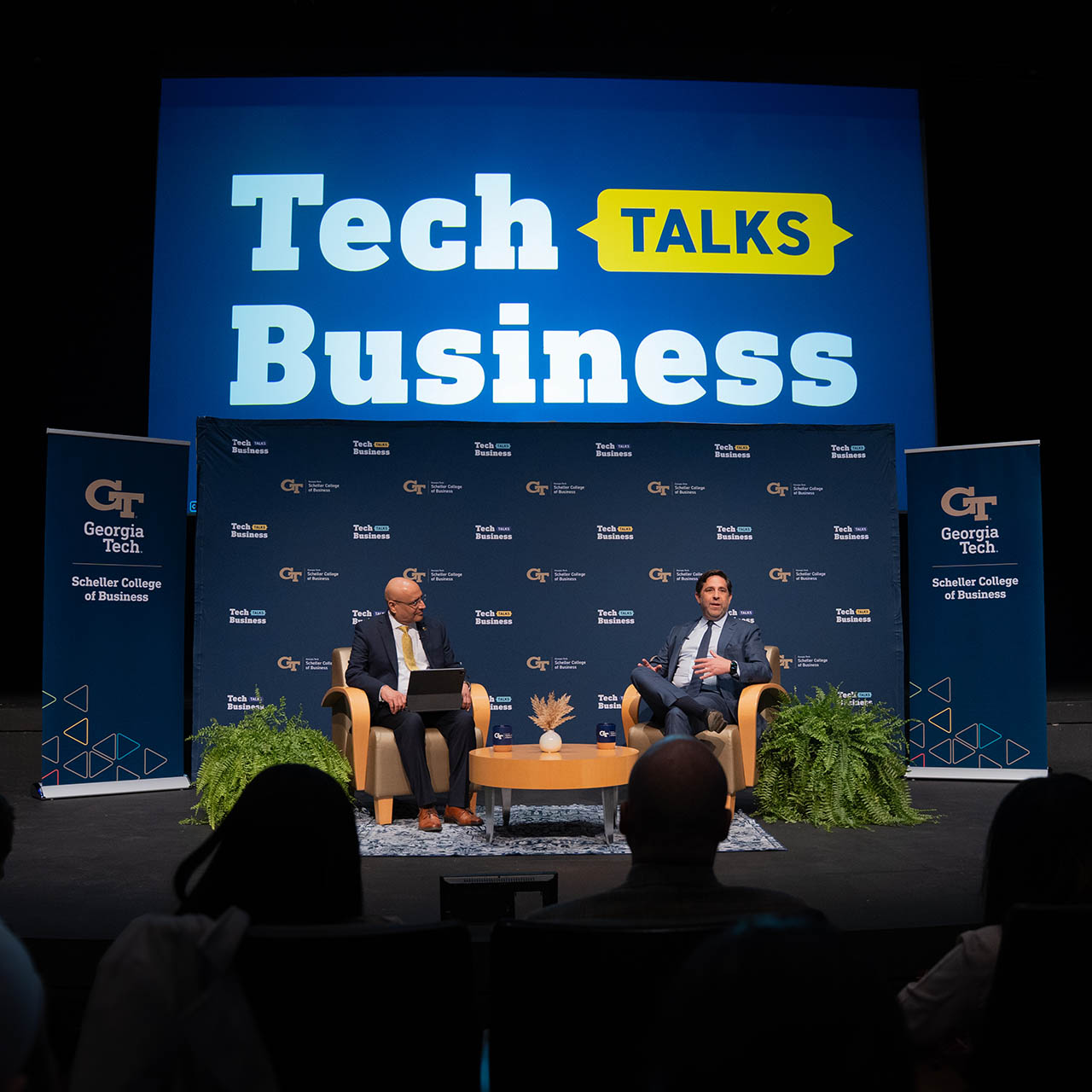
When he talks about artificial intelligence, Schlossberg is often interested in the unglamorous work around investing. At Georgia Tech in 2025, he discussed operations, distribution, document production, client interactions, and tools that help investment teams digest information. Testing tools before wider investment use was part of the discussion. Handling other people’s capital gives experimentation a different set of consequences from testing a new office gadget.
One example he gave in August 2026 was institutional onboarding: a process that could involve 25 steps between a client agreeing to do business and money actually being invested. He posed reducing that journey to five as a question involving both AI and process redesign. It was an ambition for simplification, rather than a declaration that the reduction had already happened.
Fewer handoffs. AI plus process redesign.
An illustrative ambition, not a measured result.
The example is revealing because a handoff is where a large organization becomes visible to a customer. Inside the firm, each department may have completed its task. Outside it, the customer is still waiting. A career across departments provides a useful vantage point on that gap. The interesting question becomes who is responsible for the whole journey when everyone is responsible for a piece.
His 2025 shareholder letter had already identified private markets, active equity performance, and financial flexibility as areas requiring attention. It also pointed to the ability to take an investment strategy developed in one market and distribute it elsewhere. A UK-managed Global Equity & Income strategy, for example, drew $5.1 billion of net long-term inflows in 2024, with demand in Japan. The international résumé had acquired a commercial counterpart.
At the Milken Institute’s 2026 Global Conference, his discussion of private assets included a distinction between access and expectations. He emphasized long investment horizons and the role of those assets as a minority of a portfolio, while acknowledging the relevance of liquidity and valuations. This is a more demanding conversation than simply offering another product. Making something available creates a corresponding obligation to explain its terms. For the executive who has worked in both product development and distribution, that obligation joins two familiar questions: what the firm can provide, and what the person receiving it understands.
The arithmetic keeps its own counsel
Scale supplies opportunities and a rather unforgiving scoreboard. In his letter covering 2025, Schlossberg described selling intelliflo, establishing a joint venture in India, and moving toward an investment infrastructure combining Alpha and Aladdin. The modernization of the Invesco QQQ Trust brought more than $400 billion of assets into long-term revenue-earning assets under management while reducing shareholder fees. These are specific business changes against which a strategy can be judged.
The latest monthly figures available for this profile were more mixed. Invesco reported preliminary assets under management of $2,537.8 billion at September 30, 2026, down 0.9% from August. The month included $1.1 billion in net long-term outflows, $5.7 billion in money-market outflows, and a $16 billion negative impact from market returns. Currency movements also reduced assets. The figures remain preliminary.
Preliminary assets under management
−0.9% versus the previous month
Those numbers resist a tidy victory lap. Assets under management move with markets, currency, and clients’ decisions; they are not a personal balance sheet or a pure measure of management skill. For Schlossberg, the task is to improve the parts he can influence while explaining the rest clearly. A chief executive may choose the strategy. The monthly statement arrives with its own editorial policy.
Atlanta makes the circle smaller
The global job has a local address. Schlossberg is the 2026 chair of the Atlanta Committee for Progress, a partnership joining business, academic, and civic leaders with the mayor. Its remit includes economic development, transportation, education, and affordable housing. These are the conditions in which a company’s employees live and a city’s future employees grow up. They also require cooperation across institutions that answer to different constituencies.
He chaired his first committee meeting on April 10, 2026, at Invesco’s Midtown headquarters. Mayor Andre Dickens described him as having the curiosity of a local reporter. Schlossberg, who grew up in Columbia, Maryland, spoke about Atlanta’s combination of size and personal participation. The appeal, in his telling, includes an economy diverse enough for executives to sit together without every conversation becoming a contest between direct competitors.
“Atlanta is a big city that feels small to operate in.”
Andrew Schlossberg · April 2026
His industry responsibilities have expanded too. The Investment Company Institute elected him chair in October 2025 and returned him for a second year on October 9, 2026. The job places him among peers considering how investment funds serve individuals as markets and technology change. Running one firm and representing an industry are distinct assignments: the latter asks competitors to find enough common ground to act together.
A small matter of Chelsea
For all the geography in his career, one of the more durable souvenirs of Britain came from his son’s liking for blue. The family became Chelsea supporters, held season tickets, and named their dog Chelsea. Watching matches consequently introduced some confusion for the dog. In a conversation with Dan Draper and Joe Cass, football became an easy point of connection. Cross-border understanding occasionally begins with a shirt color.
There is a modest symmetry between that story and his working life. Participation creates connections that an organizational chart cannot supply. Staying long enough to understand a place brings advantages; remaining curious about it keeps those advantages useful. Twenty-five years after joining Invesco, Schlossberg is still dealing with the practical problem his abandoned rotation program was meant to solve: how separate people and businesses learn to work together. He has a much larger assignment now. The education continues.