When Stephen Schwarzman recalled being rejected by Goldman Sachs, David Solomon had a contribution to make. Goldman had rejected him, too. Twice. Schwarzman, the Blackstone co-founder, joked that he had been smart enough to apply only once. Solomon supplied the ending: “I applied a third time.”
It is a useful little exchange to keep beside the official biography. The biography has the reassuring procession of titles: partner, division co-head, president, chief executive, chairman. The conversation has two people remembering that somebody once looked across an interview table and decided against them. Even on Wall Street, the retrospective has better lighting than the original experience.
Solomon eventually joined Goldman in 1999. He became its chief executive in October 2018 and its chairman in January 2019. Getting through the door took persistence. Running the place would require something more awkward: deciding when persistence had stopped being a virtue.
The education before the spreadsheet
Born in Hartsdale, New York, in 1962, Solomon grew up in the suburbs north of New York City. He graduated from Hamilton College in 1984 with a degree in political science. For someone who would spend his working life arranging capital, it was an education with an unusually large allocation to words.
He has consistently defended that allocation. Talking about Hamilton in 2017, he emphasized learning to think, write and speak clearly. His practical advice to students included taking accounting, but also studying things that interested them. A balance sheet matters. So does being able to explain what it means to another human being.
The point has particular force in his profession. An investment banker has to understand a transaction and persuade people to trust the judgment behind it. Numbers can be correct while the conversation goes badly. Solomon's attachment to a liberal arts education fits a career built around that second problem.
Hamilton remained part of his life after graduation. He became chair of its trustees in July 2021, following years of board service, mentoring and support for scholarships, professorships and campus improvements. His daughter also graduated from the college, in 2016. The relationship acquired both an institutional life and a second generation.
Hamilton, class of 1984. Political science. A career in finance built partly on the ability to make a complicated argument clear.
A long apprenticeship in other people's decisions
Before Goldman came Irving Trust, Drexel Burnham and Bear Stearns. Solomon arrived at Goldman as a partner and co-head of its high-yield and leveraged-loan business. He had accumulated a career elsewhere before receiving the title that many people spend an entire Goldman career pursuing.
That background placed him in financing: the work of helping companies obtain money and navigate the terms attached to it. He went on to lead the firm's Financing Group, joined its Management Committee in 2004 and became co-head of investment banking in 2006. He held that last position for a decade.
There is a distinction between being a good adviser and being the person who must act on the advice. An adviser can lay out alternatives. A chief executive has to live with the chosen one, including the employees, investors and colleagues who preferred another. Solomon's years close to corporate leaders gave him a view of the job. They could not give him the experience of occupying it.
The final promotions came quickly by comparison. President and co-chief operating officer in January 2017; sole chief operating officer in March 2018; chief executive that October, succeeding Lloyd Blankfein. The financing specialist now had responsibility for the whole institution, including the parts that did not fit neatly into his previous expertise.
Thirty-five pages about getting dressed
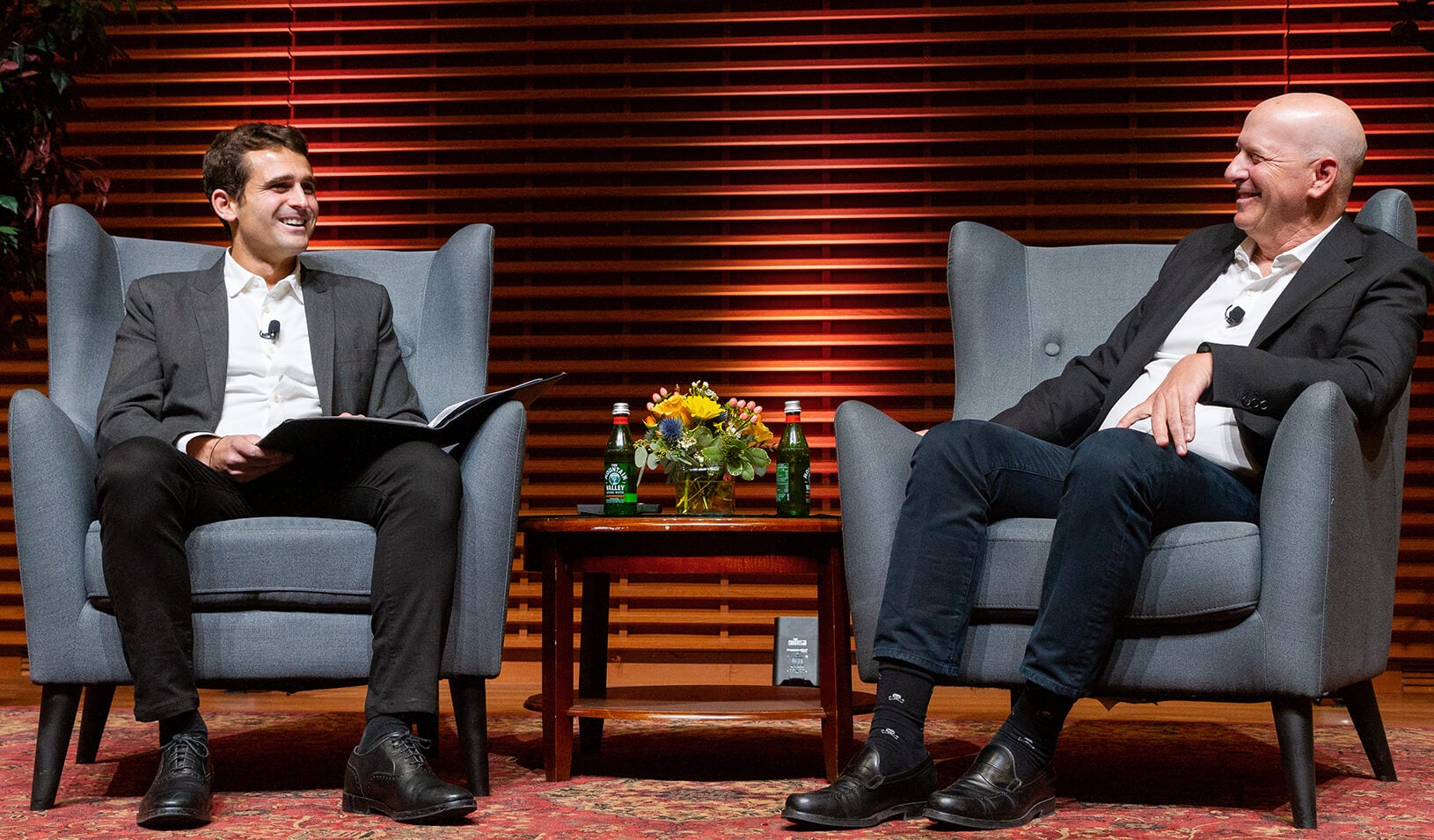
At Stanford in 2020, Solomon told a story about Goldman's dress code. Walking around the firm, he had noticed employees already dressing casually. Yet the written rules ran to 35 pages. He described replacing them with a short instruction whose opening was admirably usable: “Dress in a way that's appropriate for your day”.
The comedy is in the paperwork. A company trusted to advise clients on consequential decisions had somehow needed a small booklet to discuss trousers. The managerial issue was more serious: written rules and working reality had drifted apart. Solomon's response was to make the rules acknowledge the reality.
His first investor day in January 2020 dealt with a larger version of that problem. Goldman publicly set out its businesses, plans and performance targets in a format the institution had never held before. Shareholders received a more explicit account of what management intended to do and how it expected to be judged.
That creates a bargain. A leader gets room to explain a strategy; investors get numbers against which to test the explanation. It also removes some of the comfort of institutional mystique. Once a target is public, missing it becomes a discussion rather than a private disappointment.
“I applied a third time.”
David Solomon, recalling his Goldman Sachs applications
The hobby that got its own headlines
Solomon's other public identity came with a shorter name: DJ D-Sol. A banker making dance music is an irresistible combination for a headline writer, and a slightly less irresistible combination for anyone hoping to discuss a bank's operating strategy. The hobby gave his public image something that quarterly results seldom provide: a sense of personal taste.
There was a business attached. In 2018 he launched Payback Records in partnership with Big Beat/Atlantic Records, with proceeds directed to charity. Its releases offered an outlet for his own music and room for other artists. A hobby had acquired distribution, collaborators and a reason to have meetings.
The collaborators were real names in music. In 2021 Solomon released “Learn to Love Me” with OneRepublic frontman Ryan Tedder. Payback also released Oliver Heldens's “Break This Habit”, featuring Kiko Bun. Discussing that collaboration in 2020, Solomon explained his interest in giving other artists a place on the label and described music as a way to step away from the pressures of his day job.
At Stanford, he said DJing had made him easier for younger employees to approach. There is something plausible, and rather funny, about a chief executive becoming less intimidating through an activity that requires standing above a room full of people. A shared interest can open a conversation that a management title closes.
Visibility carries its own bill. In October 2023, Goldman confirmed that Solomon had stopped public DJ performances more than a year earlier. The explanation distinguished the music from the media attention around it, which had become a distraction. The same hobby that helped make the boss approachable had become another subject the company had to explain.
When the strategy needs an edit
Goldman's consumer expansion supplied a harder test. An October 2018 internal reorganization set out an ambition to reach a broader group of consumers and investors through Marcus and the firm's investment capabilities. It was a widening of the audience for a bank associated with corporate and wealthy clients.
By 2023, the retreat from parts of consumer lending was under way. The third quarter brought a 33 percent decline in earnings and a write-down connected with GreenSky, the lending business Goldman was selling. These were consequences on an income statement, with little patience for a persuasive origin story.
The distinction matters when assessing Solomon. A profile that lists only the subsequent results erases the cost of the decisions that preceded them. One that stops at the consumer setbacks misses the later work of narrowing the business. His record includes both the expansion and the retreat.
In his 2025 shareholder letter, published in March 2026, Solomon could point to $58.3 billion in annual net revenues and a 15 percent return on equity. Goldman had also reduced historical principal investments from roughly $64 billion to $6 billion over the period discussed in the letter. That change meant less capital tied up in those holdings.
Company results during Solomon's tenure. These figures describe the firm, not his personal wealth.
The useful question is how a leader handles evidence that complicates the plan. In an interview published in April 2026, Solomon discussed the consumer bet and the need to adapt. He also acknowledged that advising chief executives had left him underestimating how different the job would feel once he held it himself.
That admission gives the polished career sequence some texture. Experience can prepare a person for responsibility without reproducing its weight. Even a banker with decades of access to chief executives can arrive in the office and discover that proximity was an incomplete education.
The next job inside the same job
By 2026, artificial intelligence had become part of Solomon's discussion of Goldman's operating model. In a conversation with Ben Horowitz and David Haber, he described OneGS 3.0, an effort to rethink core processes using AI. The name had progressed through versions; the underlying task remained getting a large organization to work differently.
His public priorities also remained grounded in clients. In a May 2026 asset-management conversation with Matt Gibson, released in June, he put investment performance first. Technology could change the means of delivering a service. Clients would still judge the outcome. For a bank, an impressive demonstration is only the start of the conversation.
The October numbers offered a fresh test. Goldman reported third-quarter net revenues of $18.68 billion, net earnings of $5.29 billion and annualized return on equity of 18.7 percent. A quarter is a measurement, not a verdict on an entire career, but it is one of the measurements the chief executive has to answer for.
Solomon's story keeps returning to the gap between an argument and its consequences. He could argue his way past rejection, explain the value of a liberal arts degree, simplify a dress code and set out a bank's ambitions. Then came the more demanding work of finding out which arguments survived contact with events.
There is room in that life for a record label, a college board and an occasional joke about a failed interview. The office still comes with the same stubborn requirement: choose, watch what happens, and decide whether to keep going. The third application was worth making. Other decisions needed an edit.
Continue the conversation
Interviews, music and public profiles for the curious.