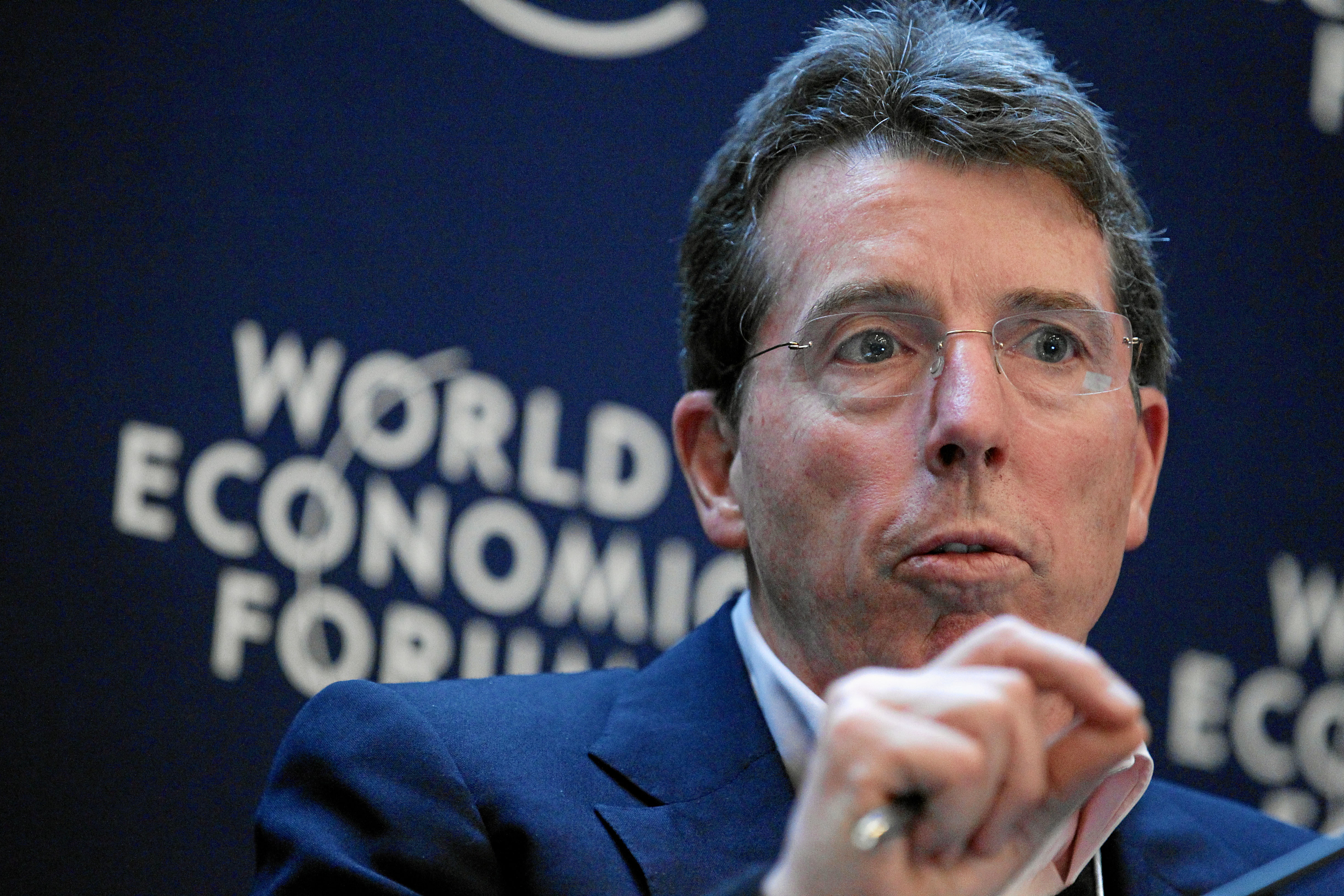
In January 2012, Bob Diamond sat on a stage in Davos for a session called “Building Trust.” He was chief executive of Barclays, a British bank whose investment-banking ambitions he had helped turn into a business. Six months later, he had resigned and was answering questions in Parliament about the manipulation of benchmark interest rates. The photograph survives with its original caption. So does the uncomfortable distance between the subject on the stage and the events still to come.
Diamond’s career has continued for more than a decade since that summer. He founded Atlas Merchant Capital, built a partnership with David Schamis and returned to the financial industry as an investor. Today, his interests run from consumer credit to digital assets. There is plenty to write after the resignation.
Still, a second act does not arrive with a clean balance sheet of memory. Diamond’s story carries the banker who helped build Barclays Capital, the executive who left during Libor, and the investor who believes he can recognize another opening. All three occupy the same chair.
A trader by way of the computer room
The route began some distance from a trading desk. Diamond grew up in Concord, Massachusetts, with two teachers for parents. He graduated from Colby College in 1973 after studying economics, then earned an MBA at the University of Connecticut. Education remained a working connection: he taught at UConn early in his career and later served as a trustee at Colby.
In 1979 he joined Morgan Stanley through information technology. He wanted to trade, and eventually moved onto the repo desk, then into bonds. It is a useful beginning for someone now interested in the systems that move financial transactions. Before he was responsible for the business, he had worked around its machinery.
His responsibilities became international. At Morgan Stanley he led European and Asian fixed-income trading. He moved to Credit Suisse First Boston in 1992, with senior assignments in Tokyo and New York. By the time Barclays recruited him in 1996, he had experience of markets, management and working across countries.
The early career resists the idea of a banker emerging fully formed from a business-school classroom. There was a computer room, a trading desk and a series of jobs that widened the view. The grand titles arrived later.
- 1979Morgan Stanley
Technology → trading - 1996Barclays
Building an investment bank - 2013Atlas
Investing with operators - 2025Hyperliquid Strategies
Chairing a digital asset company
The bank inside the bank
At Barclays, Diamond found a large institution with room for an ambitious markets business. Barclays Capital became his project. The challenge was to build an investment bank within an organization already known for other kinds of banking, with its own habits and history. That required people, customers and a willingness to keep committing resources to the idea.
He joined the executive committee in 1997 and became an executive director in 2005. His responsibilities included Barclays Capital and Barclays Global Investors. The progression mattered because it placed the markets operation increasingly close to the center of the group.
Then September 2008 presented an opportunity under circumstances nobody would have ordered. Lehman Brothers failed. Barclays acquired its North American investment-banking and trading business after the bankruptcy, giving the British bank a substantial Wall Street operation. Diamond helped lead the deal.
Buying part of a collapsed firm sounds tidy when written as a single sentence. The work involves people whose previous employer has just failed, customers who need continuity and systems that must function while ownership changes. It is a transaction with an operating problem attached. That combination would become a recurring part of Diamond’s later investment pitch.
In January 2011, he succeeded John Varley as Barclays’ group chief executive. The builder of the investment bank was now responsible for the whole institution. The job also brought a much larger public audience.
A rule meets a reckoning
Diamond’s approach to teams had a memorable shorthand: a “no jerks” rule. In banking, where individual revenue can buy considerable tolerance for difficult behavior, such a rule asks whether a productive colleague is also a tolerable one. It is a management question with more bite than the usual office poster.
His public enthusiasm for Barclays was equally plain. “I love Barclays,” he told the parliamentary committee in July 2012. The declaration came after his resignation, during questioning about misconduct that had exposed a different picture of the institution.
On June 27, regulators announced settlements over Barclays’ submissions to Libor and Euribor, benchmarks used in financial contracts. The UK Financial Services Authority imposed a £59.5 million penalty. Barclays announced total penalties of £290 million across the British and American settlements. The findings concerned the bank’s conduct, including submissions influenced by traders’ positions and submissions reduced during the financial crisis.
Diamond resigned on July 3. The following day, he appeared before the Treasury select committee and acknowledged mistakes and reprehensible behavior. His stated approach to culture had failed to prevent the wrongdoing.
The episode belongs in any serious account of his career because it changed both his employment and his public meaning. A teamwork rule can express a sincere preference and still prove insufficient. An executive’s attachment to an institution can coexist with failures inside it. The uncomfortable work of biography is to keep those facts together.
June 27 → July 3, 2012
From the announcement of Barclays’ benchmark-rate settlements to Diamond’s resignation.
A partnership, rather than another corner office
In 2013, Diamond founded Atlas Merchant Capital. David Schamis joined as a founding partner in January 2014 after years investing in financial-services businesses at J.C. Flowers. Diamond brought operating experience; Schamis brought a background in financial private equity. The partnership gave the new firm a more specific proposition than a famous banker finding somewhere to sit.
Atlas invests in financial services and works with management teams. Its stated approach puts industry knowledge alongside capital: understanding regulation, assessing operational risk and executing transactions with partners. The firm has offices in New York and London and invests across public and private markets.
There is a practical distinction between running a bank and investing in businesses that serve or resemble one. An investor must decide which problem deserves capital, which team can use it and how ownership should be arranged. Diamond could bring experience from banking without needing to recreate his former employer.
His post-Barclays ambitions also included Atlas Mara, formed with entrepreneur Ashish Thakkar and listed in London in December 2013. That venture pursued African banking acquisitions. It was a separate undertaking from Atlas Merchant Capital, and the shared name should not blur the distinction.
The broader thread is his preference for a financial business with something to build. Atlas’s portfolio spans market infrastructure, credit and advisory businesses. The firm’s case rests on knowing the sector closely enough to help its companies, rather than treating every investment as a miniature version of a bank. Experience has to become useful to somebody else.
Old instincts, new plumbing
By 2025, Diamond and Schamis were explaining a move into the Hyperliquid ecosystem. Hyperliquid Strategies was designed around a treasury strategy holding HYPE, the ecosystem’s token. The business combination closed on December 2, 2025. Diamond became chairman; Schamis became chief executive. The company’s shares began trading under the ticker PURR, a small contribution to the otherwise sober vocabulary of corporate finance.
The distinction between chairman and protocol founder matters. Diamond chairs a company with exposure to the ecosystem. He did not create Hyperliquid. His role concerns the organization bringing that exposure to public-market investors.
In their September 2025 Forward Guidance interview, the partners discussed trading infrastructure, perpetual swaps and institutional access to digital assets. The conversation placed a longtime bank executive in a market whose participants often question the need for traditional intermediaries. It is an interesting place for him to spend his attention.
More conventional financial technology sits beside that work. In August 2026, Atlas led a minority investment in Edge Focus, a consumer-credit firm developing underwriting technology and a capital-markets platform. The announced uses of the investment included hiring, technology development and expansion with lending and institutional partners.
These are different businesses, with different exposures. Together they show where Diamond’s second act is spending its time: on how financial activity is organized, financed and delivered. The computer-room beginning has acquired a long afterlife.
WATCH · SEPTEMBER 2025Diamond and Schamis on digital marketsThe Forward Guidance conversation ↗The ties that outlast the title
For all the international assignments, Diamond has kept recognizable New England attachments. He was a high-school linebacker, is a Red Sox fan and has coached youth baseball. London added Chelsea to his sporting interests. A banker can study an elaborate risk model and still have his weekend improved by eleven people in matching shirts.
His college connection has also lasted. He is a life trustee and former chair of Colby’s board, and has received honorary degrees from Colby and UConn. His current institutional affiliations include Yale’s School of Management Council of Global Advisors and the Council on Foreign Relations. These ties give the career a geography beyond offices and transactions.
The father he admired offered a simpler daily instruction: keep learning, and pass something on. Diamond recalled that advice when discussing his upbringing. It helps explain why an account of his life should make room for education alongside banking. The work of passing on experience was part of his own description of the job.
There are smaller public details, too. His first reported tweet, in October 2014, celebrated his daughter Nell’s wedding. The finance executive’s entry into social media was a father-of-the-bride announcement. Even a career spent in markets occasionally produces a message with no valuation attached.
His recent interview schedule returns to digitization, artificial intelligence and the future of banks. Atlas’s 2026 investments give those conversations a business context. He remains occupied with what financial institutions might become.
The second act is ongoing. It has colleagues, commitments and a record of its own. It also has the first act close at hand. Diamond can bring decades of experience to the next decision; the people assessing that decision can bring decades of history. That is the price, and the usefulness, of a very long memory.
“Every day, you have to learn some and teach some.”
His father’s advice, recalled by Bob Diamond
Follow the next chapter
More of Diamond’s work, interviews and career history.
- Atlas Merchant Capital · Current biography
- Bob Diamond on LinkedIn · Bob Diamond on X
- The August 2026 Edge Focus investment
- Forward Guidance interview · Watch on YouTube
- Colby’s 2007 personal profile · The Barclays Capital years
- The 2012 regulatory findings · Hyperliquid Strategies’ December 2025 filing
- Recent appearances and company news · Wikipedia biography