Adena Friedman arrived at Nasdaq with an MBA and a rather particular ambition. She wanted to manage a complicated product. Cereal did not appeal. Neither did dish soap. A market, though: here was something with customers, prices, distribution problems and enough moving parts to keep a curious person occupied. In 1993, she joined as an intern. One early assignment involved a trading system that had technology, regulatory approval and an awkward shortage of revenue.
The system was called PORTAL. It served a restricted-securities market for qualified participants. Friedman wrote a product plan, including a fee. The work was unglamorous in the way that useful business work often is: establish what something does, identify who needs it, then work out why they should pay. Long before she became Nasdaq’s chief executive, she was learning to treat a market as something people had built and could improve.
That habit offers a way into a career usually compressed into a pleasing headline: intern becomes CEO. The compression loses the interesting part. Between those two jobs came data products, acquisitions, an excursion into private equity and a growing conviction that Nasdaq’s machinery could be useful far beyond its own exchange. The intern’s question kept getting a larger budget.
The political scientist who preferred products
Friedman grew up around Baltimore, with a father who worked at T. Rowe Price and a mother who practiced law. Finance was available as a family reference point; she initially chose political science at Williams College. Her education also included Soviet studies and a language program in Russia. She was interested in how systems worked before she began charging anyone to use one.
A summer internship in Al Gore’s Senate field office in Nashville helped change her direction. The practical work and career prospects of politics did not match what she had imagined. Nashville had another attraction: Michael Friedman, her boyfriend and future husband, was studying law at Vanderbilt. She applied to Vanderbilt’s business school, and only Vanderbilt. Romance, on this occasion, came with a course catalog.
She earned her MBA in 1993. Marketing, particularly product management, gave her a way to combine commercial questions with financial ones. Pricing and distribution could be considered alongside the thing being sold. Her eventual choice of Nasdaq followed that interest. Financial infrastructure offered the complexity she wanted, with consequences that extended well beyond a supermarket shelf.
“The product is the market.”
Adena Friedman, recalling her early career thinking
When information became her business
Friedman’s first years involved turning capabilities into things customers could understand and buy. By 2000 she was leading Nasdaq’s data products division. An exchange produces information as it operates: prices, trades, the signals that other people use to make decisions. Managing that information as a business brought her close to both the technology and the customer.
Her responsibilities widened into corporate strategy. Robert Greifeld, who became CEO in 2003, gave her a larger remit after she took on a project involving Nasdaq’s closing prices. Acquisitions required another stretch: valuing businesses, negotiating purchases and working out how the pieces would fit. Product management had supplied an entry point. She now had to become fluent in the finances of the whole company.
By the time she left for Carlyle in 2011, her record included leading Global Data Products, a $250 million business whose organic revenue grew at a compound annual rate of 15 percent between 2004 and 2009. She had also worked on acquisitions including INET, OMX and the Philadelphia Stock Exchange. These were concrete responsibilities accumulated over years, with results attached.
Organic revenue CAGR in Global Data Products, 2004-2009, during her leadership of the business.
The detour through the other side of the bell
In 2011, Friedman left Nasdaq to become Carlyle’s chief financial officer and a managing director. The move took a longtime exchange executive inside an investment firm preparing for public ownership. Carlyle went public in May 2012. She helped lead that transition, experiencing the demands of a listing from the company’s side of the transaction.
There is a useful symmetry here. An exchange needs companies to believe public ownership is worth the work. A CFO has to live with the work. Friedman’s time away gave her both perspectives, as well as experience in a different management culture. She would later describe Carlyle as intensely collaborative and the Nasdaq she knew as more oriented toward command and control.
She returned to Nasdaq as president in 2014, became president and chief operating officer in late 2015, and succeeded Greifeld as CEO on January 1, 2017. She was the first woman to lead a major U.S. stock exchange. On January 1, 2023, she added the chair’s role. Her path to the top had included leaving the building.
- 1993Joins Nasdaq as an intern
- 2011Moves to Carlyle as CFO
- 2014Returns to Nasdaq as president
- 2017Becomes Nasdaq CEO
- 2023Adds the board chair role

Buying the work behind the spectacle
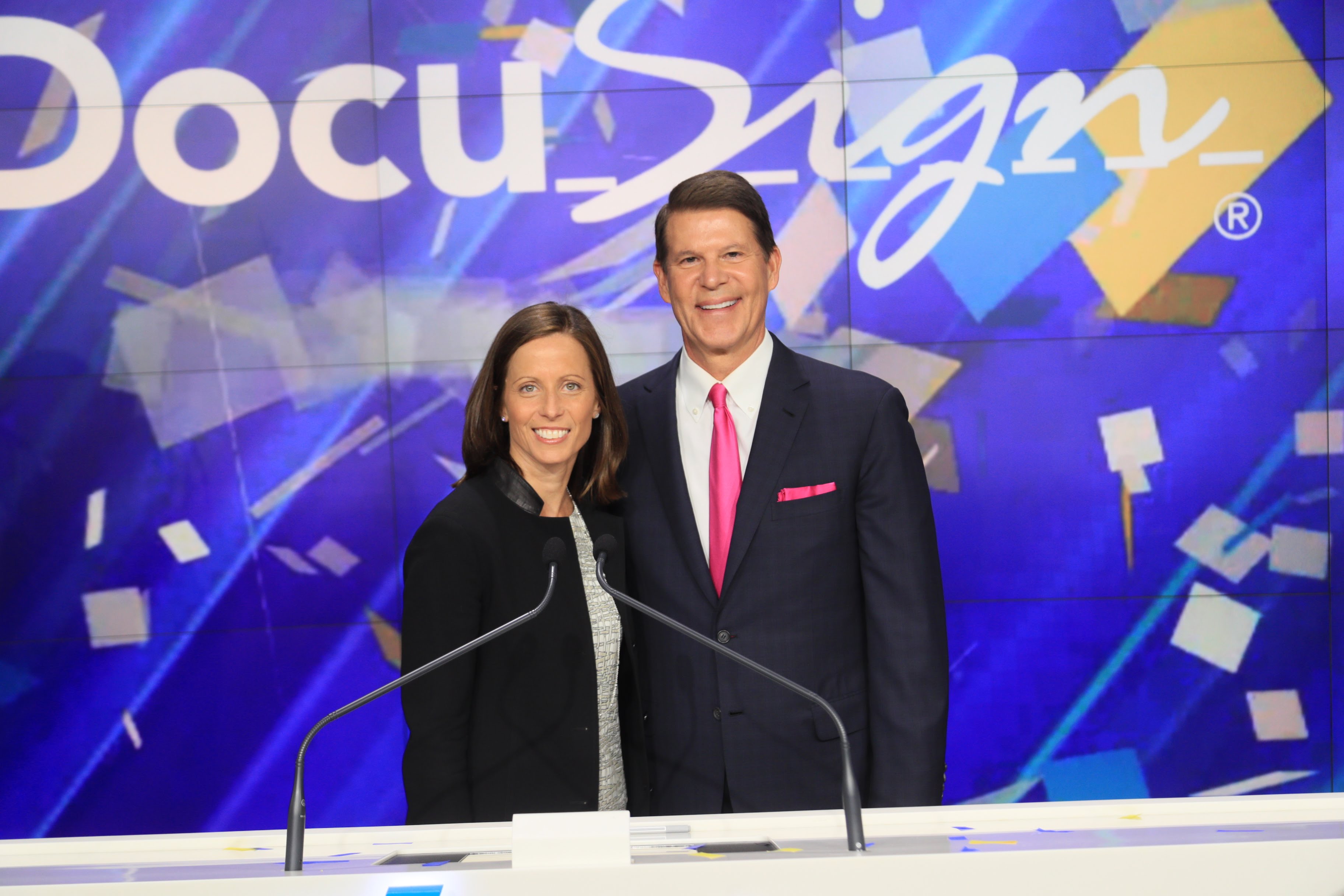
The bell ceremony is easy to photograph. Risk software is less obliging. Under Friedman, Nasdaq has invested heavily in the less visible work that keeps finance functioning. In February 2021 it completed the $2.75 billion acquisition of Verafin, a company supplying technology to detect financial crime. The customer base extended Nasdaq’s reach further into banking.
Adenza followed. Nasdaq announced the transaction in June 2023 at a value of $10.5 billion and completed it that November. The business brought software for risk management, regulatory reporting and capital markets. Its Calypso and AxiomSL offerings placed Nasdaq deeper inside the daily operations of financial institutions. The commercial logic echoed Friedman’s early work: find a complicated, consequential process and make its supporting systems useful to clients.
Buying a software business also brings obligations. Customers have to keep using it, systems have to work together, and a purchase price has to earn its place in the accounts. The announced Adenza value describes the scale of the commitment, rather than proving its wisdom. For Friedman, the strategy has made her original interest in complex products a company-wide proposition.
Verafin
Acquisition completed in 2021
Adenza
Announced deal value in 2023
A small obsession with commas
Friedman’s descriptions of leadership can be unexpectedly domestic in scale. In her 2017 Vanderbilt graduation speech, she remembered volunteering to edit group assignments. She cared about argument, grammar and comma placement. She urged graduates to reread an email before sending it. Somewhere inside the enormous abstraction called global finance, a misplaced comma was still getting attention.
She also remembered a student all-nighter spent on a project for a liquor distributor. The client supplied no refreshments. Later, during an overnight acquisition negotiation, she found herself using the same skills: keeping a tired group focused, preserving good humor and getting everyone to the finish. Her account made teamwork sound like a practiced craft, with fatigue and distraction among its ordinary materials.
In 2025, she explained her approach as “collaborative command.” People should bring competing views into the room, then move quickly once a decision is made. Nasdaq’s strategic reviews have used a hats exercise to prompt different ways of considering a problem. Discussion has a purpose and an endpoint. A market infrastructure company cannot deliberate indefinitely while everybody else waits for an answer.
The scoreboard, and the plumbing
Friedman holds a second-degree black belt in taekwondo. Asked about competitiveness, she has described business as a team sport and acknowledged how sharply losses register. She also argues that competitiveness can coexist with kindness. The combination helps explain why her talk of collaboration comes with an insistence on decisions and measurable performance.
The scale of the systems she oversees gives those preferences practical weight. At an April 2025 public conversation, she said Nasdaq’s systems had handled 550 billion messages on April 7 amid market turmoil. Messages are distinct from completed trades; they describe the traffic the machinery must process. Investors may remember a volatile day through the movement of a portfolio. The exchange operator also remembers the load.
Financial crime presents a different systems problem. Friedman has argued for collaboration among banks, technology providers and public authorities, with AI and cloud tools helping distinguish suspicious transactions from legitimate ones. An exchange business built around competition now sells tools that depend, in part, on institutions working together. Her job contains both impulses, often in the same conversation.
“I just want you to understand that the plumbing has been working.”
Adena Friedman, April 2025
What she wants to build next
Friedman’s public argument for markets extends beyond their technical operation. In her 2019 TED talk, she considered how capitalism could make opportunity more widely available. Public ownership remains central to that argument: companies obtain capital, while investors gain a chance to participate in their growth. It is also central to Nasdaq’s business. The conviction and the commercial interest travel together.
Her January 2026 essay on AI put durability ahead of novelty. She argued that investment needs patience, enterprise adoption needs trust, and companies need to redesign work to realize the technology’s promise. In August she joined Intuit’s board. In September, Nasdaq reported test collateral trades involving tokenized money-market-fund shares with Vanguard and Wellington Management, using Calypso. The experiment connected a newer technology to established institutional workflows.
There is a recognizable continuity from PORTAL to those tests. Friedman keeps returning to the work of making a system function for its users. Markets can appear inevitable once they are large enough: screens light up, prices arrive, the bell rings. Her career has unfolded among the decisions underneath that apparent inevitability. Someone has to define the product, make the argument, check the details and decide what to build next.