Jenny Johnson learned something useful in the credit card business: a spreadsheet could tell you what people were likely to do next. Long before artificial intelligence became a standing item on the corporate agenda, she was watching a less glamorous contest. Lenders with better data had an advantage over lenders without it. The lesson stayed with her after Franklin Templeton left banking behind. Somewhere inside an old department, the future had been quietly doing its paperwork.
That is an instructive place to begin with Johnson, the chief executive of Franklin Templeton. Her surname offers the obvious story. Her grandfather founded the business; her father ran it; her brother preceded her as CEO. Yet the jobs she did on the way up offer a more revealing explanation of how she works. Consumer lending, operations, technology, wealth management: she spent decades encountering the parts of a financial company that customers rarely see.
She became CEO in February 2020, after joining the firm in 1988. By then she had something more useful than a brief introduction to the family enterprise. She knew its habits. She also knew that a familiar way of doing business could become a very expensive attachment.
A surname gets you into the story
The family connection is substantial. Rupert H. Johnson Sr. founded Franklin in New York in 1947 and named it after Benjamin Franklin, whose thrift suited the venture. Charles B. Johnson, Jenny’s father, took over in 1957. The company went public in 1971, moved to California after an acquisition in 1973, and bought the Templeton business in 1992. Its history contains plenty of continuity, but also a recurring willingness to buy its way into unfamiliar territory.
Jenny’s own first steps included school-holiday mailroom work at 14. She graduated from the University of California, Davis in 1987, worked as a trainee at Drexel Burnham Lambert, and joined Franklin the following year. Her early assignments included a bank the company owned. The route to the investment manager’s top job took a detour through the ordinary business of lending people money.
There is a useful corrective here to the usual executive biography, with its tidy upward arrows. Different departments create different kinds of embarrassment. A technology system has to run. A loan has to be repaid. An operational problem cannot be charmed into becoming a strategy. Johnson’s eventual remit included leadership across every major division of the firm. The apprenticeship was unusually broad, even allowing for the unusually helpful surname.
The deal had to work between people
Her opening weeks as CEO came with a large number attached. On February 18, 2020, Franklin Templeton announced its agreement to buy Legg Mason for $4.5 billion in cash, alongside the assumption of approximately $2 billion in debt. An incoming executive’s customary listening tour had acquired a rather demanding practical examination.
The deal closed on July 31. At closing, the combined business reported $1.4 trillion in assets under management. The intention was to add complementary investment capabilities and a wider distribution network while preserving the specialist managers’ investment approaches. Buying a financial firm means buying people whose methods, relationships, and judgment are much of the value. The logo is the easy bit to bring home.
Johnson visited Legg Mason’s investment boutiques on a two-week trip before the integration moved into its next phase. She later described the value of those meetings in building trust. There were difficult personnel decisions, including choosing people from the acquired business over Franklin candidates. Familiarity with the buyer did not guarantee the chair.
Her account of leadership uses a basketball comparison: even an excellent point guard will struggle in the center’s position. That makes the organization chart sound pleasantly athletic, until one remembers that moving the players involves actual careers. Her emphasis was on getting people into suitable roles and building a team that could trust one another.
“deals succeed or fail based on whether the cultures mesh.”
Jenny Johnson, December 2021
The cultural question remains central to understanding her acquisition strategy. A parent company needs enough common infrastructure to make scale worthwhile. An investment team needs enough independence to keep doing what clients hired it to do. The interesting work happens at the boundary. Too much uniformity risks sanding away the reason for the purchase; too little leaves an expensive collection of separate businesses.
More shelves in the investment cupboard
Lexington Partners joined Franklin Templeton in April 2022, bringing secondary private equity and co-investment expertise. The announcement put the firm’s aggregate alternative assets above $200 billion. It also set out a collection of distinct specialties: Clarion Partners in real estate, Benefit Street Partners in alternative credit, K2 Advisors in hedge fund strategies, and Lexington in private equity.
Putnam arrived on January 1, 2024. That acquisition expanded Franklin Templeton’s retirement business and took its defined contribution assets above $100 billion. These purchases had different purposes. One broadened access to private-market capabilities; another added investment strengths and retirement scale. Reading them simply as an appetite for size misses the decisions about which capabilities to own.
Johnson traces the private-markets effort to strategic planning in 2018, when the firm was watching institutional allocations change. Her ambition includes reaching wealth clients as well as institutions. Education is part of that project: advisers need to understand the investments before putting them into clients’ portfolios. Access sounds inviting; suitability requires more conversation.
The distinction matters for her public persona. She is comfortable discussing new ways to invest, while the practical problem remains the same as it was in a lending department: understand the exposure. An investment can be interesting and still be wrong for a particular owner. Product breadth creates choices. It also increases the responsibility attached to making them.
The dinner conversation turned to blockchain
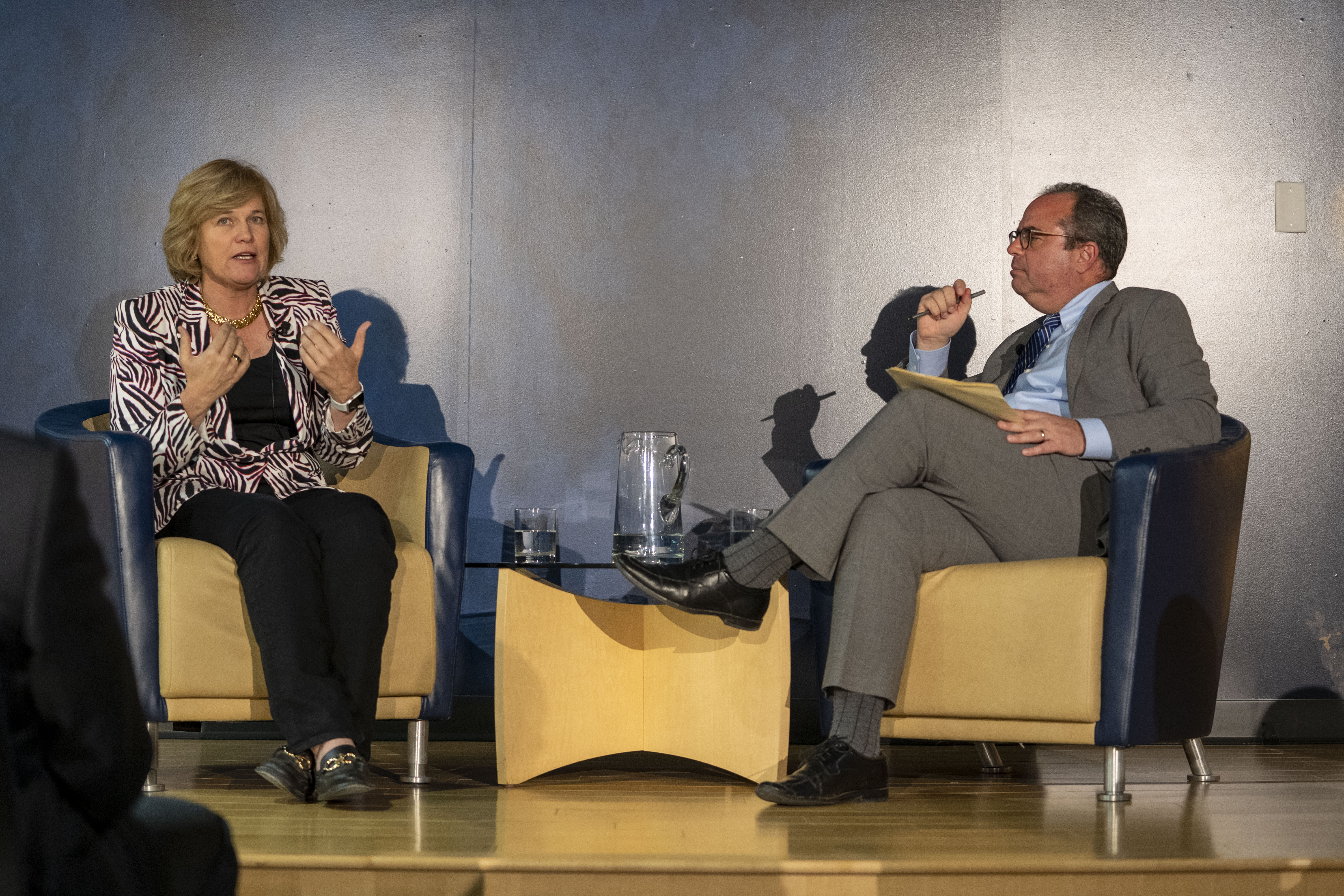
At the inaugural UC Davis-Financial Times Biz Quiz in November 2022, Franklin employee and MBA student Brandyn Lee found himself at dinner with Johnson and investment executive Wylie Tollette. Lee later recalled discussing blockchain’s real-world effects with his CEO. After dinner, he watched her interview with Financial Times editor Peter Spiegel. The evening covered leadership, rates, consumer spending, and alternative investments. A business quiz had acquired a fairly comprehensive warm-up act.
Her interest in blockchain has a concrete expression. Franklin Templeton launched its OnChain U.S. Government Money Fund in 2021, using a public blockchain to process transactions and record ownership. That puts a familiar financial product together with a different recordkeeping system. The attraction extends beyond the daily drama of cryptocurrency prices to how investments are administered and distributed.
By September 2022, Johnson was discussing technology’s effect on asset management in a filmed conversation with Morgan Stanley’s Tracy Castle-Newman. The subjects included blockchain and finding emerging growth companies. Taken together with the fund launch, it shows that the interest predates the current rush to attach an AI label to everything with a screen.
There is a recognizable thread between these subjects and her early data experience. Both concern the machinery underneath an investment business: what it knows, how it records a transaction, and how a product reaches its owner. For an executive who has run operations and technology, these are familiar kinds of questions, even when the vocabulary changes.
A boardroom can still miss the obvious
Johnson has also described a smaller, more awkward operational failure. After she presented a board update, a director praised a slide as the work of Matt, her male chief financial officer. The CEO’s contribution had been credited to someone reporting to her. The anecdote is funny only until one imagines having to decide whether to laugh.
She has used the episode to discuss unconscious bias and the value of allies. Her involvement with Catalyst, where she is listed as a board officer and treasurer, gives that concern an institutional outlet. The lesson of the slide is modest and uncomfortable: reaching the top of an organization does not automatically correct the assumptions inside the room.
The attention she receives as a woman leading an investment firm sits alongside an extensive network of advisory roles. Her biography lists the Monetary Authority of Singapore’s International Advisory Panel, the NYSE Board Advisory Council, and the Investment Company Institute’s Board of Governors. Her working world reaches well beyond the firm her grandfather founded.
THE BUSINESS SHE LEADS / SEPTEMBER 2026
$1.79 trillion
Assets under management, spread across five categories
Still taking the machine apart
The business continues to change around her. In October 2025, Daniel Gamba, Terrence Murphy, and Matthew Nicholls became co-presidents, with Johnson continuing as CEO. The appointments distributed responsibility across commercial activities, public-market investments, and finance and operations. The title she holds today is chief executive, after years in which president appeared alongside it.
In September 2026, the company announced an agreement, through Clarion, to acquire a majority stake in European real-assets manager Stoneshield Capital. The announced timetable anticipated a fourth-quarter close, subject to conditions. The distinction between signing and completing matters. A strategy is still a set of obligations to carry out, however handsome the announcement looks.
An October 5, 2026 iCapital conversation took place at Johnson’s Montana ranch. The setting suited a discussion about conviction, disagreement, culture, and adapting to technology. Her life has room for horses as well as investment committees. A ranch is also a useful reminder that even a chief executive occasionally answers to something entirely unimpressed by a job title.
In her September 2026 conversation on Excess Returns, she described experimenting with AI herself, including making a short film about rum and pirates for her son’s distilling business. She also admitted that coding tools could defeat her. The experiment is a pleasingly domestic version of the larger task: try the thing, discover its limits, and learn enough to ask better questions.
Her four leadership priorities are people, passion, purpose, and persistence. They leave considerable room for the unglamorous work. Johnson’s career suggests why that room matters. Knowing a business well gives its leader something concrete to question. The family name may remain above the door. Inside, there is always another department where the future is doing its paperwork.
Keep the conversation going
- Franklin Templeton · official biography
- Jenny Johnson · LinkedIn
- Inside the Legg Mason integration · interview
- Excess Returns · September 2026 conversation
- iCapital · the Montana ranch conversation
- CNBC · watch the June 2025 interview
- Morgan Stanley · technology and investing
- Franklin Templeton · latest company news
- September 2026 · assets under management