Jason Liberty asked his predecessor a question most successors would probably prefer to leave unspoken. They were onstage aboard Star of the Seas in August 2025, in a conversation about leadership and legacy. “How am I doing?” he asked Richard Fain. Fain replied that the question was about four years late. A performance review, it turns out, can travel at a leisurely speed even aboard a new cruise ship.
The exchange had twenty years of working together behind it. Fain had hired Liberty in 2005; Liberty became chief executive in January 2022. Their easy teasing gave a public glimpse of a relationship usually expressed through appointments and announcements. The mentor could deliver a joke. The successor was comfortable enough to supply the opening.
By November 2025, Liberty would also take the chairman’s seat. The former finance executive now occupied both positions at Royal Caribbean Group. His route there offers a useful way to understand the job: years spent inside the machinery of a company whose customers buy the chance to forget machinery altogether.
Before the view, the arithmetic
Liberty came to Royal Caribbean from KPMG, where he had been a senior manager. His education had followed a distinctly numerical course: an accounting bachelor’s degree from the University of Miami, a master’s in finance from Indiana University, and an MBA from the University of North Carolina’s Kenan-Flagler Business School. The transcript has a certain consistency. Nobody appears to have mistaken the assignment for marine biology.
At Royal Caribbean, he moved through corporate and strategic planning, then corporate and revenue planning. In 2012 he became senior vice president of strategy and finance, with responsibilities including deployment, treasury and investor relations. Deployment is a particularly revealing word. Before a passenger chooses a destination, somebody must decide where a ship should be.
That work puts an executive between two kinds of uncertainty. A vessel represents a long commitment. The traveller choosing a holiday has a shorter horizon and plenty of alternatives. Planning brings those clocks together: where to put capacity, how to price it, and how to make the investment worthwhile. Liberty was learning the company through decisions that eventually became itineraries.
- 2005Joins the group
- 2013Becomes CFO
- 2022Becomes CEO
- 2025Adds chairman
He became CFO in 2013 and executive vice president in 2017. The portfolio around the finance job expanded well beyond the accounts. It included strategy, shared service operations, legal and technology. His work also encompassed the Silversea acquisition and the company’s European joint ventures. A luxury cruise brand and a technology operation ask different questions of their managers. He had experience on both sides of that conversation.
This breadth mattered when his promotion was announced. Externally, a CFO is often encountered on an earnings call, explaining what has already happened. Inside the business, Liberty had responsibilities across brands and shared operations. His preparation for the chief executive’s role had been happening in plain sight, though the public view of it was narrower.
A successor with permission to change
When Fain discussed handing over the job in 2021, he said he expected Liberty to take the company in a different direction. That is a useful expectation to place on a successor. It gives continuity some breathing room. A long apprenticeship can teach someone how to make decisions without requiring every future decision to resemble the teacher’s.
Liberty, meanwhile, emphasised the culture and values he had helped develop. He also spoke directly about travel advisers: “I am a huge advocate of the trade.” Selling a cruise involves enough choices that knowledgeable intermediaries can earn their place. He wanted more individual conversations with them, a practical ambition for an executive becoming more visible outside the company.
The handover continued in stages. Fain remained chairman after Liberty became CEO; Liberty added the chairmanship in November 2025. The company’s board later described the combined role as supporting unified leadership and accountability, alongside an independent lead director. The progression gave the succession a shape more gradual than a single farewell photograph could convey.
Fain has since described their relationship as one in which they learned from each other. He also made the point that a predecessor must accept disagreement. There is something reassuringly ordinary about that observation. Even a company with ships on seven continents eventually encounters the familiar problem of letting another person do the job in their own way.
“How am I doing?”
Jason Liberty, to Richard Fain
Star of the Seas, August 2025
The numbers behind the holiday
Liberty’s first year as CEO included the introduction of a financial program called Trifecta. Announced in November 2022, it set three goals for the end of 2025: adjusted earnings per share of at least $10, adjusted EBITDA per available passenger cruise day of at least $100, and a return on invested capital of 13% or more.
The language could empty a poolside conversation rather quickly. The underlying questions are easier to follow. What does each unit of available cruise capacity earn? What reaches shareholders? How effectively does the company use the capital committed to the business? A holiday company needs answers to all three, particularly when its investments are built in shipyards.
In July 2024, Royal Caribbean announced that it had achieved the goals on a trailing twelve-month basis, eighteen months ahead of schedule. That qualification matters: it described the preceding year’s performance. The 2024 results also included approximately $6.1 billion of high-cost debt refinancing and the return of a shareholder dividend. Liberty’s finance background remained relevant after the title changed.
How early the group announced it had reached its Trifecta targets, on a trailing twelve-month basis, in July 2024.
The visible side of those years was a succession of ships. In 2024, the group introduced Royal Caribbean’s Icon of the Seas and Utopia of the Seas, alongside Silversea’s Silver Ray. The range matters as much as the launch calendar. A family holiday and an expedition or luxury itinerary can belong to the same corporate portfolio while asking for very different experiences.
In 2025, the group delivered 9.4 million vacations. Star of the Seas and Celebrity Xcel joined the offering, and Royal Beach Club Paradise Island opened. The business was adding places to spend a day as well as ships on which to spend a week. Each addition made the company’s idea of a vacation a little less dependent on the vessel alone.
The next trip can take a different route
Then there are the rivers. Celebrity River Cruises is scheduled to enter the market in 2027, beginning with Celebrity Compass and Celebrity Seeker. In January 2026, the company announced plans for ten additional river ships, bringing the intended fleet to twenty by 2031. These are future commitments, with the work of building and operating the fleet still ahead.
The Rhine and Danube give the strategy a different setting. A guest who knows Celebrity from the ocean may be interested in seeing Europe at another pace. The commercial idea is easy to recognise: a company can retain a relationship while changing the kind of trip it offers. Familiarity with a brand becomes an invitation to try somewhere else.
Liberty’s current remit also includes nearly 100,000 employees from more than 130 countries. The group’s fleet reaches all seven continents. Those facts put a human and geographical scale around the strategy. Keeping a guest relationship depends on the work of people who may never meet the chairman, but who deliver the experience represented by his decisions.
Ship design remains part of the next chapter. In January 2026, Royal Caribbean announced two Discovery Class orders with Chantiers de l’Atlantique in France, with deliveries expected in 2029 and 2032. Liberty described the opportunity as one to “redefine how Royal’s guests experience the world.” The dates are a reminder of how far ahead a cruise executive’s diary extends.
A signature pointing toward shore
In September 2026, Liberty appeared beside Sandals Resorts executive chairman Adam Stewart at Royal Caribbean Group’s Miami headquarters. They marked an agreement for the group to acquire a 50% interest in Sandals and Beaches Resorts for approximately $3 billion. The move carried the vacation strategy into a substantial land-based resort business.
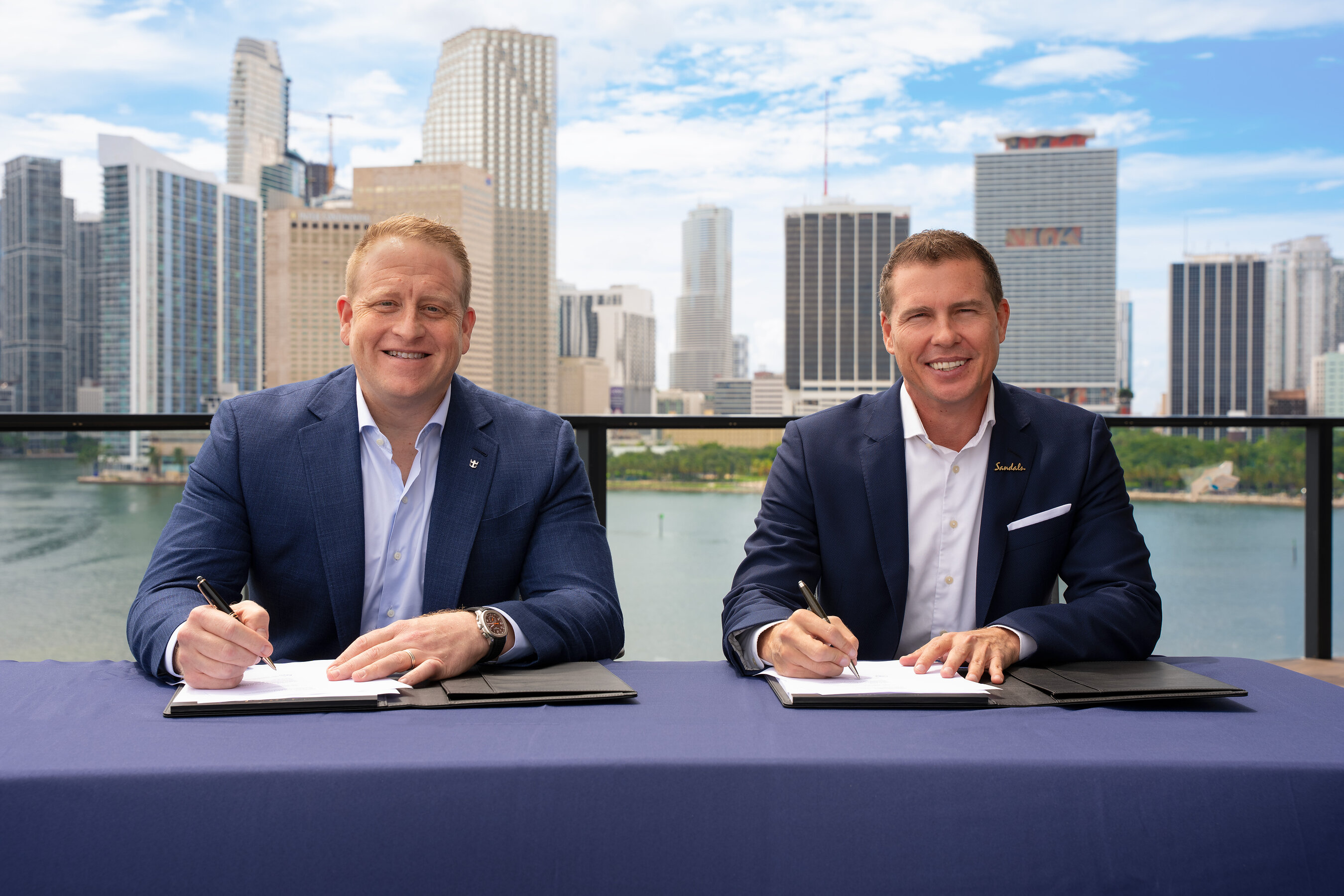
The transaction was expected to close in early 2027, subject to approvals and closing conditions. The announced structure called for shared board leadership by Stewart and Liberty, with Stewart remaining executive chairman of Sandals and Beaches. Royal Caribbean secured committed debt financing for the investment. The signature begins a further set of obligations; it does not complete them.
The attraction is understandable. Sandals and Beaches bring a different kind of accommodation, while serving people who also spend money on vacations. Whether that relationship produces the expected benefits will depend on execution. A resort stays put. Ships move. Customers can choose either, and their affection for one experience must be earned again in the next.
Liberty’s responsibilities now extend into aviation governance, too. Southwest Airlines appointed him to its board in August 2026. He also serves on the University of Miami’s board of trustees and UNC Kenan-Flagler’s advisory board. His professional map has widened considerably since the KPMG years, while retaining connections to the institutions where he studied.
There is a pleasing circularity to that career: accounting, planning, finance, then the responsibility for deciding where the whole enterprise should go. The next river ship, the next resort partnership and the next guest booking give Liberty different ways to answer the question he once put to Fain. The answer will keep arriving, one vacation at a time.