Josh Weinstein had joined a cruise company without ever taking a cruise. The paperwork came first. The revelation arrived later, on board, when the corporate lawyer watched passengers and crew going about the business of enjoying a holiday. Here was the human consequence of all those contracts. People had saved, planned, packed and travelled to be happy for a week. His employer was supposed to make that happen. For a corporate lawyer, the business offered an unusually cheerful subject to put beside the paperwork: a holiday that people would want to remember.
By August 2022, when he became Carnival Corporation’s chief executive, Weinstein had spent twenty years learning the machinery behind that answer. He had worked in legal, run treasury, led the British business and overseen global operations. The holiday business had introduced him to a remarkable quantity of work. His career suggests that knowing where the money goes can be useful preparation for understanding why the customer comes.
The photographs near his desk offered another kind of briefing. They showed his family on cruises over the years. In a 2022 interview, he described being able to connect memories of his children growing up with particular sailings. A fleet can be counted in ships, berths and dollars. A family tends to count it in summers. Weinstein’s job involves keeping both sets of accounts in order.
A job advertisement, then an education
Born in Brooklyn and raised in Syracuse, Weinstein studied at the University of Pennsylvania before attending New York University School of Law. His early professional route led through Skadden in New York and Greenberg Traurig in Miami. Corporate law gave him proximity to businesses, but proximity had its frustrations. Advisers helped with a transaction and moved on. He wanted to stay around for what happened next.
He answered a Carnival job advertisement and joined in 2002. The decision put him inside a company where the legal documents eventually became ships, terminals and journeys. It also began a long education in moving between specialties. The person hired to help a business make agreements would eventually have to decide what the business should agree to do.
By October 2007, when Carnival announced his appointment as vice president and treasurer, he had already worked on more than fifty financing transactions representing more than $12 billion of debt. His legal responsibilities had included acquisitions, divestitures, commercial contracts and intellectual property. That is an extensive backstage pass to a travel company. Very little of it requires sunscreen.
David Bernstein, the chief financial officer, supported the appointment. Treasury became Weinstein’s occupation for the next decade. In 2017 he moved to the presidency of Carnival UK, the operating company behind P&O Cruises and Cunard. In June 2020 he became chief operations officer. The assignments widened from documents to money to people and ships. Each promotion enlarged the list of things he needed to understand.
Eight brands, several ideas of a good time
There is a practical complication in Weinstein’s talk about happiness: passengers disagree about what produces it. Carnival Corporation now operates eight cruise brands. Carnival Cruise Line, Princess, Holland America Line, Seabourn, Cunard, P&O Cruises, Costa and AIDA do not offer one interchangeable holiday with different stationery. The differences are part of the business.
Weinstein made preserving those identities a priority when he took the top job. A short, exuberant sailing and an expedition-style luxury voyage attract different expectations. The task is to make the promise clear, then fulfil it. A customer who chooses the wrong atmosphere may discover that even a beautifully executed holiday can be somebody else’s idea of fun.
That makes the chief executive’s position interesting. Scale invites standardisation, especially in purchasing and the systems passengers never see. A holiday also depends on character, the thing standardisation can flatten. Weinstein’s portfolio approach leaves room for brand leaders who know their guests. The corporate centre must find savings without making every dining room feel as though it has been furnished by the same committee.
“Our job is to make people happy.”
Josh Weinstein · 2022
His own experience as a passenger gives the argument a domestic scale. He has talked about the convenience of unpacking once and letting different members of a family find their own activities. That modest detail is more revealing than a grand theory of leisure. The holiday succeeds when the arrangements recede far enough for people to enjoy one another.
A treasurer’s habits in the chief executive’s chair
When Weinstein succeeded Arnold Donald on August 1, 2022, he brought a long internal apprenticeship to a demanding balance sheet. His eventual answer included SEA Change, a programme introduced in 2023 that put financial returns and emissions intensity on the same scorecard. The name was nautical; the measurements were decidedly financial.
The original targets included a fifty percent increase in adjusted EBITDA per available lower berth day against the June 2023 guidance baseline, a twelve percent adjusted return on invested capital, and a reduction of more than twenty percent in greenhouse-gas intensity from 2019. Those are company measures, with specified definitions. They describe how efficiently the business uses its capacity and capital, rather than simply how many new ships it can announce.
By June 2025, Carnival reported that it had exceeded the programme’s financial targets eighteen months early. Adjusted EBITDA per berth day had risen fifty-two percent against the programme baseline, while adjusted return on invested capital exceeded twelve and a half percent. The achievement made a useful argument for the former treasurer: better performance could come from getting more out of the business already in hand.
There is a human challenge hidden inside such targets. A number has to travel from an investor presentation into decisions made by people booking itineraries, maintaining equipment and serving dinner. The chief executive cannot make all those decisions. He can make the priorities understandable enough that other people’s decisions begin to point in the same direction.
The ribbon has a balance sheet
At Celebration Key’s opening on Grand Bahama in July 2025, the work acquired a more photogenic form. Weinstein stood alongside Carnival Cruise Line president Christine Duffy and Shaquille O’Neal, the brand’s chief fun officer. The scene contained a ribbon, bright shirts and a retired basketball star. Corporate capital allocation rarely gets such agreeable weather.
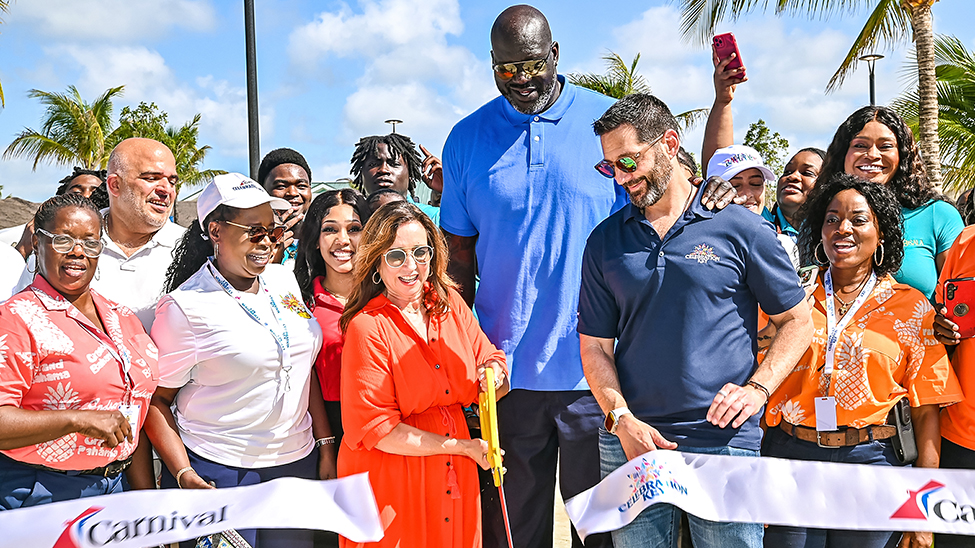
Celebration Key opened on July 19, with Carnival Vista making the first call. Its beach, lagoons, dining venues and distinct visitor areas turned a corporate destination strategy into a day ashore. By July 22, two ships were visiting together, bringing more than seven thousand guests. The investment announced at that point totalled $600 million, including a pier extension.
For a passenger, the appeal is immediate: somewhere to swim, eat and spend the day. For Carnival, the destination becomes part of the reason to choose an itinerary. The company can work on the holiday beyond the ship’s gangway. For Grand Bahama, jobs and local business participation are part of the bargain. A successful port day has several constituencies, and they do not all carry a beach bag.
The fuel bill joins the conversation
Weinstein’s environmental argument has the vocabulary of an operator. Burning less fuel reduces an expense as well as emissions. It connects a distant corporate objective to daily choices about equipment, routes and how a vessel is run. For someone who spent ten years in treasury, the connection hardly requires a conversion experience.
In its 2025 sustainability reporting, Carnival said it had reached its twenty percent greenhouse-gas intensity reduction goal against 2019 five years ahead of the original 2030 deadline. It also reported cutting food waste by forty-seven percent against its baseline and producing almost ninety percent of onboard water from seawater. These are reported operating results with different measures and baselines; they should not be rolled into one convenient claim that the environmental work is finished.
In 2026 he began a two-year chairmanship of CLIA’s Global Executive Committee. The role puts him in discussions where competing cruise operators share problems, including the availability of future fuels. A company can improve its ships while still needing ports, suppliers and infrastructure to move with it. The limits of an individual balance sheet become especially apparent when the infrastructure belongs to somebody else.
What he wants to do with the ships he has
By September 2026, Weinstein was describing a strategy of moderate capacity growth, investment in existing vessels and continued work on commercial execution. His comparison was arresting: the cost of one large new ship could refurbish roughly twenty to twenty-five existing vessels. That arithmetic makes the dry dock a rather consequential place. Newness can be purchased in more than one size.
The latest quarterly results gave that approach a current financial setting. On September 29, Carnival reported third-quarter net income of $1.9 billion and adjusted net income of $2 billion. Customer deposits reached a third-quarter record of $7.6 billion. Booked occupancy and pricing for 2027 were also at record levels. These are results and forward bookings, rather than a guarantee about the next voyage through the economic cycle.
His responsibilities now extend to Chipotle’s board, which he joined in November 2025, and the Pérez Art Museum Miami’s trustees. The central occupation remains making a complicated service business function for people who have paid to stop thinking about complicated things. The lawyer who had never cruised has spent most of his career inside that contradiction. Somewhere between a financing agreement and a family photograph, he found a business worth staying for.