The strange thing about selling travel is how rarely your customer travels. A person might book a holiday twice a year and think about one every afternoon. Between those two habits sits @hotel. Its wager is that the company showing you the place you want to be can also sell you the room when you finally get there.
- The audience came first: Tripscout grew a network of destination accounts before launching hotel booking.
- The rates have a door: private offers reach registered travelers through a restricted booking experience.
- The relationship continues: Traveler Care offers human help after the room is booked.
At its June 2022 launch, the mechanism was almost comically small: send the word “hotel” in an Instagram message. A chatbot returned a private booking link. Behind that little exchange sat hotel inventory, search filters and a travel agency. The holiday began inside the same app where someone had been avoiding their inbox.
01 / The trip before the trip
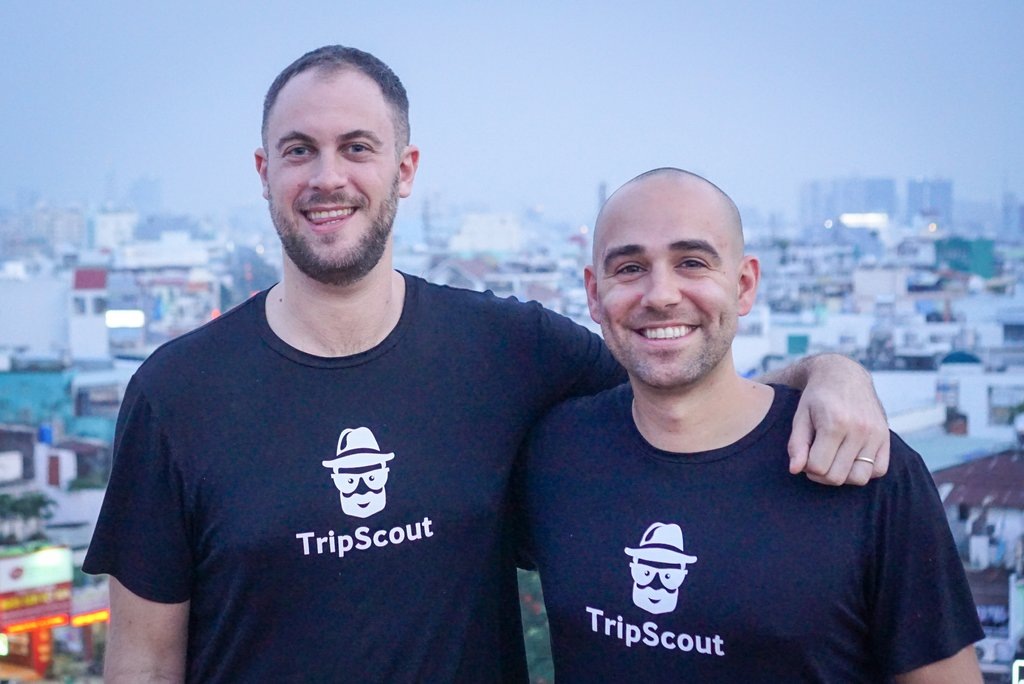
Konrad Waliszewski and Andy Acs founded TripScout in 2015. The early product offered local discovery and travel guides. In his own account of the company’s beginnings, Waliszewski describes handing out personal phone numbers to hundreds of thousands of users for feedback. This was research with an inconvenient side effect: the customers could actually call.
He also remembers 219 fundraising meetings before finding an early group of backers. The number is revealing because it makes the eventual business look less inevitable. A useful travel app still needed money, distribution and a reason to stay on someone’s phone between holidays.
The pandemic made that last problem unavoidable. Travel itself was interrupted, but interest in travel survived. Tripscout leaned into social content, including Instagram’s short-form video format. In 2020, the company said monthly social views grew from two million to more than 200 million. By March 2021 it reported over a million app users.
Those figures described attention, not hotel bookings. Yet they offered evidence for a different product rhythm: serve the traveler who is dreaming today, even if departure is months away. The practical insight was behavioral. An occasional purchase could have an everyday audience.
02 / A price with a door on it
@hotel’s hotel-booking launch gave that audience something to buy. The original Instagram route led people into a closed user group, where private offers could be distributed differently from publicly advertised prices. Launch reporting named Hotelbeds and HotelPlanner as inventory partners. @hotel supplied the audience and booking experience; it did not need to own the buildings.
This distinction helps explain the discount pitch. A hotel may want another booking without displaying a lower price to every shopper on the internet. Restricted distribution provides another route to that customer. The message was the entrance to the offer, while the actual reservation used a booking platform.
- 01See the place
- 02Message “hotel”
- 03Open private rates
- 04Book the stay
For travelers, the useful task is a careful comparison. Match the dates, occupancy, room category, cancellation terms and final total. A cheaper nonrefundable reservation and a flexible reservation are different purchases. Private access creates another price to check; it does not establish that every offer will beat every alternative.
The alternatives are familiar: Booking.com, Expedia, Agoda, Hopper and the hotel’s own website. @hotel competes by arriving through social discovery and coupling its offers with assistance. Its expertise spans audience building and accommodation distribution, two jobs that meet at checkout.
03 / What the little message cost
The launch was financed with substantial capital. In June 2022, Tripscout announced $10.25 million in Series A equity, led by Accomplice and Corazon Capital, alongside $3.5 million in venture debt. Those are different obligations. Adding them together describes financing available, rather than the cost of building a particular feature.
Waliszewski said the money would support the booking platform, audience growth and creator partnerships. Further reporting in January 2024 described another $4 million raise. The lesson for a founder is not that organic attention costs nothing. Content, technology, supplier connections and the people answering customers all require resources.
“Social media is the new SEO.”
Konrad Waliszewski / June 2022
04 / Somebody has to answer
A feed can make a swimming pool look irresistible. It cannot reopen one when a guest arrives and finds it closed. @hotel’s response is Traveler Care: human assistance advertised around the clock, including WhatsApp and direct messaging. Its published guarantees address room accuracy, listed amenities and unexpected fees.
In February 2024, coverage of its DM Concierge described personalized recommendations for travelers choosing accommodation. The proposition extends beyond finding a low number on a screen. A family searching for particular amenities may need a conversation. A guest facing a room problem needs somebody who can help resolve it.
That promise also gives the model its operating test. Low acquisition costs offer little comfort if support is expensive or a supplier disappoints. Equally, a lovely travel video cannot overcome restrictive cancellation rules. For customers, the terms attached to the reservation still deserve the same attention as the view.
05 / The audience has another customer
The Tripscout name now also fronts a destination-marketing business. Tourism boards and travel brands buy access to its content and distribution capabilities. Its case studies describe creator collaborations, seasonal campaigns and amplification. Visit Maine and Visit Idaho are among the named clients.
In April 2026, Tripscout announced destination awards based on 2025 social performance. It reported 90 million followers across 150 Instagram channels and said destination clients pay for guaranteed targeted impressions. That audience total is a network measure, not a count of unique customers. The distinction matters when judging the business.
There is another route into shopping, too: the @Hotel Chrome extension compares accommodation offers while people browse booking sites and discloses possible affiliate commissions. The point of contact has widened beyond the DM. What remains useful to copy is the sequence: understand the recurring interest, earn attention, then make the purchase reachable. The room is booked once. The daydream returns tomorrow.