Despegar began with an annoyance familiar to anyone who traveled before the web absorbed the errand: a line. In 1998, Roberto Souviron was home in Buenos Aires from Duke University and needed a ticket back to the United States. The queue at a local agency was long enough to make the future look obvious. He bought online from a US site instead, then recruited four friends - Martín Rastellino, Christian Vilate, Mariano Fiori and Alejandro Tamer - to build the Latin American version.
Each put in a reported $15,000. None was a tourism veteran. Their advantage was a sharper observation: the same desire to compare and buy travel online would cross borders, but the machinery beneath it could not simply be imported. Latin America had different currencies, payment habits, airline connections, credit constraints and service expectations. Despegar launched in 1999 as a regional company from the start.
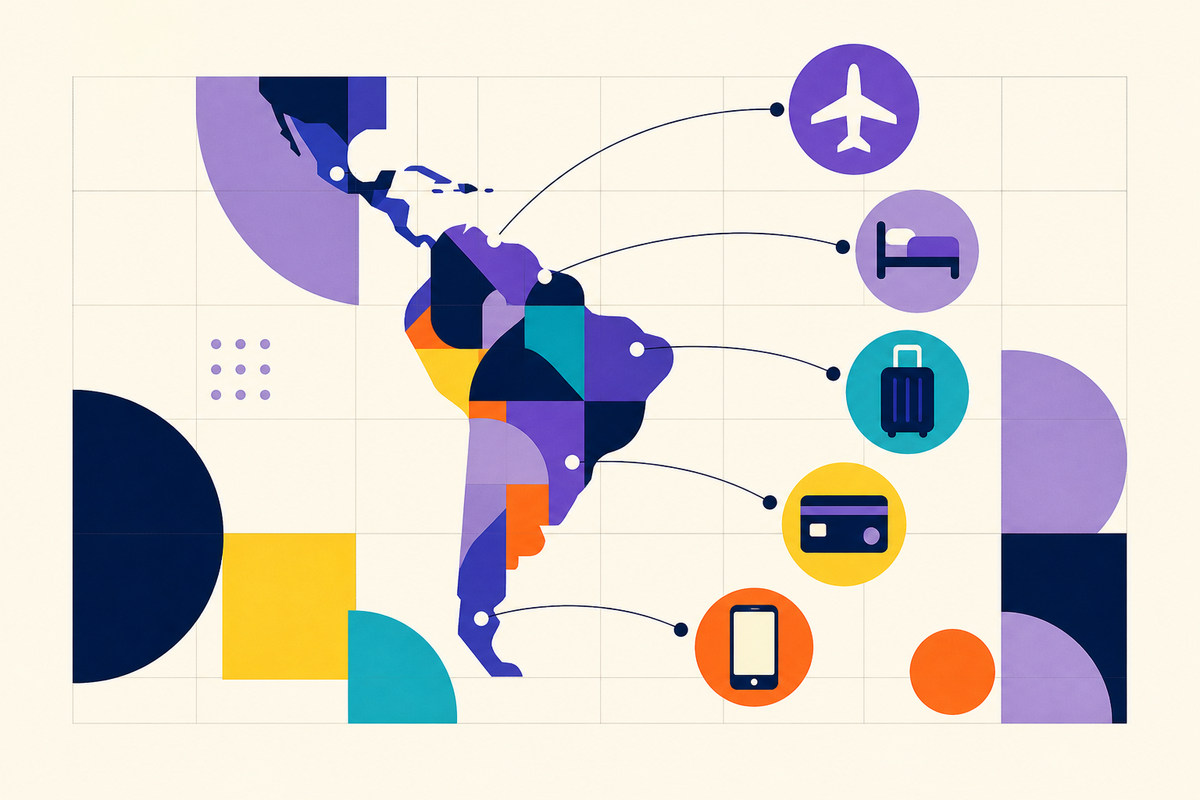
One checkout for a trip with too many moving parts
To a traveler, Despegar is a website and app for flights, hotels, vacation rentals, packages, cars, buses, cruises, transfers, activities and assistance products. The Spanish name means “to take off”; in Brazil, the company uses Decolar, its Portuguese equivalent. Behind those storefronts sits a portfolio that includes Best Day and HotelDo in Mexico, Viajes Falabella, Viajanet, vacation-rental software company Stays.net and payments business Koin.
The practical problem is coordination. A family comparing a holiday does not want to negotiate separately with an airline, a hotel, a lender and a transfer desk, then keep four cancellation policies in four inboxes. Despegar gathers supply, makes it searchable, packages components, accepts local payment methods and gives the customer one account in which to manage the result. Its final public annual report said the platform connected travelers with more than 250 airlines and roughly 945,000 vacation-rental units worldwide.
Most customers are leisure travelers, with some independent business travelers. The company reported 4.8 million travel customers in 2024 and describes its broader reach as more than 30 million customers across 19 countries. For travelers, the benefit is not novelty. It is the reduction of tab-opening, payment failure and uncertainty.
The Latin American vacation has too many tabs. Despegar’s business is closing them.The marketplace in one sentence02 / The machine underneath
Flights bring the crowd; the basket makes the business
Despegar earns commissions and supplier incentives, charges service fees on transactions and sells advertising. It also earns from B2B distribution, white-label storefronts, software licensing and Koin’s payment and lending services. The mix matters. Airfares are competitive and easy to compare, which makes flights a powerful door into the marketplace. Hotels, packages and other non-air products create more room for cross-selling and generally better economics.
Competitive air search brings high-intent travelers into the marketplace.
Hotels, packages, cars, activities and insurance expand the order.
Koin, installments and alternative payments rescue purchases that a card limit might stop.
App alerts, Pasaporte rewards and cross-ecosystem benefits create another reason to book.
That explains Koin, which Despegar acquired in stages beginning in 2020. In much of Latin America, the challenge is not merely finding a room at the right price. It is paying for the room with the methods and credit available to the buyer. Koin provides a gateway, fraud prevention and consumer lending. It processed more than 691,000 transactions in 2024 and served more than 280,000 customers. A travel marketplace owning this layer can approve more demand while learning where checkout breaks.
The app tightens the loop. In the fourth quarter of 2024, mobile accounted for 53.6 percent of transactions, a record for the company. A phone is more than a smaller booking window: it carries alerts, itinerary changes, loyalty and support through the trip. That can make an occasional website purchase behave more like an ongoing service.
The booking desk moves into a pocket
Share of transactions made through the app. Bars are indexed to the Q4 2024 value.
Global inventory, local inconvenience
Booking.com and Expedia have global scale. Airbnb defines vacation rentals. Airlines and hotels would prefer customers to book direct. Metasearch tools make prices legible, and local agencies understand particular markets. Despegar’s distinction is the combination: a recognized regional brand, Spanish and Portuguese experiences, local payments and financing, direct Latin American supply, physical sales points in some markets, and a multi-brand portfolio assembled over years.
Its Expedia relationship shows how this position works. Expedia invested $270 million in 2015 and supplied lodging outside Latin America. In 2024, the companies reset the arrangement through a 10-year agreement: Expedia gained a defined share of global hotel bookings while Despegar gained flexibility to source more accommodation, serve B2B and white-label customers, license software and pursue acquisitions. A competitor can also be infrastructure when the boundaries are drawn carefully.
HBX Group added more lodging and package inventory in 2025. World2Meet took over Despegar’s destination-management operation in 2024 and remained a service partner. In 2026, Civitatis agreed to bring its tours, excursions and guided visits onto Despegar. Each deal pushes the marketplace closer to the entire trip without requiring Despegar to own every bus, bed or museum ticket.
04 / Sofia and the second customerThe AI assistant is also a wholesale product
Sofia, launched in 2024, changes the opening move from filling boxes to having a conversation. A traveler can describe a kind of holiday, timing or preference and receive suggestions that connect inspiration with bookable inventory. The useful test is not whether the assistant can write an attractive paragraph about Cartagena. It is whether it can narrow a choice, respect a budget and move a traveler toward a manageable itinerary.
Despegar then found Sofia a second customer. Karisma Hotels & Resorts licensed the technology to enhance its own chatbot, Despegar’s first major software-as-a-service partnership. That move reveals expertise beyond retail travel: search, personalization, pricing, language models and conversion can be sold to suppliers and partners. Banks, airlines and retailers already use Despegar’s B2B and white-label capabilities. In 2024 those channels together reached 18 percent of gross bookings, giving the company distribution even when its own name is not above the checkout.
Consumer distribution trained the product. Partner distribution gives the same machinery a second life.Why Sofia matters beyond the chatbot05 / After the public market
Prosus buys the missing piece of a regional loop
Despegar listed in New York in 2017 and spent the next years acquiring Viajes Falabella, Best Day, Koin, Viajanet and Stays. It also endured the pandemic, an existential shock for a business built around movement. By 2024, revenue had reached $774.1 million, adjusted EBITDA $175.2 million and gross bookings $5.5 billion. Prosus agreed to pay $19.50 a share in cash, about $1.7 billion in enterprise value, and completed the acquisition in May 2025.
For Prosus, travel fills a conspicuous gap beside iFood, events platform Sympla and OLX Brazil. The early integration is mundane in the best way: referrals, points and cashback. Prosus reported that by March 2026, 15.4 percent of Despegar’s Brazilian B2C net revenue came from iFood customers earning or redeeming points through the shared Clube program. Roughly 2.4 million people had enrolled in cross-cashback initiatives.
Prosus’s FY2026 reporting put Despegar gross bookings at $5.9 billion, revenue at $804 million and adjusted EBITDA margin at 16 percent. It also said orders rose 44 percent. The strategy remains recognizable: use competitively priced air to win customers, convert more of them into non-air products, expand advertising and B2B, and apply agentic AI to growth and operations.
Five friends launch a regional online travel agency from Buenos Aires.
Despegar raises $332 million in its New York Stock Exchange debut.
Best Day, Koin, Viajanet and Stays broaden the portfolio across Mexico, Brazil, payments and rentals.
Sofia launches; Expedia signs a new 10-year lodging agreement.
Prosus closes the acquisition, Gonzalo Estebarena becomes CEO and ecosystem links begin to show up in Brazil.
A travel company becoming regional infrastructure
Despegar sits between global online agencies and local travel sellers. It is large enough to aggregate international supply, but local enough to turn regional friction into features. It serves consumers directly, supplies other businesses behind the scenes and sells specialized technology to hospitality partners. That makes “online travel agency” correct but incomplete.
The risk is equally plain. Travel is cyclical, currencies move, customer support gets difficult precisely when disruptions are widespread, and suppliers constantly try to reclaim direct relationships. AI may improve discovery while also giving new intermediaries a chance to stand between Despegar and the traveler. Prosus brings distribution and investment capacity, but ecosystem logic only works if customers find the handoffs useful.
The company’s history offers a practical lesson. It borrowed a behavior proven elsewhere, then spent 26 years localizing the inconvenient parts: supply, payment, language, trust and service. Its next chapter asks whether those accumulated parts can act as one system. The answer will not arrive in a slogan. It will show up when a traveler earns dinner points, finances a package, asks Sofia for an idea and books the whole thing without noticing how many businesses just cooperated.