The most revealing thing about Expedia Group is how often the company disappears. A traveler sees an airline's vacation portal, a bank's rewards site or a travel adviser's booking screen. The logo at the top belongs to somebody else. Underneath, Expedia may be supplying the rooms, rates, photos, payments and customer support. The company that helped put travel agencies inside a web browser is now putting its own travel agency inside other companies.
That is a different business from the one most travelers think they know. Expedia, Hotels.com and Vrbo remain the public face: three distinct ways to book a broad trip, a hotel stay or a whole vacation home. They gather demand from millions of people, then match it with hotels, property managers, airlines, rental-car companies, cruise lines and activity operators. But Expedia Group is also packaging the hard parts of that marketplace into products for businesses. Rapid API lets a company build travel into its own app. The White Label Travel Platform supplies a ready-made storefront. Expedia TAAP gives advisers a booking desk. Its advertising unit sells access to travelers with their bags half packed.
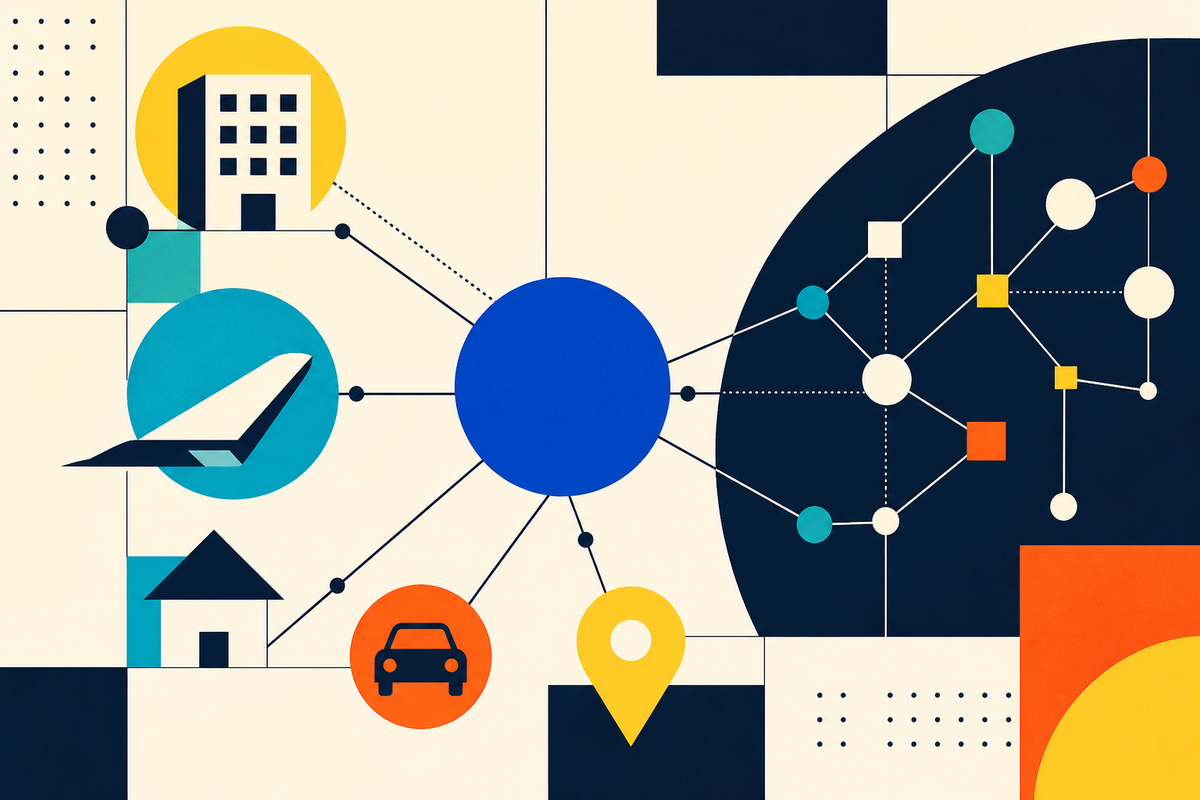
A search box sitting on a supply chain
Travel is a peculiar ecommerce category. The inventory expires every night, prices move constantly and the product is delivered by somebody other than the seller. A room can be perfect on Tuesday and worthless on Wednesday morning. A flight cancellation can scramble a hotel, a car and an activity in three countries. Taxes, currencies, loyalty rules and refund policies vary by market. Even a simple hotel card must reconcile descriptions, photographs, amenities, reviews, location data and rates drawn from many systems.
Expedia's job is to compress that disorder into a confident click. For travelers, the service solves comparison and coordination: find the options, combine parts of a trip, pay, earn rewards and get help if plans move. For suppliers, it provides distribution, demand and marketing. For B2B customers, it removes the cost of negotiating with every hotel chain, assembling content, building payments and staffing traveler service. A retailer can add vacations without becoming a travel operator. An airline can sell hotels beside seats. An adviser can search a global catalog and earn commission from one workspace.
The scale makes the abstraction real. In 2025, Expedia Group recorded $119.590 billion in gross bookings, 415.4 million booked room nights and $14.733 billion in revenue. Gross bookings are not revenue; most of that money ultimately belongs to travel suppliers. Expedia earns its portion through two main transaction models. In a merchant booking, it generally collects the traveler payment and keeps a margin after paying the supplier. In an agency booking, the supplier collects and Expedia receives a commission. Advertising, B2B distribution and trivago's referral business add other streams.
Two customers, then a third
Every marketplace must keep both sides from leaving. Travelers want choice, clear prices and reliable service. Suppliers want profitable demand, control over inventory and a direct relationship when possible. Expedia adds a third constituency: companies that want travel inside their own customer experience. That third side is strategically useful because it reaches people beyond Expedia's consumer marketing and turns fixed technology investments into a service sold at wider scale.
Supply enters
- Hotels and homes
- Airlines and cars
- Activities and cruises
- Rates, content and service
Demand arrives
- Consumer brands
- Travel agencies
- Banks and loyalty apps
- Airlines and retailers
This is where Expedia differs from narrower competitors. Booking Holdings has enormous accommodation reach and its own broad portfolio. Airbnb built a culturally distinct marketplace around homes and hosts. Google owns a high-value gateway to travel research. Hotels and airlines encourage direct booking, where they control the relationship and avoid commissions. Expedia's answer is not a single miraculous feature. It is breadth: multiple trip types, established consumer brands, a loyalty layer, advertising, first-party shopping data, service operations and technology that can sit behind someone else's brand.
The company has spent years simplifying itself to make that breadth work. Rather than lavish equal attention on every acquired storefront, it has centered the consumer strategy on Expedia, Hotels.com and Vrbo. One Key, launched in the United States in 2023, connected rewards across those flagship brands. A shared technology platform reduced the need for each brand to maintain its own plumbing. The point was not to make a vacation home feel like a hotel room. It was to let distinct storefronts reuse identity, payments, data and service while preserving a reason for each to exist.
The business hiding in plain sight
The B2B operation is easiest to understand as a set of doors into the same marketplace. TAAP is the door for travel agencies. White label is the door for brands that want a finished shop. Rapid API is the door for developers that want control. Co-branded offers and loyalty partnerships are the door for companies with an audience but no appetite for travel operations. The Travel Creator Program gives publishers and creators trackable links and commissions. Expedia Group Advertising sells placements and audience intelligence to hotels, destinations and other marketers.
Partner materials describe inventory across millions of places to stay, hundreds of airlines and car-rental companies, and a large catalog of activities. Rapid exposes shopping, booking, payment and post-booking functions in modular form. This matters because the developer is not merely asking for a list of hotels. The integration must stay fast while rates change, prevent stale availability, handle localization and preserve a traveler through cancellation or modification. Reliability is part of the product.
The growth rate shows why the quiet business has become loud. Expedia reported that B2B gross bookings rose 24 percent year over year in the fourth quarter of 2025, compared with 5 percent for B2C. That does not mean B2B is larger than the consumer operation, but it does show where incremental momentum sits. In 2026, the company said Rapid would expand further across cars, activities, flights and trip protection. Its acquisition of Tiqets added experiences supply, while the announced CarTrawler deal aimed to deepen transportation and insurance capabilities.
AI meets the missed connection
Expedia has lived through three interfaces. It began inside Microsoft in 1996, when putting travel inventory on a desktop screen was the breakthrough. Mobile moved planning and servicing into a pocket. Now conversational systems can turn a vague prompt into an itinerary before a conventional search page loads. The risk is obvious: if travelers begin with an AI assistant, the old search box loses some power. The opportunity is equally obvious: the assistant still needs current rates, bookable supply, payment and support.
The company is placing bets on both sides. Expedia Trip Matching, launched in the United States in 2025, lets a user send a public travel Reel to Expedia on Instagram and receive destination ideas and a customizable plan. Hotels.com has tested an AI agent spanning discovery, shopping and service. Expedia has worked with OpenAI and Microsoft to connect conversational planning with transactions. For partners, it has previewed AI toolkits, agent-like helpers in Partner Central and ways to bring marketplace functions into third-party assistants.
Its argument is that inspiration is cheap but fulfillment is not. A model can write a persuasive weekend in Lisbon from general knowledge. It cannot safely promise tonight's room without live inventory, nor negotiate a refund when weather closes the airport. Expedia's defensible expertise sits in the unromantic middle: supplier connectivity, fraud detection, ranking, pricing, payments and service. Its Responsible AI Council, established in 2023, reviews higher-risk uses across technology, legal, privacy and data science. That governance will matter because travel recommendations involve money, movement and occasionally a stranded person.
Where the itinerary can break
Scale does not remove vulnerability. Expedia still pays to attract consumers in an auction shaped by search engines and social platforms. Suppliers continually try to move repeat customers to direct channels. Booking Holdings can match it across much of online travel; Airbnb remains a formidable destination for homes; regional agencies understand local habits; new AI interfaces may reorder discovery before Expedia can establish itself as the booking layer. A platform that serves other brands must also avoid competing so aggressively that those partners question the relationship.
There is a product challenge, too. A connected trip sounds elegant in a presentation and messy in a storm. Linking a flight, room, ride and activity creates more opportunities to help, but also more dependencies. The company has to make the package feel coherent when one supplier changes its part. It must personalize without becoming creepy, advertise without muddying results, and use AI without replacing a clear answer with synthetic confidence.
Expedia Group's place in the market is therefore broader than “online travel agency” and more grounded than “AI travel company.” It is a global marketplace and distribution network with consumer demand on one end and industry infrastructure on the other. The consumer brands provide reach, data and trust. The B2B products distribute supply through more doors. Advertising monetizes attention around the transaction. Loyalty gives travelers a reason to return across different trip types.
The clever part is also the least visible. Expedia does not need every traveler to begin at Expedia.com if it can participate when the trip begins in a bank app, an airline site, an adviser's office, an Instagram message or an AI conversation. Thirty years after it moved the travel agency onto the internet, it is trying to make its marketplace part of the internet's travel layer. The next Expedia booking may look nothing like Expedia. That is the point.