The flights stopped. The phones did not. In 2020, Sastaticket.pk found itself handling the unhappy reverse of the business it had built: people who had bought journeys now wanted their money back. A booking platform designed to move travelers forward had to learn how to unwind their plans.
“Our sales went down to zero,” chief executive Shazil Mehkri told Business Recorder that October. Thousands of calls arrived about changes and refunds. Most employees could work remotely, but the support team lacked the infrastructure to do so. Staff were spread across office floors instead. Mehkri said the company introduced systems to process thousands of refunds, reporting a 48-hour processing time.
That episode gets closer to Sastaticket’s business than a screen full of discounted fares. Travel shopping promises control: choose the airline, compare the departure, press the button. Travel itself is considerably less obedient. A useful intermediary has to work on both sides of that divide.
“Our sales went down to zero.”
Shazil Mehkri · October 2020
The travel counter moves into the phone
Brothers Shazil and Bilal Mehkri founded Sastaticket in 2016. Their proposition was straightforward: let Pakistani customers book flights and hotels online. The brothers were selling access to a familiar activity through a different interface. A traveler could inspect the options rather than wait for somebody else to report back with a fare.
Today the website promotes flights, bus tickets, holiday packages, visa services and Umrah packages; its company description also includes hotels. The customer can be arranging a business trip, a family visit or religious travel. Those occasions have different budgets and anxieties, but share the same first question: how do I get this booked?
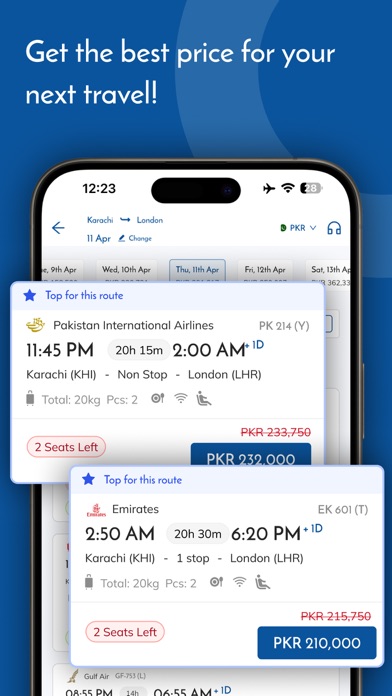
The app listing advertises access to more than 100 airlines. Its flight display makes the trade-offs visible: carrier, departure time, duration, stops and baggage. A cheaper itinerary may involve a longer journey. Putting those details beside the price gives the buyer something more useful than a large discount badge.
Bus booking broadens that proposition. The company’s bus listing names operators including Daewoo Express, Faisal Movers and Niazi Express. For someone traveling between Pakistani cities, checking a bus seat belongs to the same practical task as checking a flight. It gives the app another reason to be opened when an airline ticket is unnecessary or beyond the budget.
Against a traditional agency, the attraction is direct browsing with support available afterward. Against an airline’s own website, it is the chance to compare suppliers in one place. Other booking platforms, including Bookme, compete for that convenience too. Sastaticket occupies the transaction layer between the traveler and the operator: it arranges the purchase, while another company runs the journey.
A commission business meets an empty sky
The money follows the booking. In a 2021 interview, then-chief technology officer Mashhood Rastgar described commissions as the basic revenue model. Greater sales volumes could bring better supplier commissions, he explained. Bundling services offered another possibility for improving margins. That makes distribution and repeat use economically important, not simply attractive numbers for a presentation.
Before the pandemic, investors had backed the opportunity. Sastaticket announced a $1.5 million Series A led by Gobi Partners in November 2018. Reporting at the time put annual growth in gross merchandise value at 125 percent and order growth at 155 percent. The announced plans included product development, expanded services and entering another regional country.
Series A led by Gobi Partners
Investment capital funds the company. Booking value measures travel sold. Neither figure is the company’s revenue.
Those distinctions matter in travel. The price of an airline ticket largely belongs to the journey’s supplier. A platform can handle substantial spending while retaining only a portion. The investor’s wager therefore rests partly on how efficiently the intermediary can attract a booking, service it and persuade the customer to return.
When travel shut down, management cut cloud spending and advertising while continuing technology work, Rastgar later said. The team considered both a short interruption and a closure lasting beyond a year. Its objective was to stretch the available runway without losing staff. The immediate pressure came from cancellations and uncertainty about airline refunds.
There is a practical lesson here for other transaction businesses: budget for the work that arrives when sales disappear. A cancellation can demand attention even though it produces no fresh booking. Reducing promotional spending makes sense when the underlying service cannot be used; maintaining the ability to help existing customers remains an operational obligation.
The checkout has a Pakistani address
Sastaticket’s local positioning becomes clearer around payment. HBL published campaigns offering discounts on bookings through its own and Konnect’s applications. Separate PayPak campaign terms connect eligible card purchases at Sastaticket to the PayFast payment gateway. The booking service reaches customers through financial tools they may already know.
The point is bigger than a voucher. Comparison gets a traveler to the checkout; an accessible payment route helps complete the purchase. For a marketplace, a useful partnership can remove a step in the customer’s journey. It can also put the service in front of people who did not begin by visiting the travel website.
The company lists Easypaisa, JazzCash, Wego and Skyscanner among its corporate partners. That combination is revealing: payment brands sit alongside travel search businesses. Comparison services can be both alternatives for the customer’s first search and channels through which a booking agency gets discovered.
Its published partner program takes another approach. For qualifying monthly travel spending of PKR 1 million, it advertises PKR 20,000 cashback. The purchases must actually be used before the reward can be claimed. That is two percent by simple arithmetic, with eligibility and program terms attached.
Published offer: PKR 20,000 per qualifying PKR 1 million. The reward follows utilization.
That sequence is worth copying thoughtfully. Reward the completed behavior the business needs. A reservation and a consumed service are different events, particularly in an industry where plans change. The approach depends on being able to track utilization and afford the reward from the economics of those bookings.
Five weeks, six channels, fewer loose ends
Behind the storefront, customer communication required its own repair work. A WebEngage case study describes dissatisfaction with earlier marketing automation tools, including onboarding and support. Customer information was scattered across systems. The team wanted a consolidated view and messages that reflected what a traveler had actually done.
OrangeFox introduced WebEngage. The vendor’s account describes agreed milestones, hands-on onboarding and a launch within five weeks, with six engagement channels configured. This is a vendor account of implementation, not an independent test of marketing effectiveness. Its useful detail is the work sequence: define the use cases, connect the information, then put campaigns live.
The lesson for another company is pleasantly unglamorous. Choose the first customer problem before choosing every possible feature. Assign people to integration and insist on usable milestones. Buying software alone does not settle who owns the data, which message should fire or whether that message is helpful.
Flexibility comes with a deadline
Sasta Refund brings the company’s central tension into the product itself. Sold as an add-on at booking, it allows qualifying cancellations or changes without the airline cancellation fee. The published conditions require purchase for everyone on the booking and allow only one free modification or cancellation.
Timing matters. The product page specifies a 24-hour deadline for international routes and named carriers, including Fly Jinnah and Air Arabia, while describing a much later deadline for other eligible itineraries. The add-on’s price is generally non-refundable, and exclusions apply. The service is not a blanket promise that every disrupted journey becomes costless.
There is also a difference between processing a refund and seeing the money in an account. Sastaticket’s general FAQ says card refunds can take considerably longer to appear because the issuing bank controls that stage, mentioning up to 45 working days. The distinction helps explain why an internal processing target cannot be read as a universal arrival date for cash.
For the buyer, a sensible comparison therefore includes the final payable price, baggage, change conditions and the payment method. A traveler who values a direct relationship with an airline may choose its own site. Someone who needs comparisons and local assistance may prefer an agency. Convenience has to survive the particular trip’s requirements.
More of the trip, more responsibility
The expansion continues around the booking. TPL Insurance’s 2025 annual report records a November partnership to embed Travel Takaful in Sastaticket’s mobile app. Apple’s metadata shows a September 7, 2026 release addressing stability and performance. One development adds a service; the other tends to the machinery customers already use.
Sastaticket’s own timeline reports one million combined app downloads in 2023 and more than 1.5 million cumulative tickets booked in its 2024 milestones. Those are distinct measures, not a conversion funnel. Downloads count installations; tickets count transactions of a different kind. Neither tells the whole story of whether a traveler will return.
The more revealing measure is harder to put on a poster: whether the company makes the next difficult travel decision easier. A cheap fare can start that relationship. Clear conditions, workable payments and someone who can sort out a change give it a chance to last beyond the first departure.