Nobody posts a holiday photograph of a successful ticket reconciliation. No one returns from Thailand praising the clean handoff between a bus manifest and a ferry voucher. Yet the hour between the airport and the island can contain more uncertainty than the flight that crossed an ocean: which terminal, which counter, which currency, which slip of paper, and whether the 10:30 departure exists outside a fading timetable taped to a wall.
12Go lives inside that hour. The Bangkok-based travel marketplace lets a customer compare and book trains, buses, ferries, vans, taxis, transfers and flights on a website or phone. The list sounds ordinary until you consider the suppliers. Many are regional operators with their own schedules, sales habits and technical maturity. Some expose live inventory through an API. Others need a more practical bridge to online distribution. 12Go's work is to make both look coherent enough to buy.
In April 2026, the company put a search experience inside ChatGPT. A traveler can ask for an overnight bus from Bangkok to Chiang Mai or a chain of ferries through southern Thailand, compare live options, then move to 12Go to complete the booking. It is a current interface on top of an old problem. The clever prompt is the visible millimeter; the supplier network underneath is the kilometer of cable in the wall.
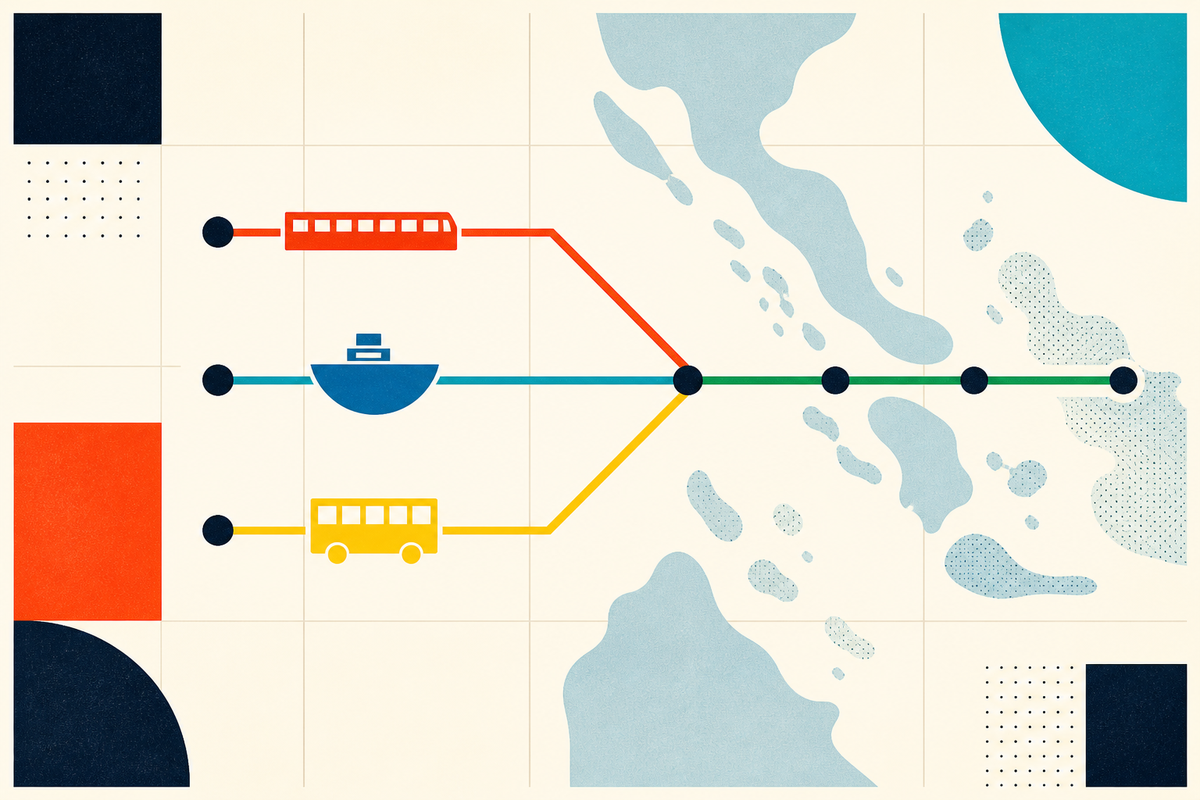
The itinerary is a translation problem
Air travel and hotels were natural early targets for online booking: large suppliers, standardized codes, mature distribution systems. Ground and sea transport is more stubborn. A single region may contain state railways, family bus companies, ferry concessions, minivan cooperatives and private drivers. Their departure points can be landmarks rather than addresses. Their ticket rules vary. A seat may be instant-confirmed, manually confirmed or exchanged for a boarding pass at a counter.
For the traveler, the problem is not a lack of routes. It is a lack of legibility. 12Go turns scattered supply into a familiar sequence: search, compare, pay, receive a ticket or voucher, get support if the plan changes. Reviews and operator details reduce the anxiety of buying from an unfamiliar carrier. Multilingual pages and international payment options make local inventory accessible before the traveler lands.
Those are company-reported figures, but they describe the shape of the advantage. A transport marketplace improves when it can show more useful departures, and more useful departures attract more customers. Customers, in turn, give operators a reason to digitize inventory and keep it accurate. The loop is less glamorous than a loyalty program and more important.
One marketplace, three paying relationships
The obvious customer is the independent traveler planning a route through Southeast Asia. Budget travelers can compare classes and carriers. Families can arrange transfers before arrival. Business travelers can use corporate accounts. The mobile apps keep tickets close at hand, including offline access when the connection disappears precisely as the conductor asks for a voucher.
But 12Go is not only a consumer storefront. Transport companies use its operator tools to publish services, receive bookings and payments, manage inventory and check in passengers. Offline travel agents can resell tickets. Publishers and travel sites can send customers through affiliate links. Larger partners can add inventory through white-label or integration arrangements. AirAsia, for example, partnered with 12Go to add trains, buses, ferries and private transfers around flights in its superapp.
Compares unfamiliar carriers, pays online and receives a usable ticket or voucher.
Reaches international demand while automating inventory, bookings and settlement.
Adds transport to an existing audience and shares commission on completed sales.
Earns commission and service revenue by making the transaction possible.
This mix matters. Consumer acquisition in travel is expensive, and a pure reseller can be pinched between advertising costs and supplier commissions. Operator relationships and B2B distribution give 12Go additional routes to market. They also produce a deeper product: the same inventory can surface on 12Go, through an affiliate, inside a partner app or, now, in a conversational search.
What the green button cannot fix
A marketplace simplifies a fragmented system; it does not abolish fragmentation. The bus can still be late. A ferry can be canceled for weather. An operator can change a pickup point. A route assembled from separately operated services may be self-connected, meaning a delay on the first leg does not guarantee rebooking on the second. 12Go discloses that distinction, and customers should read it. The smoothness of checkout is not the same as a protected connection.
One search can contain several independently operated services. Add time between legs and check whether a missed connection is protected before paying.
That is also where customer support becomes part of the product rather than a cost center hiding beneath it. Travelers buy through an intermediary partly because they want a single place to ask what happened. 12Go offers multilingual support and organizes help around booking, payment, refunds and current-trip problems. The difficult cases are instructive: every cancellation policy and manual confirmation reminds the company that its elegant interface rests on somebody else's vehicle.
Direct booking can be cheaper, and an experienced local traveler may prefer a railway's own site or the station window. 12Go earns its place when comparison, advance access, foreign payment, language and support are worth the fee. Its product is convenience with caveats, not magic.
A regional specialist inside a global rollup
Founder Alexey Abolmasov started 12Go after encountering the same ticket-buying friction as a traveler in Thailand. The company was incorporated in Singapore in 2012 and built its operating center in Bangkok. By 2014, it had raised a reported $300,000 from angel investors and was extending beyond Thailand. It later expanded its geographic reach, products and B2B systems without abandoning its original specialty: the messy ground and water leg.
In 2021, Bookaway Group acquired 12Go for an undisclosed sum. The buyer gathered regional booking companies during the pandemic, when travel demand had collapsed but the case for digitizing transport had not. The group became Travelier in 2023. Its portfolio now spans consumer brands and transport-management systems across Asia, Europe and Latin America, while 12Go keeps its own identity.
The arrangement gives 12Go broader inventory and shared infrastructure, while Travelier gains an established Asian brand and supplier network. It also creates a peculiar competitive map. Bookaway is an alternative a traveler might compare against 12Go, yet it is a sister company. Outside the group, Omio, Rome2Rio, Busbud, redBus, Trainline and direct operator sites compete for parts of the same trip. Few have precisely the same combination of Asian ground-and-sea depth, consumer checkout and operator distribution.
The moat is a thousand small exceptions
12Go's expertise is not route discovery alone. Maps can tell a traveler that a bus runs between two cities. The valuable step is making a seat on that bus reliably purchasable: synchronizing availability, mapping classes, processing payment, issuing the right document and explaining where to stand. Every market adds its own exceptions. Accumulated carefully, those exceptions become operating knowledge a generic search engine cannot instantly reproduce.
The company says its culture combines quick execution with data-informed decisions, continuous feedback and professional growth. Its staff is distributed across countries, with Bangkok as the operational center. LinkedIn listed more than 400 people associated with 12Go in 2026, while company descriptions have used a more conservative 200-plus figure. Either way, the headcount makes sense when the product includes technology, supplier management, content and multilingual service rather than a search page alone.
The ChatGPT app is therefore best understood as another door into the same building. Natural language can make a complicated request easier to express. It cannot invent a timetable, secure a seat or persuade a local operator to honor a digital voucher. 12Go's defensible work happens after the prompt and before the boarding gate.
Where does 12Go fit in travel? Between the polished global systems and the local ticket counter. It is an online agency, a marketplace, a distribution network and a software layer, depending on who is looking. For a traveler, success is almost comically modest: the van arrives, the ferry is real, the ticket scans, and there is nothing memorable to report. Boring, in this corner of the world, is a product people will pay for.
That modest promise also explains the market's remaining room. A route can be popular for decades and still be digitally obscure. Bringing it online does not require inventing demand; it requires giving existing demand a trustworthy way to transact. 12Go is betting that thousands of small improvements - one accurate pickup pin, one synchronized seat and one clearer refund rule at a time - can make regional transport behave like a global product.