The first thing LULUTRIP did was leave something out. A conventional package tour begins at your front door, corrals you onto a plane and keeps hold of you until it deposits you back home. LULUTRIP, founded in Silicon Valley in 2007, began later in the story. Buy whichever flight suits you, it told Chinese-speaking travelers. We will take care of what happens when you arrive.
This sounds like a modest edit. It was actually a rearrangement of who got to make the important decisions. The customer chose the airfare, dates and broad shape of the trip. LULUTRIP supplied the local group tour, private guide, hotel, attraction ticket, cruise, rental car or visa help. Behind those listings sat Chinese-speaking advisers, available around the clock, for the moment when a delayed coach in Cairo becomes less an inconvenience than an exercise in mime.
- What it did: aggregated and quality-checked destination travel products, then sold them online in Chinese.
- Who paid: Chinese-speaking travelers, particularly overseas Chinese visiting North America, Europe, Australia and New Zealand.
- What it cost: prices varied by trip - archived listings ran from US$115 for a Hawaii island tour to US$638 for a 10-day Egypt itinerary; a 2014 funding round was reported at nearly US$10 million.
- What changed: price-led marketplace retailing gave way to tighter control of routes, rooms, transport and in-trip service.
- What to copy: localize the risky handoff, not merely the website.
The itinerary had a hole in it
LULUTRIP's customer could book an international flight. The problem was the collection of smaller decisions that followed: Which local operator was reliable? Would the guide speak Mandarin? Could six European cities be connected without wasting half the holiday in transit? Who answered if a reservation disappeared?
Large online travel agencies were broad and efficient. Traditional agencies were reassuring but rigid. Booking directly from dozens of local suppliers offered choice at the price of homework. LULUTRIP occupied the seam between them. Its old slogan - “Global Travel, Local Service” - was not poetic, but it was exact.
and inventory
and checks
and planning
24/7 support
By late 2014, company publicity counted more than 3,000 tour routes and 2,000 independent-travel products. The range mattered, but the language layer mattered more. Translation is cheap when nothing goes wrong. When a traveler is stranded, it becomes operations.
“Our goal is to let every Chinese traveler pay the cost of a group tour but enjoy a personalized travel experience.”Jon Jiang, co-founder and CEO, 2014
The price war arrived first
In 2013, LULUTRIP pushed into mainland China. It opened storefronts on Qunar, Tmall and JD.com, distributed through travel sites and worked with offline agencies. Sales were reported to be doubling year over year. Lightspeed China Partners invested a reported nearly US$10 million A1 round in November 2014, intended for inventory, engineering, data, brand and customer service.
Money did not make the underlying marketplace easier. Tour products looked similar on a screen, and low price was an obvious weapon. By 2017, the company was frank about the limitation: its earlier model had largely taken products from upstream suppliers and offered them to consumers. That was ecommerce, and ecommerce alone did not solve the messy European journey.
The answer was to move closer to the trip. In March 2017, LULUTRIP merged with Woqu, a former competitor serving mainland Chinese travelers. The combined i++ Travel Group divided the market among four brands: Woqu for mainland customers, LULUTRIP for overseas Chinese, 66Hao for agencies and Globerouter for international travelers. The group announced a US$25 million B+ round and said it covered 56 countries, nearly 400 destinations and more than 6,700 itineraries.
The front doors stayed distinct; the plumbing could be shared. The founders' logic was that integrated supply, technology and ground service could make each storefront more specific to its audience. It is a sensible merger thesis for any vertical marketplace: customers may require different language and merchandising, while the expensive machinery underneath - contracts, capacity, quality control and emergency help - need not be duplicated.

Europe, drawn as a set of loops
HOHO EU showed what “closer to the trip” meant. Europe is geographically compact and operationally fragmented: borders, languages, rail systems, hotel check-ins and unfamiliar roads. LULUTRIP turned it into colored circuits. A traveler could enter a loop, move among cities with transport and lodging arranged, and retain Chinese-speaking guidance without joining one enormous start-to-finish group tour.
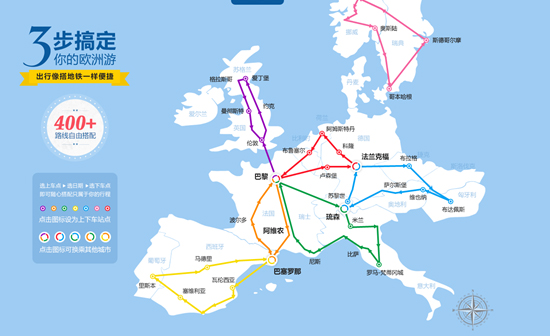
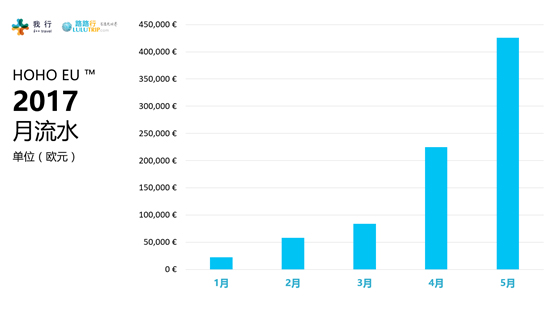
The proposition was “freedom with guardrails.” Transport left weekly. Hotels and transfers were bundled. The traveler could combine routes, while LULUTRIP could negotiate supply and oversee more of the experience. A product chart presented at the time showed monthly sales climbing from roughly EUR20,000 in January to more than EUR400,000 in May. It was a company graphic, not an audited disclosure, but the shape explains why management was enthusiastic.
The copyable bit is not the tour
There are five parts worth stealing. First, find a journey with a dangerous handoff - the point where a capable customer suddenly becomes uncertain. Second, localize beyond words: payment, service hours, cultural expectations and rescue. Third, aggregate fragmented suppliers only if you can inspect and manage them. Fourth, separate the branded storefront from shared operational infrastructure. Fifth, graduate from listings to products when comparison shopping turns everything into a price war.
This worked because the customer group was large, global and linked by a language need; because destination supply was fragmented; and because problems during travel were costly enough to justify human support. It would struggle where suppliers are already standardized, margins cannot pay for service, customers prefer direct booking, or the platform has no leverage over what happens after checkout. A marketplace cannot promise reassurance if it merely forwards an email.
There is an awkward coda. LULUTRIP's public booking domain now resolves to a parked page. Its LinkedIn profile remains visible, and old marketing emails show activity as recently as 2022, but the website no longer functions as the storefront described here. That does not spoil the lesson. Companies often vanish before their best ideas do.
LULUTRIP understood something that the travel industry repeatedly forgets: choice and confidence are different products. A traveler may want the freedom to choose a flight and still want someone to answer the telephone. The interesting business lived in that apparent contradiction - independence, with a human being standing just offstage.