Destination Toronto has one of marketing's stranger assignments. It must sell a product that has no product manager. Toronto is assembled each morning by hotel housekeepers, bartenders, transit operators, curators, chefs, sports schedules, weather systems and several million residents who did not receive the brand brief. A visitor experiences the whole bundle. The organization controls almost none of it.
That makes Destination Toronto less like a conventional travel company and more like a coordination layer. It publishes the inspiration that gets a leisure traveller curious, supplies the facts that make a meeting planner comfortable, connects buyers with local operators, and gives hundreds of tourism businesses a reason to pull in roughly the same direction. It is part media company, part enterprise sales team, part research desk and part civic coalition.
The legal entity is the Toronto Convention and Visitors Association, incorporated in 1926 and later known as Tourism Toronto. Today it is a nonprofit with more than 750 members. Its stated purpose is to ignite the city's visitor economy so communities benefit. That phrasing matters. The organization does not win when somebody likes a skyline video. It wins when attention becomes a room night, a restaurant bill, an attraction ticket, a convention contract or another dollar circulating through the city.
The city is the product. Confidence is the sale.
For consumers, the front door is familiar: neighbourhood guides, restaurant stories, seasonal itineraries, hotel ideas, festivals, accessibility information and social posts designed to turn a vague "Toronto someday" into a specific Saturday. There is no single Toronto customer. A family comparing summer getaways needs a different argument from a queer traveller planning Pride, a culinary obsessive reading the MICHELIN Guide, or a resident searching for a neighbourhood they have somehow never visited.
For business events, the work becomes more like enterprise sales. Destination Toronto helps planners source venues, organize site visits, build attendance, connect to hotels and suppliers, and reach experts in sectors such as life sciences, technology, AI and finance. A convention can take years to win and years more to arrive. In 2025, the organization and its partners secured 70 future major meetings and events expected to bring more than 370,000 attendees and an estimated C$973 million in economic impact. That is a sales pipeline with a skyline attached.
The coordination engine
Travel-trade buyers sit between those worlds. Tour operators and advisors need usable itineraries, local contacts and reasons to put Toronto into a package. Members - hotels, attractions, venues, restaurants and services - want reach, intelligence and commercial opportunity. The public sector wants tax revenue, jobs and a visitor economy that improves rather than merely occupies the city. Destination Toronto's expertise is translating between those agendas without pretending they are identical.
What they actually did
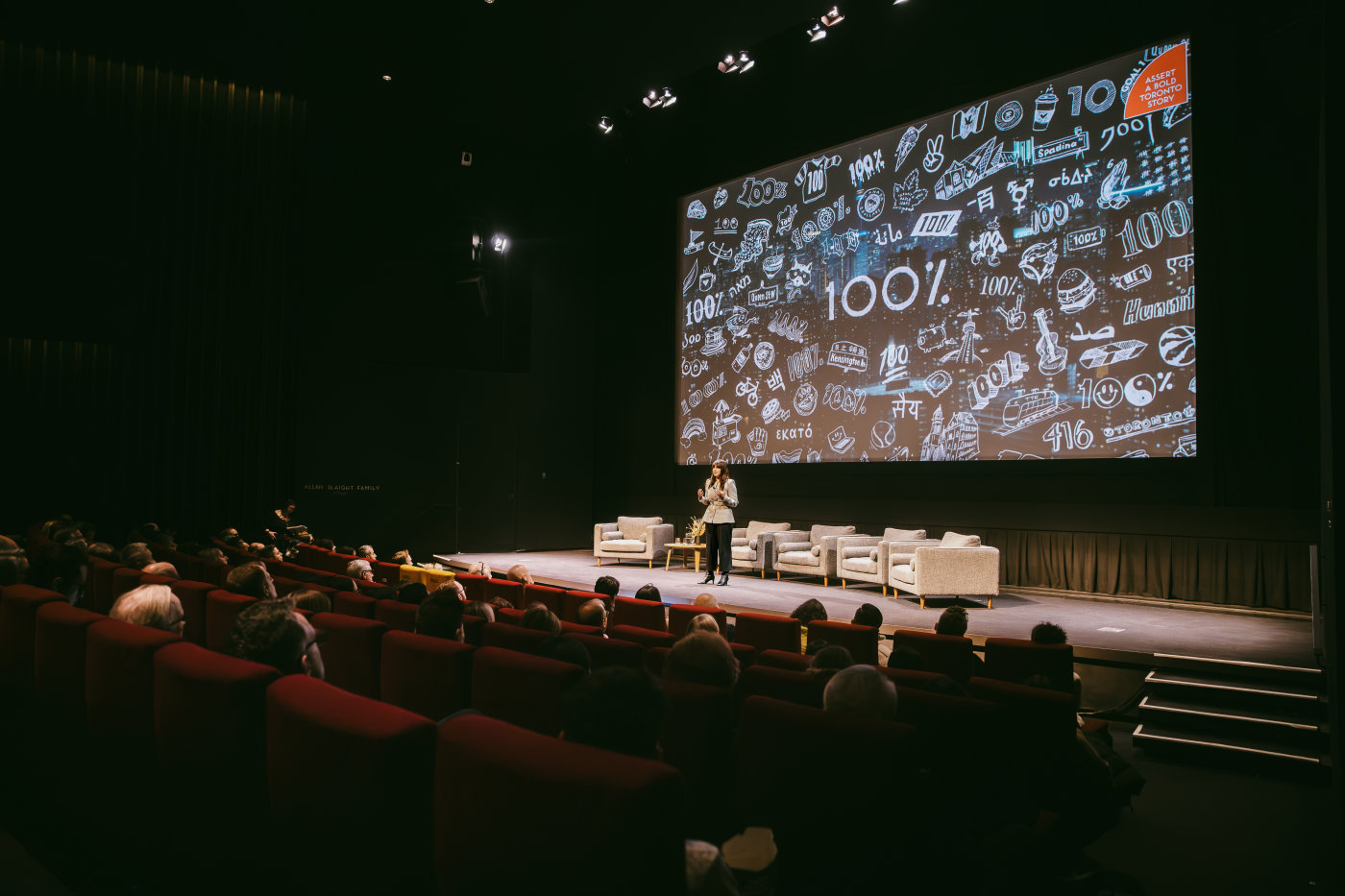
The 2025 Toronto 100% campaign is the cleanest view of the machinery. Its strategic claim was that Toronto's collision of culture, creativity and innovation could be owned rather than reduced to a generic "something for everyone." The largest push targeted New York and New Jersey, San Francisco and San Jose, Chicago, and Washington, D.C. It ran on Meta, Reddit and Pinterest, with an Air Canada partnership adding limited-time offers. Destination Canada expanded the cooperative reach.
Closer to home, the same platform targeted families and couples in Ontario, Quebec and U.S. border states through YouTube, connected television, social, search and Google's demand-generation products. TikTok creators supplied a less institutional voice. The play was not mysterious: use one recognizable idea, adapt the argument to each market, and put an offer near people already considering summer travel.
The campaign also shows what peers can copy. Build a platform broad enough for many neighbourhoods and partners, but narrow enough that the destination can credibly own it. Separate fly markets from drive markets. Match media to decision stage. Give local businesses creative territory they can use. Pair the emotional promise with a practical conversion device. Then measure arrivals, spending and booked business instead of congratulating the impressions report.
What failed first - and what changed
In 2020, the basic destination-marketing transaction failed before the creative did. Borders tightened, events disappeared, hotels emptied and an invitation to fly into a dense city sounded detached from reality. Destination Toronto stopped acting as if the old funnel still worked. It focused on supporting the local industry and speaking to residents and nearby markets, audiences that could move sooner and with less friction.
The 2021 Never Have I Ever, TO recovery campaign asked locals and visitors to confess what they had never experienced in the city. A mobile My Toronto Pass bundled offers without requiring an app-store download. By the holiday extension, the pass had attracted more than 5,000 subscribers and participation from over 40 partners. City Friends With Benefits, created with Ottawa Tourism and Tourisme Montréal, treated three cities as a drivable recovery corridor and marketed a song like a record release across Spotify, TikTok, radio and YouTube.
What changed their mind was not a single epiphany. Conditions changed. Restrictions eased, nearby travel became defensible, and the organization could graduate from hyperlocal support to regional demand and then international growth. Even in 2024, overnight visitation remained below 2019 while international travellers returned more slowly but spent disproportionately. The useful lesson is procedural: when confidence collapses, shorten the trip, lower the commitment, make the offer useful, and let the audience tell you when ambition can expand again.
The public record describes the funding mechanism more clearly than individual campaign budgets. Destination Toronto receives a portion of Municipal Accommodation Tax proceeds through an agreement with the City, plus project funds from provincial and federal governments, membership fees and cooperative revenue. The listed annual fee for an outside-Toronto business membership is C$599. A precise cost for Toronto 100% was not publicly disclosed, so any tidy return-on-ad-spend claim would be theatre.
A business model without a checkout
Destination Toronto is not venture-backed and has no meaningful startup valuation. The public-private structure is more interesting anyway. Accommodation taxes recycle part of visitor activity into future destination demand. Governments can fund specific mandates. Businesses contribute through membership and cooperative programs. An 18-member volunteer board - nine appointed from tourism and hospitality, nine community members elected by the association - oversees strategy and finances.
This is different from an online travel agency, which earns on a booking, and from a publisher, which can optimize for audience alone. Destination Toronto must create demand without favouring one checkout, represent famous icons without starving lesser-known neighbourhoods, and sell growth while showing residents a benefit. Its competition includes other city bureaus such as Montréal, Vancouver, Chicago and New York, but also Google, TikTok, hotel groups and direct venue sales. The advantage is neutrality plus access: one desk can convene the city in a way a single hotel or media feed cannot.

The next product is the destination itself
Advertising can direct attention; it cannot repair a tired venue, improve a public square, add a flight or make every neighbourhood easy to navigate. That limit is now explicit. Destination Toronto's new Destination Master Plan looks to 2036 with 29 strategies across five connected tracks. More than 400 businesses, organizations and community stakeholders contributed through interviews, 19 focus groups and workshops, including discussions focused on Scarborough, North York and Etobicoke.
The plan signals a subtle change in category. Destination marketing asks how to describe the city. Destination development asks whether the city can keep the promise. The latter is slower, more political and dependent on partners, but it is also where differentiation gets built. Competitors can copy an ad format by Tuesday. They cannot quickly copy venue capacity, accessible experiences, connected neighbourhoods, local trust or a decade of aligned investment.
Choose one claim the place can own, then make every partner's version recognizable without making it identical.
Track visitor spend, booked future business, delegate volume and partner participation alongside media metrics.
Create a service layer after the campaign: offers, venue help, itineraries, data and warm introductions.
The visitor experiences infrastructure and hospitality together. A good slogan cannot compensate for a weak arrival.
When the model does not work
The playbook breaks under several conditions. A shared campaign becomes mush if partners cannot agree on a distinctive truth. Cooperative distribution wastes money when the airline, city and local businesses target different travellers. Public funding becomes fragile when outcomes are vague or residents see only congestion and higher prices. Demand generation backfires when capacity, affordability, border rules or service quality cannot absorb the promise.
It also fails for small destinations that copy Toronto's channel mix without Toronto's air access, event inventory or budget. The transferable unit is not Reddit ads or a three-digit campaign line. It is the operating logic: align the ecosystem, identify the highest-friction decision, pair story with service, and report economic outcomes honestly. Toronto can afford a broad media plan because the product is broad. A smaller place may win by doing less for a narrower audience.
The organization's latest numbers are substantial: 28.2 million visitors in 2025, C$9.1 billion in direct spending, nearly C$13.5 billion in wider economic impact, and 378,000 delegates at 74 major meetings. Yet the best description of Destination Toronto is not the sum of those figures. It is the institution that makes a fragmented city easier to choose. For a century, the logo has changed and the channels have multiplied. The stubborn job underneath remains the same: turn a place nobody controls into an invitation many people can act on.