The most revealing moment in Paula Port's recent work began with an ordinary family question. Onstage at Destination Toronto's 2025 Business Outlook Forum, she asked ChatGPT to plan a weekend in the city with her daughter. She supplied a few hints about what her daughter enjoys. Within seconds, the machine produced an itinerary that Port said she would actually love.
The itinerary was useful. The more important discovery sat underneath it. The answer drew on a mix of travel writing, established media and Destination Toronto's own pages. A traveller could now receive a polished recommendation without visiting any one of those sources. The city's story was being assembled elsewhere, one answer at a time.
For Port, who became Destination Toronto's chief marketing officer in 2026, this was not a reason to abandon the old work of storytelling. It made that work more consequential. Every clear event listing, first-person neighbourhood guide, piece of earned coverage and useful answer could help shape what a machine would later say about Toronto. Marketing had acquired a new audience: the system standing between the visitor and the city.
A career inside one complicated brief
Port arrived at this question through a career unusually rooted in one place. She studied hospitality and tourism management at what was then Ryerson University, now Toronto Metropolitan University, from 1996 to 1999. She later joined the organization known today as Destination Toronto and built more than two decades of experience there. She now sits on the advisory council of the same hospitality and tourism school she attended.
Before the C-suite titles came the editorial machinery. As Director, Brand & Content, Port established content marketing as a core function. She helped launch a reimagined DestinationToronto.com that made space for more contributors and more kinds of city stories. During the pandemic, she developed a regionally focused strategy intended to give local tourism and hospitality businesses practical support when distant visitors were scarce.
One project from that period was PatioscapesTO. Launched as restaurants welcomed customers back to patios in 2021, it paired an immediate local need with a reason to rediscover the city. The pattern would recur in Port's work: a campaign functions best when the people who make the destination can see direct value in it.
In July 2022, Destination Toronto named her vice president of global marketing. The appointment gave Port responsibility for the strategic development and delivery of marketing and communications. It also formalized a concern already present in her content work: Toronto's public image should reflect the breadth of the people who live and work there.
Start with the story
The challenge of marketing Toronto is easy to state and hard to solve. A city of neighbourhoods, languages, food traditions, cultural scenes and competing rhythms resists the clean reduction that advertising often demands. Port does not treat that resistance as a flaw. “Toronto is layered,” she has said. “It's complex. It doesn't fit neatly into a single box - and that's exactly what makes it so compelling.”
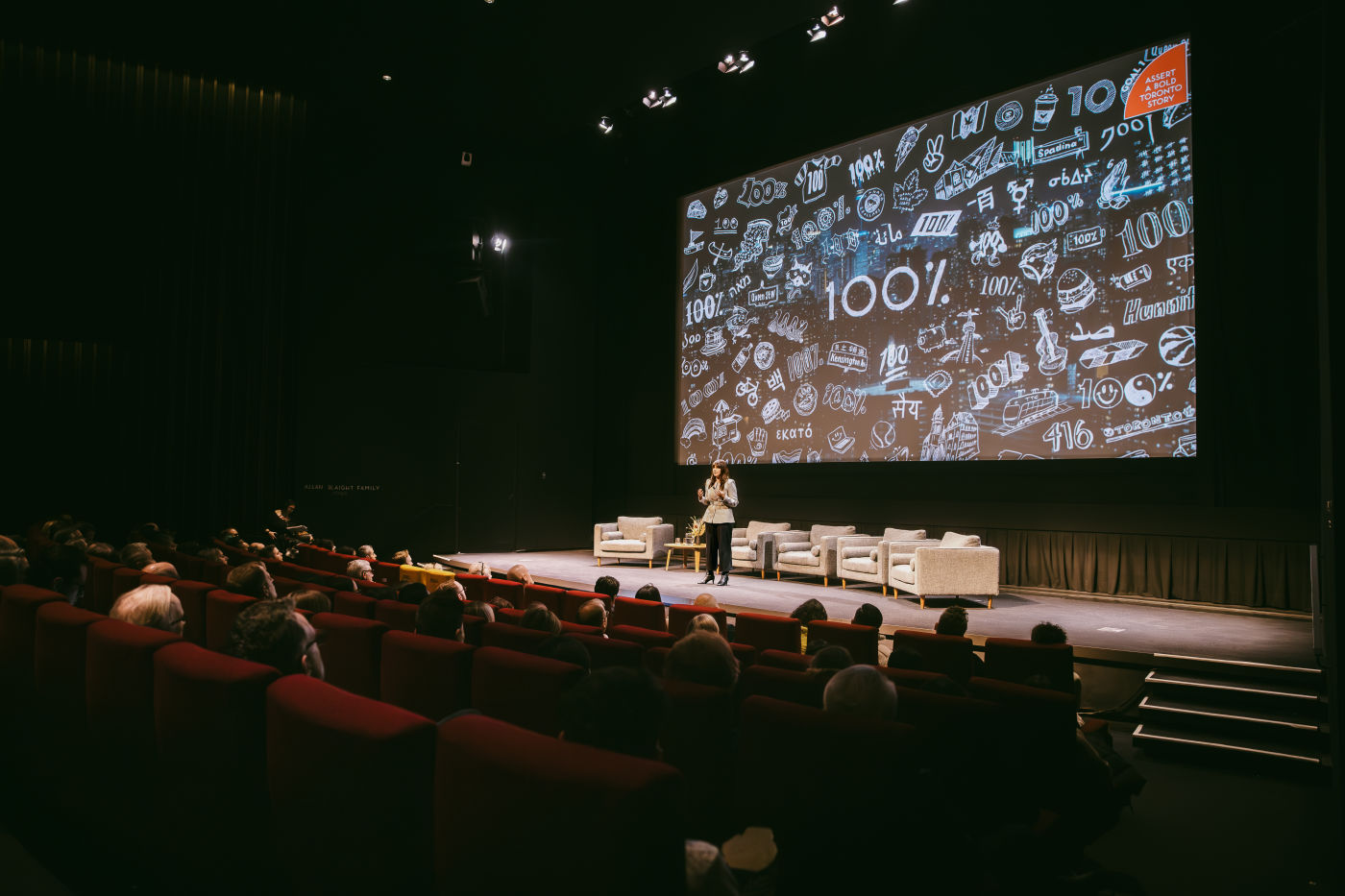
That premise became visible in the 100% platform launched in 2025. The work was designed as an honest expression of how the city shows up: global, distinctly Canadian, culturally mixed and creatively restless. The creative process with agency LifeLongCrush did not begin with a demographic segment or a media platform. It began with what the team wanted people to feel, then allowed the formats and channels to follow.
That order of operations is the portable part of Port's playbook. A channel can deliver attention, but it cannot decide what deserves attention. A demographic profile can identify a likely customer, but it cannot produce a city people recognize as their own. Starting with the story forces the difficult conversation earlier: what is true here, who gets reflected and what should remain intact when the idea becomes an ad?
Port's channel choices have followed audience behaviour. In early 2023, she told Skift that X, then Twitter, had fallen from third to fifth in importance for Destination Toronto over five years. More energy was moving toward Instagram and TikTok, where visual and creator-led storytelling could do different work. A later TikTok campaign let viewers choose between kinds of experiences and extended onto billboards in Times Square. The reported result was a reach of 3.4 million and a click-through rate 296 percent above the campaign benchmark.
The channels keep changing. The job beneath them remains recognizable: fuel curiosity, deepen engagement and help someone take the next step. Port's 2023 Marketing Playbook made that framework available to the tourism community so local organizations could participate rather than wait to be selected for a campaign.
Curiosity as management practice
Port talks about AI with the measured enthusiasm of an operator. Her most useful question is not “How are we going to use AI?” It is “What problem are we trying to solve?” In her practical guide to adoption, she suggested concrete uses such as analysing visitor feedback, researching competitors, generating campaign ideas, personalizing content and improving training. The technology enters after a need has been named.
At Destination Toronto, that thinking helped produce 6ix, an AI assistant designed to answer individual visitor questions. Static destination copy often has to speak to everyone at once. A conversational tool can respond to the person who wants an art gallery reachable by transit, a family activity for a rainy afternoon or a restaurant near tonight's event.
Her argument is cultural as much as technical. Teams need permission to test tools before the practice feels polished. Port has written about the pressure leaders can feel to appear precise and prepared, a pressure that makes unfamiliar technology look risky. Her answer is shared learning. People do not need to become AI specialists. They need enough confidence to experiment, judge the output and adapt their work.
She practices the disclosure she recommends. In a 2025 essay after speaking at the Skift Data + AI Summit, Port wrote that she had used ChatGPT to help shape the article. She also said she enjoys writing. The tool helped structure ideas and reveal connections; voice, direction and judgment remained hers. It is a modest anecdote with a clear boundary around the technology.
The useful mess
At the start of 2026, Port looked back on a year in which her team had launched the 100% platform, leaned into cultural moments such as Top Chef, opened international offices, introduced a co-operative marketing platform for members, strengthened its social foundation for the FIFA World Cup, improved its use of data and put an AI strategy into action.
Her summary did not sand off the friction. The work, she wrote, was not always tidy. There were spirited debates, and that was the part she loved most. She connected those debates to a team she described as curious, collaborative, accountable and committed to the city and its industry. The tone matters. Experimentation without accountability is merely motion. Accountability without room for debate produces cautious sameness.
The year ahead supplied a public test. Toronto was preparing to welcome World Cup visitors, and Destination Toronto's staff were volunteering as city ambassadors. The 6ix assistant was part of the welcome, helping people move from a match toward dim sum, a museum or the islands. In Port's formulation, fans might arrive for football and leave with a story they would keep telling.
Then, in February 2026, Destination Toronto promoted Port to chief marketing officer. Her remit now joins marketing, content, media relations and business intelligence. It is a fitting bundle for this moment. The brand story, the evidence behind it, the coverage that carries it and the machines that interpret it can no longer be managed as separate worlds.
The promotion followed another kind of professional loop closing. In 2025, Port earned the Certified Destination Management Executive credential from Destinations International. She was already serving on the Toronto Metropolitan University advisory council, contributing back to the program where her own tourism career began. Both roles put her work in conversation with peers and students beyond Destination Toronto. They also reflect the networked nature of destination marketing: a city organization succeeds through hotels, restaurants, attractions, cultural institutions, event planners, public partners and the people who meet a visitor in person.
Port's career offers a practical lesson in how to hold them together. Learn the place over time. Build an editorial system before chasing attention. Invite the community into the work. Let data sharpen the question without allowing it to flatten the answer. And when the interface changes from a search box to a conversation, keep teaching it what the city actually feels like.