There is a peculiar problem at the center of destination marketing: the marketer owns almost nothing it sells. Visit Fort Collins does not own the sunset over Horsetooth Reservoir. It cannot put another table in a crowded restaurant, tune the guitar at a FoCoMX show or make a hotel clerk charming. Its inventory belongs to hundreds of other people. Yet the organization’s job is to take all those independent pieces and make a traveler think, Yes, that is where I should go.
Visit Fort Collins is the official destination organization for this northern Colorado city. In practical terms, it is part magazine, part sales office, part concierge and part civic switchboard. Leisure travelers use its guides, event calendar and itinerary ideas. Meeting planners and sports organizers bring it requests for venues and rooms. Tour operators ask for routes, motorcoach logistics and local introductions. Hotels, breweries, restaurants, galleries and outfitters become the partners on the other side of the exchange.
The organization itself is a tax-exempt 501(c)(6), legally the Fort Collins Convention and Visitors Bureau. Public records date the current entity to 1987, while its destination work traces back to 1985. The 2024 tax filing reported 20 employees and $3.47 million in revenue. That is not a giant machine. It is a small coordinating layer sitting atop a city’s much larger hospitality economy.
“We are a Welcome Center by day and a Community Hub by night.”Visit Fort Collins, at the 2024 opening
The brochure rack gets a night shift
On August 1, 2024, Visit Fort Collins opened a new Welcome Center at 7 Old Town Square. The location matters: it sits in the pedestrian heart of downtown, amid the businesses and public life the organization is paid to promote. But the more interesting choice was temporal. The team did not design a room that stopped being useful when the last tourist had collected a map.
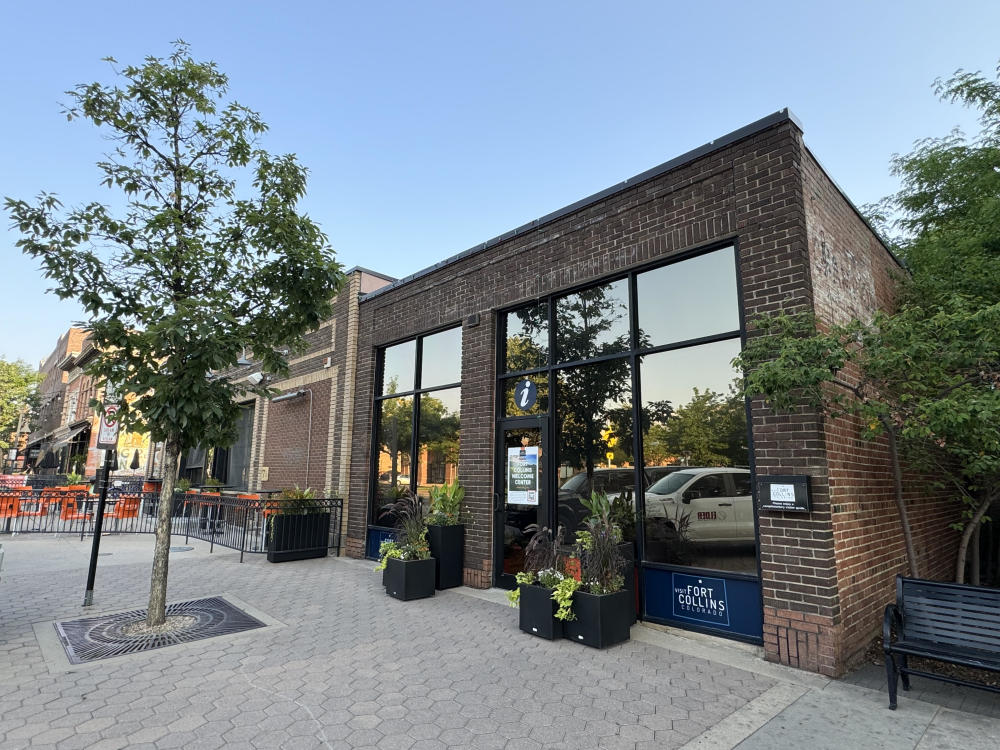
The Welcome Center has the practical dignity of a good pocketknife: information desk in one position, neighborhood venue in another.
After hours, the center hosts live music, university talks, partner mixers and makers markets. Six Ram Talks, created with Colorado State University, drew 417 people. Six performances during the organization’s 40th-anniversary celebration drew 741. A six-hour makers market welcomed 441 visitors, and its eight vendors reported average revenue of about $200 each. None of those numbers will frighten an arena. That is precisely why they are revealing: this is neighborhood-scale infrastructure doing measurable work.
The change solves two problems at once. Visitors receive advice from people who know the city. Residents receive another reason to enter a tourism office they might otherwise walk past for the rest of their lives. The room becomes proof of the product. Fort Collins is marketed as a place of music, ideas, local makers and easy conversation, so the marketing office began staging those things inside its own walls.
How attention turns into room nights
The public sees photographs of bikes, beer and foothills. Behind them is a less photogenic funnel. Sales staff pursue meetings, conventions, sports tournaments and group travel. They take leads, match planners with facilities, coordinate site visits and count definite business. By November 2024, the team reported 106 leads for the year, 46 of them confirmed. Using an industry economic-impact calculator, it estimated $15 million in direct spending and $24 million in overall spending from the business it tracked.
Sales figures reported to the Fort Collins Tourism Improvement District in November 2024. The team described its economic-impact projections as deliberately conservative while it learned the calculator.
That last caveat is unusually important. Destination marketing is full of seductive multipliers. Visit Fort Collins told its board that room nights remained the primary metric and that the broader estimates were being handled cautiously. In a business where a successful campaign may ring registers across an entire city, restraint is not modesty. It is accounting hygiene.
The bill, and the bargain
The City of Fort Collins budgeted $1.4 million in annual support for convention and visitor services in 2024. Visit Fort Collins’ total revenue that year was $3.47 million, most of it reported as program-service revenue. This is not venture capital and there is no private valuation waiting offstage. The business model is public-purpose promotion: lodging-related activity and city support finance the organization, which tries to return value through visitor spending, tax receipts, jobs and a healthier market for local partners.
A $50,000 Colorado Tourism Office matching grant became a $75,000 music-focused marketing budget. The mechanism is simple: use outside money to amplify something the city already produces well.
A later city proclamation cited a 2023-2024 study attributing 5,359 Fort Collins jobs, $7.7 million in sales tax and $360 million in economic impact to tourism. Those are citywide tourism figures, not a claim that one office caused every dollar. Visit Fort Collins occupies the connective tissue: it makes the website, pitches the story, answers the planner, hands off the lead and tries to make the whole market easier to buy.
A plan interrupted at exactly the wrong moment
In 2019 and 2020, the City and Visit Fort Collins worked with JLL’s tourism team on a destination master plan. They interviewed stakeholders, studied infrastructure, considered the nighttime economy and set out to agree on measurements. Then travel stopped. COVID-19 did not merely spoil a campaign; it invalidated the assumptions beneath a fresh long-range plan.
The response was a separate recovery plan with Clarity of Place. That sequence explains much of today’s organization. It still markets outward, but it now speaks more explicitly about stewardship, resident quality of life and local usefulness. Its Care for Colorado guidance pushes visitors toward trail etiquette, fire safety, waste reduction and less crowded places. The Welcome Center’s evening program makes the same argument indoors: a visitor economy earns legitimacy when residents can recognize themselves in it.
In 2025 the team adopted the Entrepreneurial Operating System after months of consideration. It named its purpose “Fort Collins Thrives” and its niche “Visitor Economy Architect.” The latter phrase is corporate, but accurate. An architect does not manufacture the bricks. Visit Fort Collins does not brew the beer or book the band. It arranges the pieces so a trip, a tournament or a convention can stand up.
The parts another city can borrow
- Put visitor services where visitors and residents already cross paths.
- Program the room after office hours so the brand becomes an experience.
- Give partners a referral path, not merely a logo on a sponsor page.
- Track leads, definite business and direct spending before reaching for bigger multipliers.
- Use matching grants on local strengths that already have venues, talent and an audience.
The model is not plug-and-play. It depends on a walkable center, a dense supply of independent attractions, lodging-based funding, credible civic partners and enough local programming to keep the room alive. A place with weak hotel demand, no shared identity or thin partner participation would get a handsome information desk and little else. Fort Collins has Old Town, CSU, a music network, breweries, trails and a habit of collaboration. The organization’s advantage is not inventing those assets. It is getting them to answer the same phone call.
The next room is much bigger
The organization’s latest ambition moves from one storefront to a potential full-service conference hotel on the Colorado State University campus. Visit Fort Collins, CSU and the City asked Hunden Partners to test developer interest after a feasibility study identified an opportunity for a nationally branded property. The logic is competitive: a destination can generate leads only for events its hotel and meeting inventory can actually hold.
This is where the little Welcome Center becomes more than a charming anecdote. Both projects ask the same question at different scales: what physical space is missing from the visitor economy? One answer was a room where a tourist could get directions and a resident could hear a scientist or a songwriter. The other may be a hotel large enough to keep a conference from drifting south toward Denver.
Destination marketers usually sell the view. Visit Fort Collins is increasingly working on the frame.