Payday has an excellent memory. A business can change its software, redesign its logo, or announce a strategy with a handsome new acronym. Its employees will still remember whether the money arrived when it should. John Gibson has built much of his career around the work that makes that ordinary expectation possible.
When Gibson became president and chief executive officer of Paychex on October 14, 2022, he arrived by way of the service organization. He had joined in May 2013 to run service, then become president and chief operating officer in December 2021. The route matters. For more than eight years, his job sat close to the point where a company’s promises meet a customer’s questions.
Today he leads a Rochester business that reported about $6.5 billion in fiscal 2026 revenue and serves approximately 840,000 customers. Yet the most revealing thread in his public career is smaller than those numbers: his insistence that technology and the people who help customers use it belong in the same conversation.
The interview that stayed with him
In September 2022, with the handover approaching, an analyst asked Gibson how he thought about balancing service and technology. Gibson recalled his own interview at Paychex. He and Martin Mucci, the outgoing CEO, had recently been reminiscing about it. What attracted Gibson was the agreement between Mucci’s vision and his own experience of where their industry was going.
“I see it one and the same,” Gibson said of technology and service. It is a compact answer to a question that can otherwise occupy an entire conference. For him, improving the software and improving the help around it were connected tasks.
That recollection supplies a useful origin for his Paychex years. Gibson had come through Ameritech, where he held sales and service leadership roles, and Convergys, where he became president of the HR management division. He also served as CEO of AlphaStaff, an HR outsourcing provider for small and midsize businesses. His experience covered both large organizations and smaller employers buying expertise they did not maintain themselves.
At Convergys, the HR division supplied solutions to clients in 68 countries. That meant his background already extended beyond a single payroll system or domestic customer base. A Bachelor of Arts from Indiana University, followed by executive education at Kellogg and INSEAD, sits alongside those operating roles. The education and the jobs describe a career spent learning how organizations work, sell, and deliver.
“I see it one and the same.”
John Gibson on technology and service · September 2022
A customer rarely calls about the strategy
At Paychex, Gibson helped expand service beyond a familiar telephone conversation during office hours. The organization added round-the-clock options, chat and social media support, and resources for customers using multiple products. These changes are unglamorous in the useful way that a spare key is unglamorous. Their value becomes apparent at the moment someone needs them.
The company credited his service leadership with record client retention and satisfaction. In 2016, its customer service and contact center work won a gold award in the Customer Sales and Service World Awards, with Gibson credited for the Clients for Life mission. Retention is a fitting measure for this chapter of his career: it asks whether customers choose to stay after experiencing the service.
His responsibilities also included integrating Oasis Outsourcing, an acquisition that expanded Paychex’s professional employer organization business. A PEO arrangement brings an employer together with an outside provider for functions such as payroll, benefits administration, and HR support. Integrating that kind of business requires the operating details behind the announcement to work.
By December 2021, Gibson’s remit had broadened to sales, marketing, and product management as president and COO. The promotion brought the people developing and selling the promise closer to the executive who had been responsible for delivering it. Less than a year later, a succession process developed over several years put him in the chief executive’s chair.
Fourth in line, with room to change things
Gibson became only the fourth CEO in Paychex’s first half-century. Mucci remained chairman, and founder Tom Golisano remained a director. It was a transition with continuity built into the seating plan. Gibson also joined the board, which expanded from ten members to eleven.
He took over a company that already combined payroll software with advisory services. His task was to develop that combination further. In his succession announcement, he emphasized customer experience, the expanding role of technology, and using Paychex’s data to offer useful insights to business owners. These were practical ambitions for an executive whose previous job had included the daily workings of the company.
His early appointments reflected that interest in delivery. In May 2023, Paychex brought in Elizabeth Roaldsen as senior vice president of operations and customer experience. Her responsibilities included leading more than 6,000 service employees. Gibson’s explanation connected service experience, HR technology, and data science, the same ingredients he had been discussing before he became CEO.
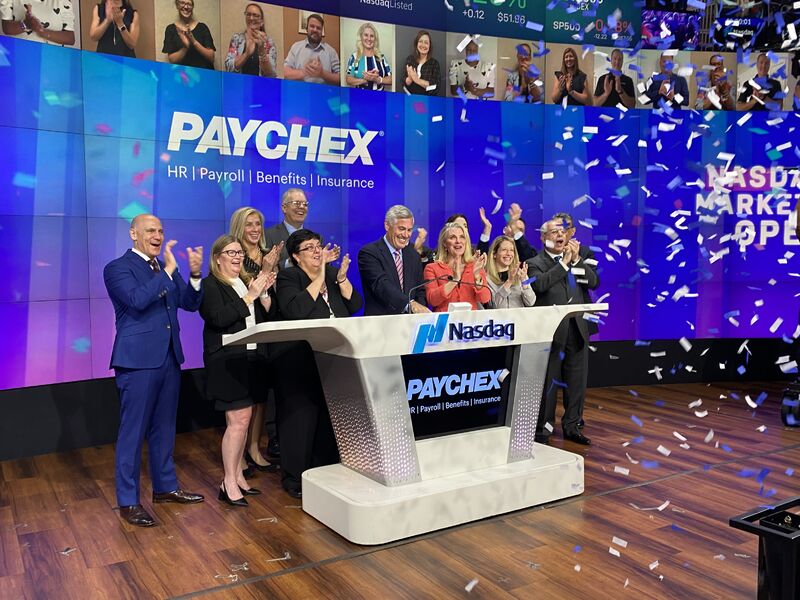
There was a public celebration, too. On August 23, 2023, Gibson rang Nasdaq’s opening bell as Paychex marked forty years as a publicly traded company. The photograph has all the ceremony the occasion deserves: colleagues applauding, the company name behind them, confetti falling. A payroll business is allowed a little paperwork in the air.
The $4.1 billion test
The larger change arrived on April 14, 2025, when Paychex completed its acquisition of Paycor. The all-cash transaction valued Paycor at approximately $4.1 billion on an enterprise basis. It was the largest acquisition in Paychex’s history, and it put a consequential decision at the center of Gibson’s tenure.
Paycor brought HR, payroll, and talent software, along with a stronger position among larger employers. For Gibson, the deal extended the reach of the technology-and-advice approach he had spent years developing. A company buying payroll for a handful of employees and an employer supporting a substantial HR department have different needs. The acquisition gave Paychex more ways to address that range.
The transaction announcement projected more than $80 million in annual cost synergies for fiscal 2026. That was an expectation at the time of the deal. The work of combining sales, products, and service would determine what customers actually experienced. Gibson said the integration would prioritize sales expansion and product innovation.
In February 2026, he described the acquisition as the decision that had most affected Paychex during the previous year and pointed to progress on integration. His public emphasis remained on bringing the businesses together. Buying a software company can be announced in a morning; making its capabilities useful across a larger organization is a longer assignment.
Approximate enterprise value, all cash.
Paychex’s largest acquisition to date.
An eight-person business has a different question
On a March 2026 earnings call, Gibson offered a more concrete explanation of the business he wanted to build. Consider a company with eight people, he suggested. It may have neither an HR director nor a payroll specialist. The owner is deciding how to get the work done without assembling an entire department.
He then moved to employers with 250 or 500 people. They may already have an HR team, but need more support, better tools, or access to outside expertise. His argument was that Paychex could serve both situations, taking on work for one employer and supplementing an existing team for another.
He used restaurant wages in Rochester and San Francisco as an example of the insights a large payroll provider could offer. Local compensation data can help an employer think about recruiting. The point was specific: having data is useful when it helps answer a decision the customer actually faces.
“Would you mind doing it for us or doing it with us?” was how Gibson described the requests coming from some customers. The phrasing is revealing. It moves the conversation from acquiring software to deciding who will carry out the task. It also explains why someone who spent years running service might see opportunity in a technology business that still employs advisers.
AI meets the missing time entry
By 2026, that argument had acquired a new vocabulary. Paychex launched WISE, short for Workforce Intelligence Strengthened by Expertise, in May. The company describes it as an AI engine embedded in its workflows. The name is ambitious; one of the early applications is refreshingly ordinary: spotting a payroll problem before processing day.
In September, Paychex reported that nearly 90 percent of identified time and pay-rate errors were corrected before payroll processing day through its Intelligent Pay Cycle capabilities. The qualification matters. This measures identified errors in the reported workflows, rather than a promise that every possible payroll mistake has disappeared. Missing records and unresolved approvals are the kinds of details involved.
The company also introduced WISE Hire in September, covering recruiting tasks including sourcing and workflow automation. In October, its SixFifty platform announced an agentic HR compliance specialist. On October 19, Paychex introduced a tax penalty protection service that combines AI-supported operations with advocates handling eligible payroll tax issues. Financial protection comes with terms, conditions, and limits.
Together, these launches give Gibson’s strategy something tangible to be judged by. The questions are about completed work: a problem flagged early, a recruiting task handled, a tax notice pursued. The customer who has been promised an easier afternoon is entitled to notice whether the afternoon actually becomes easier.
- 01Spot the gapMissing time or pay data
- 02Flag it earlyBefore processing day
- 03Resolve itCorrect the record
Rochester, and a wider table
Gibson’s responsibilities now reach beyond Paychex. In December 2024, the Federal Reserve Bank of New York appointed him to its Second District Advisory Council. The council generally meets three times a year, bringing senior business leaders together to discuss economic conditions with the bank’s leadership. His place there connects an operating business to a broader discussion of employment and the economy.
On September 1, 2026, he joined ManpowerGroup’s board. The appointment brought his experience in HR services and technology to another business concerned with how organizations find and manage people. His community record includes service with the United Way of Greater Rochester and the Finger Lakes and Hillside Family of Agencies.
These commitments sit alongside regular television appearances discussing the labor market and Paychex’s results. They expand his audience, but the central question of his career remains close to the customer. Can a growing organization make expertise easier to reach? Can its technology remove work that an employer would otherwise have to do?
Gibson’s next chapter will be measured in acquisitions, earnings, and product launches. It will also be measured in less ceremonial moments, when someone needs an answer and gets one. The Nasdaq bell rings once to open the market. The obligations of payday keep coming back.
Keep the conversation going
More from Gibson, on screen and in his own professional updates.
Watch / CNBCGibson on Mad Money, December 2025 ↗Watch / NasdaqThe August 2023 opening bell ↗Follow / LinkedInJohn B. Gibson, Jr. ↗Explore / PaychexExecutive biography ↗Read / The transactionPaychex completes its Paycor acquisition ↗Read / New York FedThe Second District advisory appointment ↗