The revealing line in Katy Bunn’s new job is not the title. Chief marketing officer is tidy, legible and easy to fit beneath a name. The more interesting part is the change she wants the title to make possible. Marketing, in her description, can become a production engine: another team asks for a thing, marketers make the thing, and the finished thing travels back over an invisible fence. Bunn sees a different job. She wants marketing to uncover customer insight that can alter decisions across a company, from the products it builds to the service it provides.
That ambition arrived with a large canvas. Bunn became chief marketing officer of Paychex on July 1, 2026. The Rochester-based payroll and human-capital-management company had acquired Paycor for $4.1 billion in April 2025. Bunn, who had spent a decade at Paycor and then its Paychex business unit, was stepping into a role that asked her to connect a broad portfolio while preserving the human logic underneath it.
Her phrase for that logic is simple: the voice of the customer. She wants it present in everything the company does. The statement sounds like familiar corporate language until you follow its implications. If marketing is responsible for listening, then it needs access to operating conversations. If customer evidence exposes a product gap, a service failure or an unmet need, marketing cannot stop at changing the message. It must help the organization respond.
A consumer marketer walks into HR tech
Bunn’s route to that idea began well outside payroll software. A Cincinnati native and graduate of Lakota East High School, she studied media at Ohio University from 2003 to 2007. She then spent the early stretch of her career inside Cincinnati advertising, marketing and branding agencies, including Northlich and Powerhouse Factories, which was then part of Empower MediaMarketing.
The client list was consumer-facing and wonderfully specific: White Castle, Long John Silver’s and American Greetings. One assignment helped launch Taylor Swift’s greeting-card line. It is a useful detail because it places Bunn at the junction where a public identity becomes an object another person chooses, signs and hands to someone else. A greeting card is a small product, but it is also word of mouth made physical.
Word of mouth was her starting discipline. She later moved back and forth between advocacy work and strategy, deliberately. The advocacy side taught her how ideas travel between people. Strategy taught her to ask whether the underlying brand deserved to travel in the first place. She found that promotion could not overcome a brand that failed to connect. Without resonance, attention did not reliably become changed behavior or perception.
That back-and-forth became the pattern of her career: begin with people, clarify what a brand means to them, then design the conditions in which they might choose to tell someone else. The method traveled easily from hamburgers and cards into human-resources technology because Bunn does not treat “business” as the opposite of “consumer.” A business purchase still contains a person who must trust the decision, use the product and explain its value to colleagues.
“We’re not marketing to businesses,” she has said. “We’re marketing to people.” The distinction matters in HR technology, where a buyer is often choosing systems that will shape paydays, hiring, schedules and performance conversations for everyone else. The software may be sold to an organization. Its consequences arrive one employee and one manager at a time.
The decade that kept changing shape
Bunn joined Paycor in 2016 and began with marketing initiatives connected to the company’s community investments. Her remit expanded through brand strategy and marketing, leader strategy, industry growth and corporate strategy. The job names changed, but the connective task remained: understand the audience, identify what the organization could do for them, and align teams around that promise.
By 2018, as senior director of marketing communications, she was teaching companies to map an employee’s experience from before the first day of work. Her advice emphasized regular manager check-ins, goal-setting and supportive culture. Only after employees were truly engaged, she argued, should a company ask them to become referral sources or social ambassadors. Advocacy was an outcome to earn, not a switch to flip.
Later she became senior vice president of leaders and industry growth, responsible for a company-wide strategy focused on leaders and a cross-functional healthcare program. She helped Paycor along the road to its 2021 Nasdaq listing. In this period, her subject grew from brand communications into the operating environment around frontline managers: the people who translate a company’s intentions into an employee’s ordinary Tuesday.
The company around her kept changing. Paycor evolved from a regional payroll provider into a broader HCM platform, became publicly traded, and then became part of Paychex. Bunn moved from leading growth ideas to helping steer strategy through integration. When she was promoted to CMO, she brought institutional memory from several versions of the business.
One career, four widening circles
Continuity is useful during an acquisition, but nostalgia is not the job. A combined company has to explain a larger set of products without making the customer do the organizational chart in their head. Bunn’s opportunity is to make those connections legible: which problem is being solved, for whom, and how the parts work together. Her consumer background helps here. People do not experience a portfolio as a spreadsheet. They experience whether a company recognizes their problem and reduces the effort required to solve it.
The work beyond the org chart
The public shape of Bunn’s career includes a second, parallel track. She has served on the board of the organization behind Cincinnati’s Flying Pig Marathon since 2017. She has mentored through Adopt A Class and previously at Oyler Elementary. Her volunteer connection to American Heritage Girls reaches back to 1995.
Her most personal community project is the Kelly Beerman Girls Leadership Institute, established through American Heritage Girls in memory of a close friend. The program supports underserved girls in leadership development. It also makes concrete a theme that appears in Bunn’s corporate work: leadership becomes real when another person receives tools, attention and room to act.
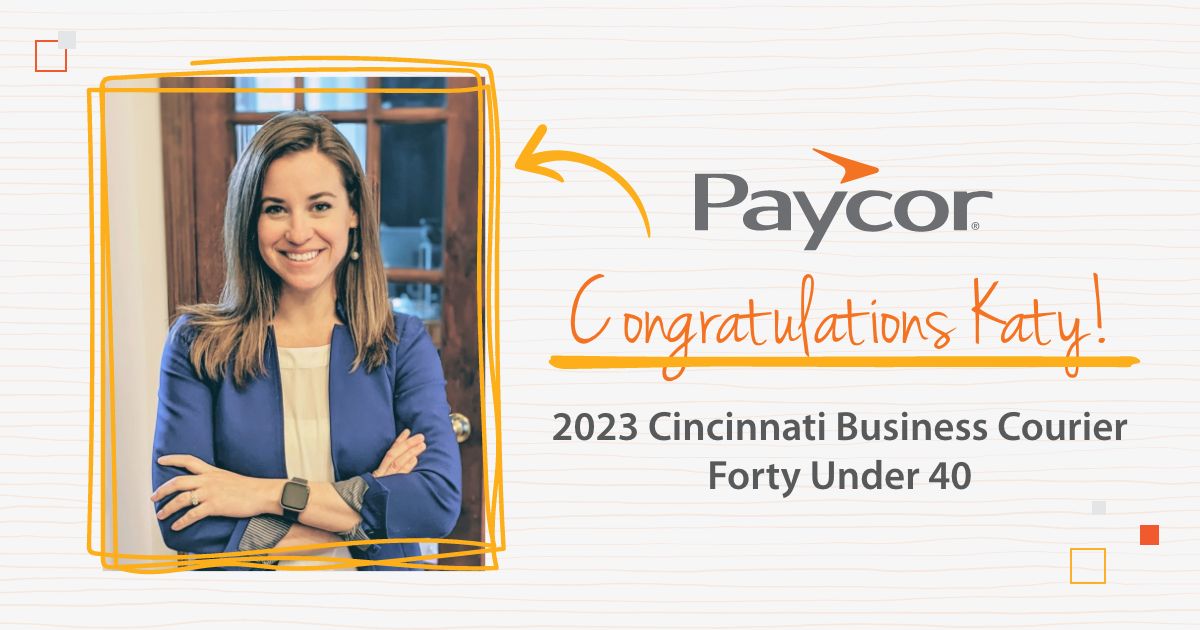
Colleagues have described her as someone who moves from mentee to mentor and shares experience with junior teammates. Paycor’s celebration of her 2023 Forty Under 40 recognition highlighted her coaching of women rising through leadership. In 2024, she completed WE Lead, the Cincinnati Regional Chamber’s 10-month leadership program for women. Even as she mentored others, she kept choosing structured environments in which to examine her own goals and growth.
There is also a local rhythm to the story. Bunn remains based in the Cincinnati area, typically working from home or Paycor’s downtown office. She lives in Loveland with her three children. A profile of her outside work found her kayaking the Little Miami River, a modest vacation feeling close to home. The CMO of a Rochester-based public company is still operating from the region where she went to high school, attended her first agencies and built long community ties.
Human-centered, even when the subject is AI
In a Paycor session on the AI-augmented workforce, Bunn and engineering leader Timothy O’Neill addressed how an HR company could plan for disruptive technology without losing the people inside the plan. Her stated interests were employee motivation, engagement and the power of frontline leaders to build cultures that retain and attract talent.
The framing fits her larger thesis. Technology can produce an answer, but organizations still need to decide what deserves attention. Automation can remove a task while creating new uncertainty somewhere else. Customer insight helps distinguish novelty from usefulness. A human-centered approach asks who gains confidence, who carries the risk and whether a tool improves the moment in which a manager or employee must act.
Brand advocacy, in Bunn’s model, is downstream of experience. It cannot be commissioned like a banner ad. Employees advocate when the culture supports them. Customers advocate when the product and service keep the promise. Marketing’s role is partly to communicate that promise and partly to keep the organization honest about whether it has been kept.
She has a compact definition of brand: what people say about a company when it enters a room. That shifts control away from the company without making the company powerless. Leaders can still shape what gets said. They do it through accumulated encounters - a useful product decision, a clear answer from support, a manager who has the right information, a campaign that sounds like it understands the day.
Bunn’s new role brings her career’s two recurring motions together. One moves inward, from customer observation toward strategy and operations. The other moves outward, from a coherent experience toward word of mouth. The first helps a company become worth talking about. The second reveals whether people noticed.
For Paychex, the immediate work is about connecting a growing portfolio and strengthening a brand after a consequential acquisition. For Bunn, the longer project is more precise: change who gets heard before the brief is written. Put the customer in the room early enough to affect the answer. Then give people an experience they might choose to carry into the next room themselves.