Before breakfast, someone has to get the doughnuts to Detroit. In ADP’s account of Motown CPL, a bakery supplier serving 74 franchise locations, that meant baking each afternoon and delivering overnight. Behind the trucks sat another production line: timecards, payroll entries and a spreadsheet. Administrative manager Dean Koulouras looked at the arrangement and asked, “What on Earth are we doing?”
- ADP combines payroll software with people who handle the administrative work around it.
- Its products stretch from small-business payroll to enterprise HR and outsourced employment administration.
- The useful buying question: which repeated handoffs will actually disappear?
The spreadsheet wasn’t broken. The process demanded too much attention. Motown moved payroll to ADP, then added connected time and attendance months later. Koulouras reported saving 15–20 hours each biweekly cycle. This is a customer account published by the vendor, rather than an independent experiment. Still, the sequence is instructive: remove one chore, discover the next bottleneck, connect the two.
The deadline is the product
Automatic Data Processing occupies an unusually intimate corner of business technology. Its work ends up in somebody’s bank account. Employers buy help calculating wages, withholding taxes, administering benefits and keeping employee records straight. Workers encounter the result as a pay statement, a time-off balance or a mobile screen. Successful execution is wonderfully uninteresting. Nobody gathers around to admire a correct deduction.
Henry Taub and his brother Joe started the business in 1949 as Automatic Payrolls. Harvard Business School’s account of Henry describes an early focus on small employers and Wall Street financial firms. The idea was straightforward: take a recurring administrative problem off the customer’s hands. The machines and interfaces have changed; the deadline still arrives.
Payroll has an unforgiving measure of usefulness: did the right person get the right money at the right time?
That makes payroll different from software a team can quietly abandon. A beautiful dashboard is pleasant. Reliable processing, tax expertise and someone who can resolve an exception determine whether the purchase earns its keep. ADP’s positioning rests on that combination of technology and service. Its customers can buy tools, hand over administrative work, or choose some mixture of both.
One company, several buying decisions
Start with RUN Powered by ADP, the small-business platform. Payroll and tax handling sit at its center, with packages adding hiring and HR support. It makes sense for an owner who wants the administrative routine contained. The buyer is purchasing a repeatable way to get through payroll without becoming a payroll specialist.
Workforce Now connects a broader set of functions: payroll, HR, benefits, time and talent. This is where Motown’s experience becomes useful. A clock records hours; payroll consumes hours. Asking a person to carry the same information between systems creates work every cycle. A shared workflow can remove that particular burden, provided the underlying records and rules are correct.
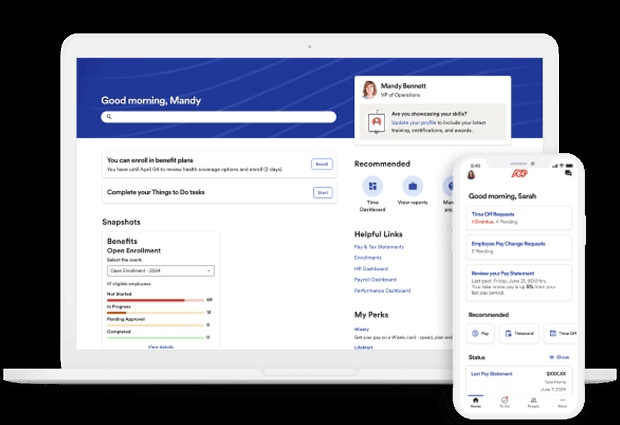
Lyric HCM addresses enterprise organizations with more complicated structures and connected HR, payroll and workforce needs. TotalSource takes a different route: co-employment. ADP assumes specified administrative employer responsibilities while the client keeps control over hiring, pay decisions and daily operations. Buying a PEO relationship deserves a different conversation from buying a software subscription. Responsibility is part of the package.
The arithmetic of staying put
ADP reported roughly $21.9 billion in fiscal 2026 revenue. Its proxy statement put Employer Services client retention at 92.1%. That retention figure belongs to that segment; it is not a universal satisfaction score. Together, the numbers suggest the commercial power of work that repeats and relationships that persist.
Employer Services client retention
The economics extend beyond a software fee. ADP reports Employer Services and PEO Services separately, and PEO revenue includes benefits pass-throughs. It also earns interest on money held for clients before payments are made. Revenue therefore needs some interpretation: the total represents several kinds of activity, rather than one enormous pile of interchangeable subscriptions.
For a customer, the price is more personal. RUN and Workforce Now direct prospective buyers toward a quote. ADP’s pricing guidance says headcount, payroll frequency and required services affect cost. A useful comparison includes implementation, timekeeping, benefits, tax work and support. Then count the internal hours the proposed setup would remove. A cheaper invoice can coexist with a more expensive routine.
The exceptions are where experience pays
ADP competes across several markets at once. A small employer might compare payroll providers such as Paychex or Gusto. A larger HR team might evaluate Paylocity, Dayforce or an enterprise suite. The relevant comparison depends on the work being handed over. ADP’s case is strongest when software, regulatory knowledge and continuing service need to arrive together.
Its acquisitions reveal where it has added expertise. In 2011, ADP bought Asparity Decision Solutions, a Durham company supplying benefits decision tools; the price was undisclosed. In October 2024, it bought WorkForce Software for approximately $1.2 billion in cash, adding workforce-management capabilities for large employers. Both transactions addressed work surrounding the paycheck.
Now comes AI. In January 2026, ADP announced Assist agents designed to flag payroll variances, identify missing tax information and answer employee policy questions. The payroll agents include human oversight. These are useful ambitions to test against an actual workflow: can the system catch the unusual change, explain it and help a practitioner resolve it? Buyers should ask to see their own awkward cases demonstrated.
Borrow the sequence
The portable lesson from the bakery is practical. Map a payroll cycle. Mark every number entered twice and every approval waiting in someone’s inbox. Choose one handoff to fix, measure the time returned, then connect the next. This is an editorial recommendation drawn from the case, not a promise that every employer will repeat its savings.
It depends on sensible conditions. Incorrect time records and poorly configured policies still need correction. An employer with simple requirements may find a smaller service sufficient; a complex organization needs implementation capacity and clearly assigned responsibilities. Ask who handles exceptions before signing. When the trucks leave overnight and payday arrives on schedule, the most valuable improvement may be the work nobody has to do again.