At Sheridan County YMCA in Wyoming, one employee can wear several hats. An instructor may also work another role, and each job still has to arrive correctly on the same paycheck. For the person running payroll, that small fact can create a surprisingly large amount of work.
Nicole Romeo, the YMCA’s senior director of human resources and culture, inherited manual workarounds and disconnected systems. Her first instinct was to modernize, perhaps with Workday. The organization chose Netchex instead. In its published customer account, a payroll run that had taken two hours fell to about 15 minutes. The interesting question is what disappeared in those missing 105 minutes.
- The job: connect payroll, HR, timekeeping, benefits and hiring.
- The customer: U.S. businesses with people on shifts, across roles and across locations.
- The pitch: shared records, mobile tools and support from people who know the account.
- The buying question: what happens to your awkward pay period, and what does the whole year cost?
One worker, several jobs
The YMCA story gives us a clue. Staff holding multiple positions could record time under one login. Reports became easier to interpret. A project manager guided the transition. Romeo also reported some continuing learning around class check-ins. This was a customer’s account of a particular implementation, rather than a promise that every payroll department will recover precisely the same amount of time.
“Payroll used to take at least two hours.”Nicole Romeo · Sheridan County YMCA
Netchex’s time tools address the underlying mechanics: mobile punching with geofencing, hardware clocks, missed-punch alerts and manager approvals. Department transfers accommodate work across roles. Scheduling allows shift swaps and pickups, while the attendance dashboard gives managers a view of who is in. These details matter because a timesheet begins life far from the payroll office.
Consider the ordinary journey of an hour worked. Someone records it; someone approves it; a pay rule gives it a value; an accounting report assigns it a home. Each handoff is an opportunity for a second spreadsheet. Connecting those steps is the substance behind the rather grand phrase “human capital management.”

A paycheck has a long memory
Netchex began with Will Boudreaux and Stuart Ethridge in 2003. Both had worked in the payroll industry. Their account of the opportunity was straightforward: growing local employers wanted capable software and personal service, but too often had to choose between them. Restaurants, hotels, clinics and car dealerships supplied a different set of problems from a corporate finance department.
The company still organizes its pitch around those operational employers. A cloud platform brings together employee records and the tasks surrounding them. Its stated mission focuses on making payroll and HR accurate and easy. There is a certain elegance to selling something people would prefer never to think about.
Money Hill, a Louisiana golf and country-club operation, provides the darker arithmetic. President Mimi Dossett recalls an earlier manual payroll error: an employee received $26,000 instead of $2,600. The extra zero was worth $23,400. Its Netchex customer story describes connecting payroll and timekeeping for 68 employees across golf, hospitality, maintenance and food service, including seasonal workers.
The same account recalls Hurricane Ida, when local power failed but time and payroll records remained online. A cloud record has a practical value that a feature checklist struggles to express. Its usefulness becomes especially apparent when the building containing the filing cabinet is having a very bad week.
- 01HireForms + employee data
- 02TrackHours + approvals
- 03PayRates + deductions
- 04ReviewReports + labor costs
The human on the other end
Payroll software competes on features that can look remarkably alike. Netchex shares a market with ADP, Paychex, Paycom, Paylocity and Paycor. Its competitive argument rests heavily on the combination of an integrated system and accessible support. A dedicated account relationship becomes useful when the question is specific to a business, rather than to the location of a button.
Netchex describes an in-house service team with payroll and industry expertise. Customers can use phone support, live chat, knowledge articles, case submissions and video tutorials. The service page says inquiries reach actual people. This is part of the buying proposition: when the pay cycle approaches, someone should understand the account well enough to help.
Its published workplace values emphasize teamwork, creativity, open feedback and a balance of family, fun and work. Those are company aspirations. The more concrete cultural claim is visible in the service model: relationships have a place alongside the software. The challenge as a provider grows is to preserve that familiarity.
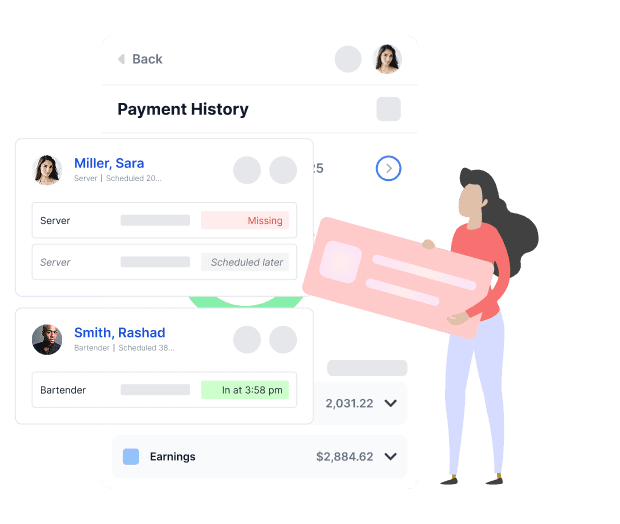
Read the annual bill
Netchex sells subscriptions priced per employee per month. Its FAQ describes a minimum fee and a standard 12-month contract. You request a quote based on your workforce and the services required. That makes the proposal a meaningful part of the product evaluation.
Core includes onboarding, time, payroll, HR, engagement and reporting, with unlimited payroll runs. All-In adds hiring, scheduling, benefits, performance, learning and AI. Flex lets buyers add selected capabilities. The menu extends beyond paying wages: NetEnroll supports benefits choices, while talent tools cover reviews, goals and employee training. Payroll also handles tax filing, multiple pay rates, garnishments and expense reimbursement.
Now for a detail worth keeping your pencil sharp over. For the 2025 year-end cycle, Netchex’s processing-fee page lists a $100 base charge plus $8 per employee W-2, with delivery extras. A separate franchise page says year-end forms are included. Those public statements make the signed proposal essential: confirm which fees apply to your package.
For 100 W-2s under the published 2025 processing schedule, before delivery charges. This is not an annual subscription quote.
Integration deserves the same attention. Netchex lists connections spanning accounting, retirement and industry software, including QuickBooks Online, DealerTrack and Daxko Club Automation. Benefits packages can use Employee Navigator. The useful test is whether your particular records move correctly, at the right moment, with an identifiable owner when they do not.
The next colleague is called Penny
Capital has helped finance the next chapter. Primus announced a growth investment in 2016. GrowthCurve Capital acquired Netchex in June 2023, when the announcement described more than 6,000 customer businesses. The stated priorities included analytics, AI, new business lines and market expansion. The current website reports more than 7,500 organizations.
Abhinav Agrawal subsequently announced taking the CEO role. In 2026, the company’s spring release materials described onboarding workflows by role, department or location, improved payroll review, and employee surveys with recognition. These are improvements to the recurring administrative chores that make a pay cycle longer than it looks on a calendar.
Mesh pushes the idea further. Presented as an early-access rollout, it introduces named AI teammates: Penny for payroll and time, Atlas for people operations, Nova for insights, Sentinel for anomalies, Milo for employee requests and Nettie for service. Its proposed progression runs from answering questions to taking instructed actions, anticipating needs and automating repeat work.
There is an appealing ambition here: show an administrator the exceptions, rather than every clean timecard. The advertised conversations illustrate intended capabilities. A buyer should establish which actions are available in their account, who can approve them, and how a correction is recorded before treating Penny as a colleague with signing authority.
Bring your awkward pay period
The most useful lesson to borrow is a method of shopping. Bring one employee with multiple jobs, a shift differential, a missing punch, a benefits deduction and the accounting export you actually need. Ask the demonstrator to complete the journey. Count the places where information must be retyped or someone must be chased.
Netchex’s positioning favors U.S. operational employers who need coordinated HR administration. Its comparison material acknowledges an implementation period rather than instant self-signup. A business seeking co-employment should evaluate a PEO arrangement separately. The service agreement also leaves responsibility for the client’s use and compliance with the employer.
A small team with straightforward needs may find that a narrower tool is enough. A complicated employer should test its own complications. The persuasive thing about a 15-minute payroll run is its ordinariness: people worked, their hours arrived in the right place, and somebody could get on with the rest of the day.
Take a closer look
Explore the product, watch it at work, or follow the company.