Payday is a peculiar measure of software quality. Get everything right and almost nobody notices. Get an employee’s pay wrong and the system suddenly has an audience. At Latitude Financial Services, the trouble was more prosaic than a spectacular computer failure: paper, repeated data entry and a payroll team with too little time to answer questions.
After separating from a global parent, Latitude was wrestling with disconnected HR and payroll processes serving 2,500 employees, according to its Frontier Software customer story. Information had to be entered more than once. Errors and delays followed. HR staff absorbed payroll queries. Installing Frontier’s hosted payroll alongside the company’s chosen ERP/HCM system reduced manual intervention and gave the payroll team capacity to respond again.
That is the useful starting point for understanding Frontier Software. The company sells the machinery that connects an employee record to a payslip: HR databases, payroll calculations, working hours, approvals and reporting. It also sells the people to operate that machinery. Its appeal becomes clearest in organisations where the tidy box labelled “employee” contains several contracts, locations, pay rules and systems.
A kitchen bench, a report writer, a very long run
Founder Michael Howard’s account of the beginning is agreeably domestic. He laid out early screen designs on a kitchen bench, using grid paper. An accessible ad hoc report writer was a priority. The business began in Melbourne in 1983 with six employees; its initial product was called chris. The ambition was to keep functionality and information together in one database.
That design instinct remains visible in ichris, the platform at the centre of Frontier’s current range. The name expands to International Comprehensive Human Resource Integrated Software. It is an acronym with a considerable workload. The system holds employee information, maintains histories, supports different languages and currencies, and supplies reporting tools. Additional modules extend that record into recruitment, learning, performance, remuneration and workforce management.
“I want to be a 100-year company.”
Michael Howard · founder, speaking in 2023
Howard’s longevity target fits a business whose software has to accommodate changes in employment practice and technology over decades. The current company overview puts statutory payroll coverage at 26 countries. Its 2023 anniversary announcement reported customers in more than 30 countries. Those numbers describe different things: holding international employee records is a broader proposition than calculating a jurisdiction’s payroll.
The employee record does the travelling
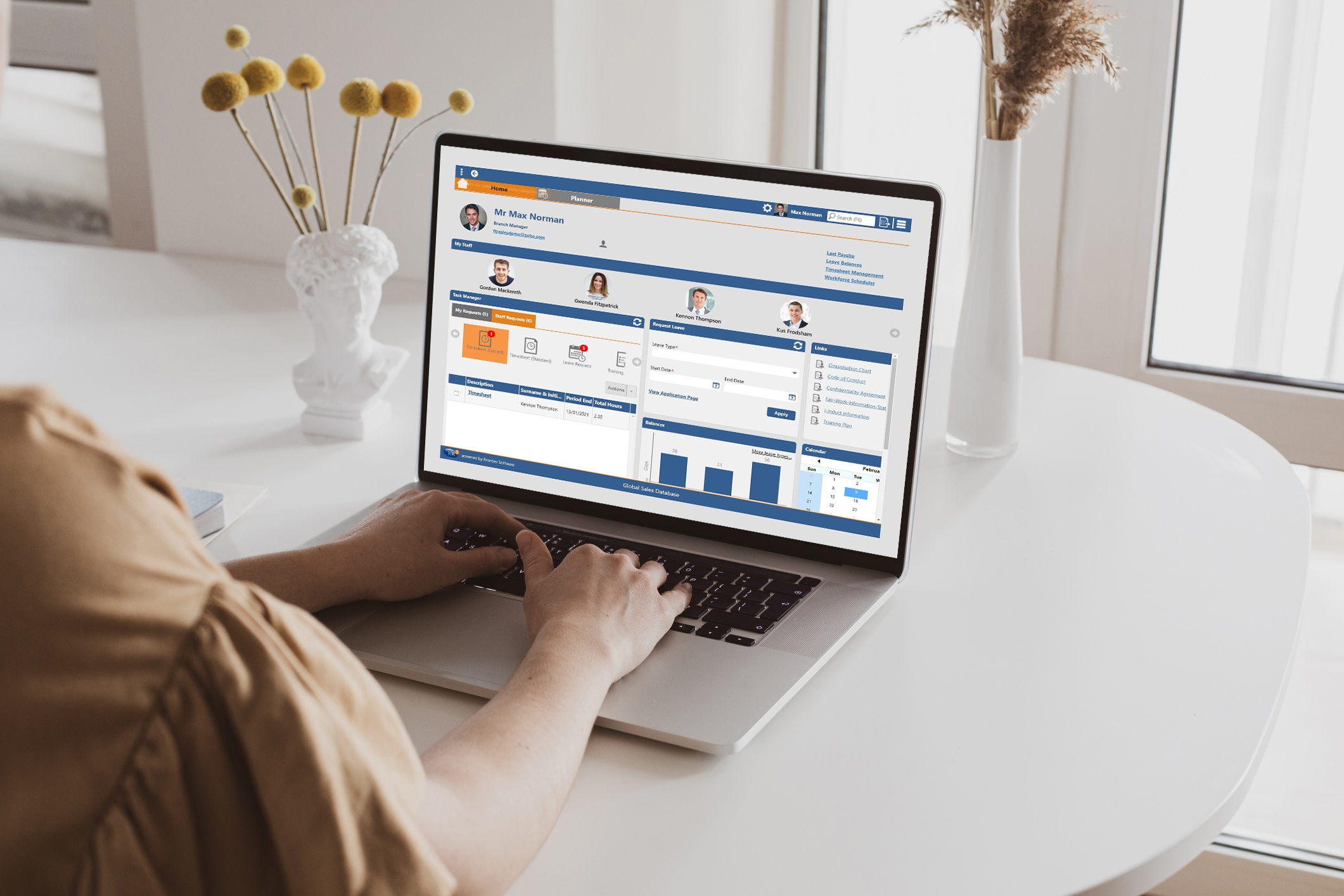
Consider the ordinary administrative journey of a new hire. Someone accepts an offer, provides personal information, joins a team, requests leave and eventually receives pay. Frontier offers modules for those connected tasks. Its self-service software lets employees view information, submit timesheets and expenses, request leave and update details. Managers receive approvals through workflow rather than having to reconstruct the request from an inbox.
For a worker, the practical benefit is access: a payslip or leave request need not begin with a message to payroll. For an administrator, it is fewer handoffs. Configurable access levels and approval processes matter because convenience alone is an insufficient design principle for bank details and employment records. The product’s job is to make an action easier while keeping responsibility for that action legible.
Frontier’s most specific efficiency example comes from using its own onboarding module, ONB21. Its published account says payroll setup for a new employee previously took up to 30 minutes and subsequently took less than 10. Digital offers, acceptance and employee-supplied information feed into ichris, reducing the need to chase incomplete details and retype them.
Less typing. More time.
Company-reported payroll setup time per new hire. Bars illustrate the stated bounds, not average timings.
Payroll manager Margaret Tomasiello described a reduction of more than 65%. That is a useful, bounded claim: the time required for payroll setup, inside one organisation. It does not measure the entire recruitment process or establish a saving every customer will achieve. The transferable idea is straightforward. Collect information where it originates, validate it, and avoid asking another person to type it again.
Seven businesses do not make one simple payroll
The customers explain the product better than the module names. Federal Group’s published story begins with seven business units, 2,000 staff and 18 modern awards in October 2012. Its activities spanned businesses including hospitality and transport. Payroll systems were separate and outdated, supported by manual procedures. The group wanted consolidated data and simpler processing.
Federal Group adopted ichris payroll, self-service and learning. The resulting shared database and reporting supported a workforce that had grown to 2,500 in the case study. The account credits automated workflows with reducing manual effort. Its significance lies in the starting conditions: consolidation had value because the organisation was already paying the administrative price of fragmentation.
AngliSchools presents another version of the same problem. A Frontier customer since 2018, the network grew to 2,500 staff. Employees working across schools complicated administration, while payroll knowledge was concentrated among too few people. The organisation added paperless onboarding and multiple-contract functionality, and moved payroll processing to an outsourced service.
The change in operating model matters. AngliSchools was responding to continuity concerns as well as paperwork. In Frontier’s account, outsourcing reduced dependence on internal staff and introduced needed segregation of duties. The case suggests that a software purchase can become a decision about who owns a process, who checks it and who can keep it running when someone is away.
Buy the software, or buy the payroll office
Frontier offers licensed on-premise software, SaaS and hosted application services. Alongside them sit implementation management, consulting, training and support. Payroll outsourcing comes in bureau, part-managed and fully managed forms. A bureau customer sends information for processing; a fully managed arrangement puts the processing work with Frontier’s payroll service. The division of labour is part of the purchase.
Choose deployment and modules. Organise the team that runs payroll.
Agree which processing tasks move to the provider.
Use Frontier’s payroll office for data import and processing.
There is a concrete example of the money involved. A published contract record puts Sport England’s cloud HR/payroll and payroll bureau award at approximately £101,481, covering January 2024 to January 2027. The scope combines software and service. It is one procurement, with its own requirements, rather than a per-employee price that another buyer can simply apply.
A sensible comparison therefore includes deployment, modules, migration, interfaces, training and the responsibilities retained by the customer. A smaller subscription figure is not a complete cost comparison if it leaves substantial processing work inside the organisation. Equally, outsourcing should be assessed against the actual work transferred. Buyers can copy the discipline of specifying the operating arrangement before comparing totals.
Frontier also occupies a useful position between replacement and integration. Latitude retained its selected ERP/HCM environment and connected payroll to it. Frontier’s current integration offering includes API services and a Workato connector, using event-triggered recipes to exchange information. Its API documentation describes checking incoming data against business rules before accepting it into ichris.
ADP is an alternative in global payroll software and services, also offering centralised processing, integration and local expertise. Frontier’s case rests on its particular combination of configurable HR modules, payroll coverage and delivery choices. The meaningful comparison is an employer’s actual country list and operating requirements, followed by a demonstration using realistic records.
The cost of losing control of the data
The history also contains a serious failure. In November 2021, a ransomware attack struck Frontier’s corporate network. South Australia’s Auditor-General subsequently described a breach affecting more than 90,000 current and former state government employees. Personal information was exposed even though the incident was on the provider’s corporate network, rather than a breach of the government’s payroll systems.
In December 2022, the South Australian government announced an agreement for approximately A$1.75 million in compensation from Frontier. Reporting described a lump-sum payment and reduced service fees through June 2024. That amount was compensation to the government, not a software implementation price or a payment promised to each affected worker.
The episode makes a practical point about the product category. Payroll security includes the movement and storage of information beyond the application employees recognise. A buyer assessing an integrated database also needs to understand copies, access and recovery arrangements. The benefit of connected records comes with an obligation to govern where those records go.
Take your awkward cases to the demo
The best demonstration for this kind of software begins with an inconvenient example: an employee with several contracts, a change requiring approval, or a record moving from another HR system. Follow it through to the payroll output. Ask the provider to show the correction and the history, as well as the successful first attempt. That exercise tests whether integration solves the organisation’s actual problem.
The fit weakens when required payroll jurisdictions fall outside the supported coverage, when interfaces cannot exchange the necessary information, or when nobody has ownership of data quality. An integrated database cannot settle an unresolved internal decision about which record is correct. These are buying conditions to establish early, before the neat demonstration acquires messy production data.
Frontier continues to extend the employee journey upstream. In an interview published in August 2026, Howard described an upcoming Vacancy Management system with interview scheduling, a careers-site builder and reusable vacancy templates. These were announced plans, rather than evidence of a completed customer rollout. The proposed tools address familiar recruitment chores: arranging interviews and keeping repeated information consistent.
That is where Frontier’s long history remains relevant to a present-day buyer. The kitchen-bench report writer and the planned vacancy templates concern the same ordinary frustration: information that people need, but must work too hard to assemble. The test of the software is whether employees and administrators can get that work done accurately, with fewer repeated steps, before the next payday arrives.
Explore the software and the story
Company website ↗ · Explore ichris ↗ · Request a demo ↗
LinkedIn · Twitter / X · Facebook
Customer stories · The founder’s 2026 interview · On-demand webinars · Watch: how payroll supports employee engagement