Payroll is the corporate equivalent of oxygen: nobody throws a party when it arrives, but everyone notices when it does not. In the late 1990s, Barb Gamey had spent about 15 years watching the Canadian payroll industry consolidate around large international providers. The systems were aging. The customer experience was drifting toward anonymity. She saw room for a company that treated correct calculations and a returned phone call as parts of the same product.
The idea became Payworks, co-founded in Winnipeg in 2000 and operating by 2001. There was no glossy launch ritual. Gamey hauled a desktop computer into prospect boardrooms to demonstrate software built in-house, then explained the other half of the offer: each client would have a dedicated representative who learned the business. It was a small physical comedy with a serious thesis. If payroll creates trust one paycheque at a time, support cannot feel like a lottery.
“I remember saying to her, ‘OK, but just so you know - there’s no plan B.’”Barb Gamey, recalling the decision to start Payworks01 / The opening
What failed first was the experience around the software
Payworks did not invent payroll. It chose a seam the incumbents had left exposed. Canadian employers needed calculations that reflected federal rules, provincial standards, Québec requirements, statutory holidays, remittances and year-end forms. They also needed help when a rule met a messy real-life exception at 4:45 on payroll day. The first failure was not arithmetic. It was the gap between the software screen and the person responsible for making the numbers right.
Gamey's daughter helped settle the founder's own uncertainty: if the opportunity looked real, go. What changed the company's mind after that was usually less cinematic. Payworks says its product priorities are driven by what customers ask for, not what internal teams assume they need. That feedback loop widened a payroll tool into a workforce-management suite while preserving a deliberately old-fashioned service promise.
One employee record, fewer places for a mistake to hide
The current product starts with Payroll and stretches across Human Resources, Time Management, Absence Management, Applicant Tracking, Workforce Analytics, Benefits, HR Advisory Services, Managed Payroll and Employee Self Service. The key is not the length of that menu. It is that the core products share a common database. Hours can move into payroll. Approved leave can update balances. Employee details need not be retyped into every system. Journal data can travel to QuickBooks Online or Xero.
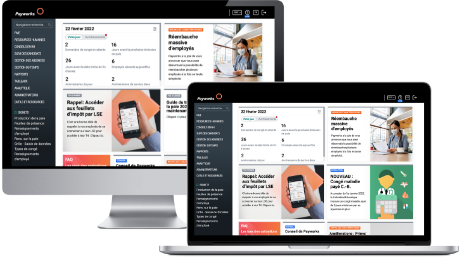
For an employee, the visible end is simpler: a mobile or web portal for pay statements, tax forms, banking details, schedules, clocking, documents and time-off requests. For the administrator, Payworks handles direct deposit, government remittances, Records of Employment and tax-form submission. Automatic legislative updates matter because Canada has thirteen provincial and territorial rule books layered beneath federal obligations. In payroll, “localization” is not a language toggle. It is the product.
Security is part of the same positioning. Payworks operates two data centres in Canada and says backup media also remains with a Canadian secure-document firm. The company describes annual independent audits, a disaster-recovery site and a business-continuity plan. Buyers should still do their own security review, but the domestic-data promise gives Canadian procurement teams a clean answer to a question that can otherwise stall a sale.
Built for the owner with one employee - and the operator with thousands
Payworks serves nearly 50,000 organizations. Its pages speak to small-business owners, payroll professionals, HR teams, accountants, bookkeepers, corporations and franchises. Public customers range from a pizzeria and a gymnastics school to multi-location retailers and CHCH television. That breadth works because the sale begins with a required task - paying people - and expands as the employer gains complexity.
The company sits in an awkward but useful middle of the market. Wagepoint, PaymentEvolution and accounting-suite payroll can look lighter for a tiny employer. ADP, Dayforce, UKG and Workday can carry larger global or enterprise programs. Rise People and Humi pitch broader Canadian people platforms. Payworks answers with Canadian compliance depth, modular products, domestic data residency and a named service relationship. It is neither the cheapest-looking download nor the grandest multinational transformation. It sells fewer headaches per pay run.
What does it cost?
The pricing structure is more public than the price. Payworks says clients are charged per run for active paid employees, not every employee left on file. Extra runs cost the same as regular runs. It says there are no licence or upgrade fees, year-end tax-form filing carries no extra charge and customers are not locked into long-term commitments. The final dollar figure is configured by quote, so any tidy internet answer claiming “Payworks costs exactly X” is tidier than the truth.
04 / DistributionMake the border somebody else's product opportunity
Partnerships reveal how Payworks intends to grow. National Bank selected it as an exclusive Canadian payroll partner. Paychex chose it as a preferred Canadian provider for cross-border needs. When Deluxe Canada wound down payroll, Payworks became its exclusive conversion and referral partner and absorbed almost 9,000 clients on top of ordinary onboarding. CIBC Business Banking added Payworks as a small-business referral partner in 2026.
These are not decorative logos. They are distribution channels built around a precise handoff: a bank, accountant or international provider has a Canadian customer with a payroll problem; Payworks supplies the local infrastructure. The company says it onboards more than 4,000 clients in a normal year through a five-step implementation, with a specialist helping the first run land cleanly. The Deluxe migration stress-tested that muscle at more than twice the usual volume.
Growth capital meets a service model that cannot become a script
In September 2025, specialist software investor Hg announced a strategic investment in Payworks. The full transaction value was not disclosed; HgCapital Trust later reported that its own participation was £16.7 million. The stated agenda is familiar - faster product development, broader reach across Canadian human-capital management and an improved client experience. The real test is specific: can Payworks accelerate without turning its dedicated-service advantage into another queue?
There are signs of product ambition. In 2026, Payworks launched an Analytics experience directly inside HR, Time and Absence Management, allowing users to build visualizations, save filters and compare data without exporting to a separate system. That follows a sensible product rule: bring the analysis to the operational data instead of asking customers to assemble another stack.
Culture supports the people-heavy model. Payworks says employees receive two paid volunteer days, and by 2025 had logged more than 6,600 hours through its Pay it Forward program. It supports more than 300 organizations and has tied community giving to its identity since the early years. The workplace offer includes hybrid flexibility, employer-paid benefits, pension contributions and professional development. Recognition has followed: Canada's Best Managed Companies every year since 2012, Platinum Club status since 2019 and five consecutive appearances among Manitoba's Top Employers through 2025.
“Everything we do is customer-centric - driven by what our customers are asking for, not what we just assume they need.”Adesola Omoniyi, product analyst06 / Steal this
The copyable part is the architecture of trust
The Payworks playbook
- Pick a mandatory workflow where mistakes carry emotional and financial weight.
- Build around the local rules global products treat as edge cases.
- Use one shared record to expand into adjacent jobs without duplicate entry.
- Make service part of the product design, not a department hidden after checkout.
- Recruit partners whose customers reach a border or capability they do not want to cross.
The easy takeaway would be “add a dedicated rep.” That misses the cost. A named human only works when the product, training and account load let that person solve problems. The deeper lesson is to design software and service as one operating system. Automation handles the recurring rules. Shared data removes handoffs. Trained people spend their time on ambiguity. Each layer makes the next one affordable.
Where it works
- Canadian employers wanting local compliance depth
- Teams replacing disconnected payroll and HR tools
- Franchises and multi-location operators
- Buyers who value guided implementation and support
Where it may not
- Businesses seeking a free tool or one public flat price
- Global groups needing many countries on one payroll engine
- Teams unwilling to configure or migrate a fuller suite
- Buyers who prefer pure self-service over a service relationship
Payworks is interesting because it made a category associated with deduction tables into a study in reassurance. Its software performs the work. Its Canadian focus narrows the terrain. Its humans absorb the uncertainty that remains. The desktop Gamey once carried is long gone, but the original pitch still fits on the screen: when the stakes are somebody's paycheque, being reachable is a feature.
Explore