The humble paycheck becomes a small novel when the employee is a caregiver. One shift pays a weekend differential. Another crosses county lines. A third needs overtime blended across two rates. There may be a per-visit payment, a retroactive adjustment, a credential about to expire, a state wage rule, and a federal report waiting at the end. Somewhere, a payroll manager has built a spreadsheet with the emotional weight of a family heirloom.
That is Viventium's chosen habitat. Founded by the Kohn family in 1991 and formerly known as BDB Payroll, the privately held company grew out of Brooklyn payroll processing into software for healthcare employers. Its customers include home care and home health agencies, hospices, skilled nursing facilities, senior living operators, continuing care communities, ABA providers, and pediatric organizations. These are businesses where the workforce is hourly, mobile, regulated, difficult to recruit, and expensive to lose.
The company says it works with more than 9,000 providers in all 50 states. After acquiring healthcare recruiting platform Apploi and caregiver rewards product Perks4Care, Viventium said its products supported more than one million healthcare employees. The count matters less than the shape of the bet: Viventium is trying to make one record travel from job application to credential check, onboarding, schedule, timecard, paycheck, and recognition.
01 / The problemThe exceptions are the product
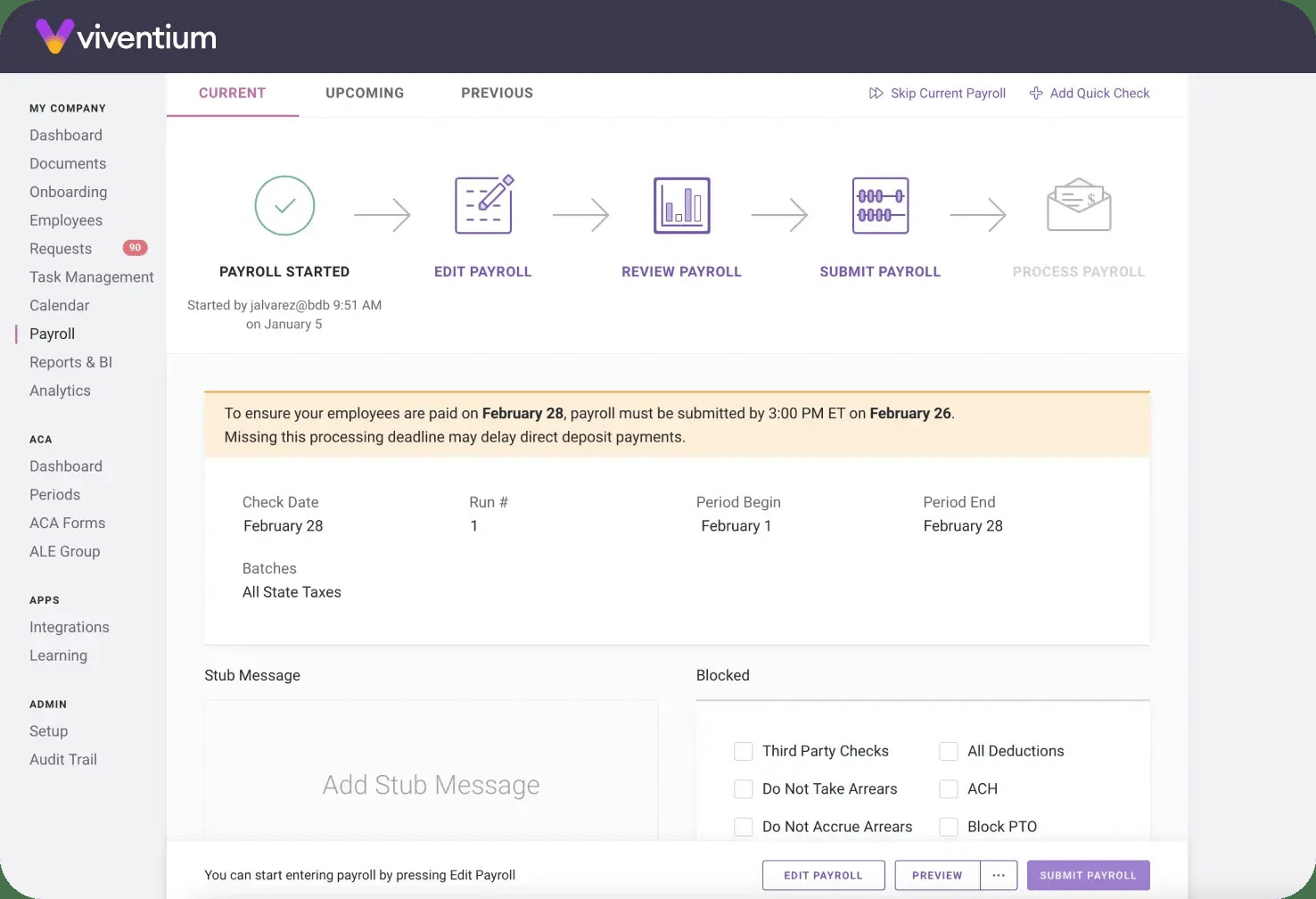
Generic HCM systems are designed around common denominators: an employee, a salary or hourly rate, a manager, a benefit plan. Healthcare operators live in the footnotes. Viventium's payroll tools account for multiple rates, shift differentials, overtime calculations, multi-location taxes, direct deposits, retirement contributions, and employee self-service. Its healthcare compliance menu includes ACA workflows, payroll-based journal reporting for nursing facilities, exclusion monitoring, and reporting that a general-purpose buyer may never need.
That sounds niche because it is. Vertical SaaS works when narrow expertise removes expensive manual labor. The payroll manager does not buy “digital transformation.” She buys the Friday afternoon she gets back when the system recognizes wage parity and does not make her repair a CSV before dinner.

“Our software is built to handle all of the little things that figure into wage calculations.”Terra Vicario, then Viventium chief marketing officer, in a 2021 DailyPay interview
02 / The expansionFrom payroll run to employee life cycle
For years, Viventium expanded around payroll: HR records, onboarding, benefits administration, ACA compliance, business intelligence, mobile employee access, and integrations with agency-management and electronic medical record systems. The partner directory is a map of what it did not build. AlayaCare and other care-management systems can feed operational data; Nevvon supplies learning; DailyPay lets workers access earned wages before payday.
Then the perimeter moved. Viventium closed its acquisition of Apploi on January 30, 2026. Apploi brought job distribution, applicant tracking, healthcare credentialing, onboarding, scheduling, and time and attendance. Suddenly the sales pitch began before someone was an employee. A candidate's information could move forward instead of being typed into another system after hire.
Perks4Care, acquired in December 2025 and announced the following March, extended the other end. Providers award points that caregivers can redeem for gift cards. Badges and a recognition profile can stay with the worker as they change employers. It is a modest mechanism aimed at a large problem: care organizations cannot hire their way out of turnover if everyday work remains invisible.
03 / The evidenceWhat failed first was the patchwork
Viventium's origin story does not offer a neat public pivot where a founder rejected one grand idea for another. The more useful “failure” appears in customer accounts. Before the switch, buyers describe manual entry between care-management and payroll systems, calculations performed outside the product, and a payroll run that depended on several people. One verified Capterra reviewer said a previous process took three employees between four and six hours each week. With Viventium, one person completed it in less than an hour while the product calculated wage-parity benefits.
That is what changed minds: fewer handoffs, calculations that matched healthcare pay, and service staff who understood the rules. Another reviewer said they moved from ADP hoping for a better price and easier use. A HomeWell case study described manual payroll entry from AlayaCare before adopting an integrated flow. The first thing to break was not payroll math alone. It was the seam between systems.
04 / The moneyWhat it costs, and what buyers are actually buying
Viventium sells business software and payroll services on a custom-quote basis. There is no simple public price card. Industry listings describe pricing as dependent on employee volume, payroll frequency and complexity, chosen modules, integrations, data migration, configuration, training, and specialized compliance needs. That makes the purchase harder to compare than self-serve payroll, but it also reflects a product where two employers with 300 people can create very different workloads.
The company is privately held. Third-party databases report a $5 million private-equity round associated with Camden Partners. In 2023, LLR Partners made a majority growth investment; ABS Capital, Camden Partners, and the founding Kohn family remained shareholders at the time. Deal values for that investment and the Apploi and Perks4Care acquisitions were not disclosed. This is not a venture story powered by a parade of announced rounds. It is a three-decade services-and-software business being shaped by private equity into a broader vertical platform.
05 / The stealThe playbook hiding in the pay stub
What can another operator copy? Not the checklist of payroll fields. The transferable move is to find a market where the incumbent system forces users to maintain a shadow operation. If the real workflow lives in spreadsheets, email, and institutional memory, the generalist product has left an opening.
Steal this vertical SaaS sequence
- Start with a painful, recurring transaction where mistakes have immediate consequences.
- Learn the industry's ugly exceptions until they become native fields, rules, and reports.
- Integrate with operational systems customers cannot or will not replace.
- Expand one handoff at a time, following the same record upstream and downstream.
- Sell measurable relief: hours removed, duplicate entry avoided, errors caught, staff retained.
Viventium followed that path from payroll into HR and compliance, then upstream into recruiting and downstream into recognition. Its 2026 partnership with Flychain adds a financial view of labor, often a healthcare provider's largest expense. The company is not merely bundling features. It is trying to make workforce data continuous enough that operations, HR, and finance stop arguing over whose spreadsheet is current.
There is also a service lesson. Healthcare-specific software is less useful if the support person cannot distinguish a shift differential from a shift. Viventium emphasizes dedicated industry experts alongside the product. That labor makes the model less pure than a touchless SaaS fantasy, but buyers handling regulated pay may consider informed help a feature, not gross-margin debris.
06 / The boundaryWhen the vertical bet does not work
Specificity has a border. Viventium is designed for U.S. healthcare workforces. A global employer needing multi-country payroll, a clean salaried software company, or a tiny business shopping by published monthly price may get more value from a generalist. A buyer unwilling to standardize data or connect scheduling and care-management systems will preserve the same silos under a new logo. And reward points will not repair low wages, bad managers, or impossible schedules; recognition works as a complement to decent work, not a substitute.
The unified-platform argument also carries familiar risk. Acquisitions do not become one experience merely because the logos share a press release. Apploi's recruiting data has to flow reliably into Viventium's HR and payroll products, permissions must remain coherent, and clients need a migration path that does not interrupt hiring or payday. Customer reviews are favorable overall, but some users mention reporting friction, slow responses, glitches between sites, and feature gaps in employee communication. Vertical depth does not excuse ordinary software chores.
07 / The marketA system of record for care work
Viventium sits between broad HCM suites such as ADP, UKG, Paylocity, and Paychex; healthcare workforce products such as Empeon and Smartlinx; and point solutions for hiring, scheduling, learning, or compliance. The generalists bring scale and wide feature catalogs. The specialists compete on the details of care delivery. Viventium's answer is to combine specialist depth with suite breadth.
The next test is less glamorous than the acquisitions. The company must prove that a provider can recruit faster, enter data once, run accurate payroll, see labor cost clearly, and keep more caregivers. Indeed gave Apploi Hire an Enterprise Customer Excellence Award in August 2026, a useful signal on the hiring side. The more meaningful scorecard will be operational: fewer empty shifts, fewer corrections, faster onboarding, and fewer spreadsheets named “FINAL_v7.”
Viventium's story is a reminder that enterprise software does not have to begin with a new category. It can begin with a stubborn old task and the observation that the standard tool misunderstands it. The weird paycheck was not an edge case to tolerate. It was the map.