Payroll is boring until Friday morning. Then it is electricity. A missed deposit, a mangled withholding or an employee locked out of a pay stub can turn the blandest function in a company into its loudest emergency. Asure Software has spent the past several years arranging itself around that fact. The Austin company sells the software, tax plumbing and human help that small and midsize businesses use to pay people, track time, manage benefits, hire, stay compliant and, ideally, avoid a frantic call before lunch.
That description sounds tidy. The company history is anything but. Today's Asure descends from VTEL, a 1985 videoconferencing pioneer. It later became Forgent Networks, collected patent-licensing revenue, bought workforce and workspace software, and adopted the Asure name in 2007. For years, its portfolio tried to answer two unrelated questions: Where should employees sit, and how should they be managed and paid?
The $120 million act of subtraction
In October 2019, Asure agreed to sell its workspace-management business to FM:Systems for $120 million. Room scheduling and office utilization went one way; payroll and human capital management went the other. By the following summer, management was telling investors that Asure was fully focused on SaaS HCM for small businesses.
What failed first was not necessarily the software. It was the category logic. A buyer looking for payroll does not naturally wake up wanting meeting-room optimization, and a facilities manager is not the obvious buyer for tax filing. The mixed portfolio complicated the pitch, capital allocation and product roadmap. The sale changed management's mind about breadth: focus would come first, then Asure could rebuild a wider basket around one customer and one recurring operational problem.
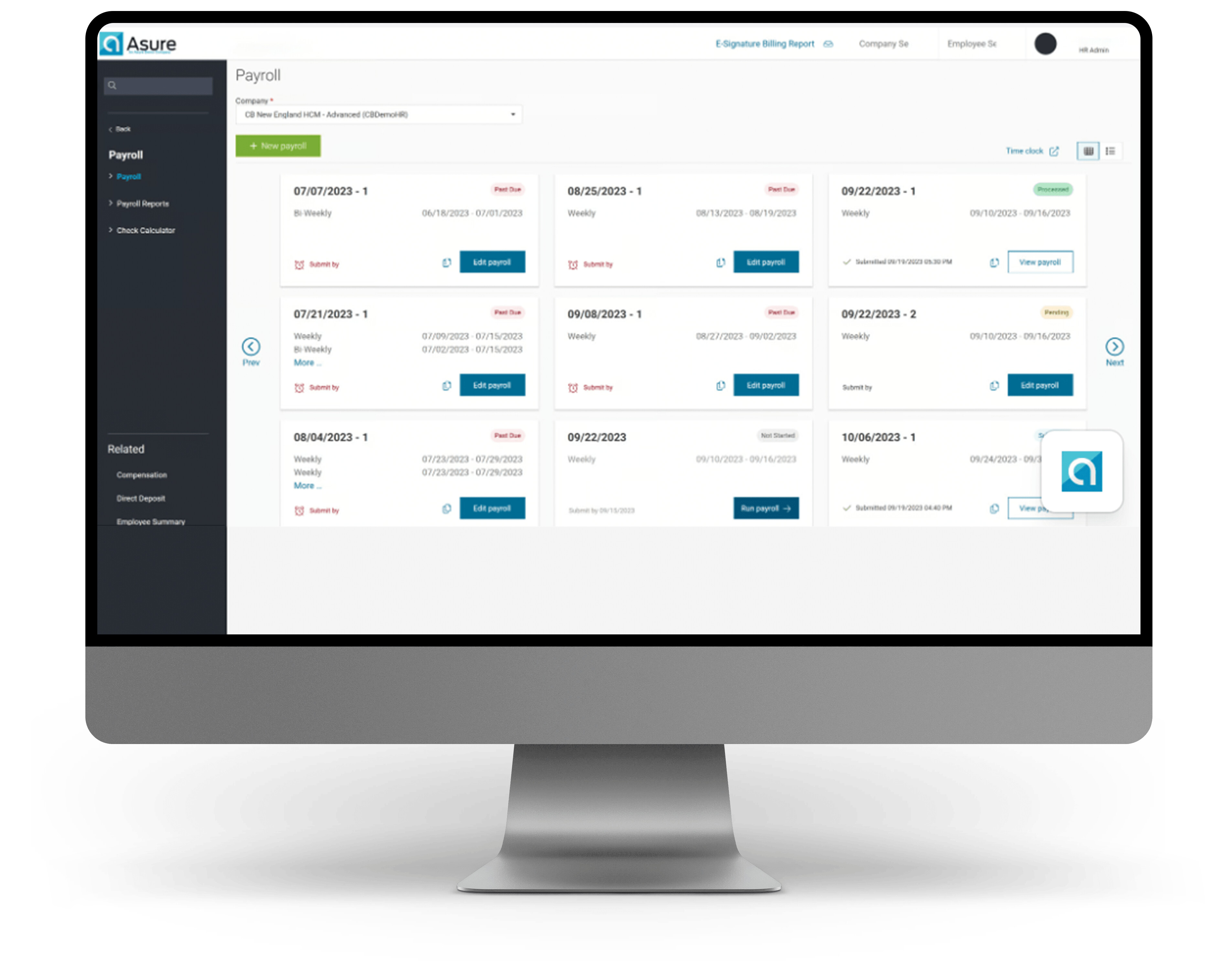
The new center of gravity is AsureCentral, the system that connects payroll, HR, time and attendance, recruiting, benefits, employee self-service and compliance. The product is sold by custom quote. Asure says pricing depends on headcount, modules and setup. That makes a clean checkout-page comparison impossible, but it fits a product whose cost depends on whether a company needs basic payroll or wants to hand over the whole administrative headache.
Software on one side, operators on the other
Asure's most useful distinction is not a feature. It is a choice of operating model. A customer can use AsureCentral to run payroll and HR internally. Or it can use AsureWorks, launched in April 2026, and have Asure specialists process payroll, handle tax filings and reporting, and maintain employee records. The client remains the employer of record, unlike the co-employment arrangement common to professional employer organizations.
That dial matters because a 20-person founder-led business and a 500-person multi-state employer may buy the same nouns but need radically different levels of help. Pure self-service is cheap until nobody on staff understands a tax notice. Full outsourcing is reassuring until the business dislikes the loss of control or added expense. Asure sits between those poles and lets service intensity rise with complexity.
What does that cost? Asure does not publish a universal number, and any precise sticker price would be false confidence. Its quote changes with employee count, modules and service level. Asure's own market comparison puts software-led small-business payroll in a broad neighborhood of $30 to $60 a month plus roughly $4 to $8 per employee, while warning that AsureCentral must be quoted directly and AsureWorks depends on how much administration is delegated. The useful comparison is not monthly fee against monthly fee. A buyer should price implementation, tax filing, add-ons, internal staff time, the response to notices and the cost of correcting a bad payroll.
A roll-up disguised as a product suite
Asure also grows through a less fashionable mechanism: buying payroll resellers and customer relationships. Its annual filing explains the attraction plainly. When Asure acquires a reseller that licensed its software, it can recognize the reseller's full customer revenue instead of collecting only a recurring licensing fee. In 2025, it completed seven customer-relationship asset acquisitions with a total purchase price of about $20.5 million.
Then came the larger deal. Asure paid $39.5 million for Lathem Time in July 2025. Lathem traces its history to 1919 and sells PayClock Online plus physical timekeeping equipment. This was not random nostalgia for punch clocks. Time data lives immediately upstream from payroll. If Asure captures the hours, flags exceptions and routes approval before payday, it has both another sales door and a cleaner path into the paycheck.
The marketplace broadens the basket again without requiring Asure to build every tool. The company advertises more than 125 integrations, including connections in the Workday, SAP and AWS ecosystems and services from Equifax and TurboTax. Revenue can include subscription, service, transaction and referral fees. It is a practical form of expansion: own the regulated core, integrate the edges, and attach more value to a customer relationship that may last years.
The AI has to touch the work
Luna is Asure's answer to the current AI question. The assistant sits inside AsureCentral, where it can answer employee and manager questions, surface exceptions and help complete permitted actions. In August 2026, Asure described Luna's evolution from copilot to a more agentic coworker across payroll, tax and compliance.
The interesting part is not conversation. Payroll already has plenty of interfaces. The hard product problem is controlled execution: permissions, live employee data, compliance-aware logic, audit trails and a clear point where a human must approve. An agent that summarizes a policy is convenient. One that safely advances a payroll task inside the system of record could change labor economics. One that acts incorrectly has found the worst possible place to hallucinate.
This is also where Asure's service layer may help. Certified professionals and customer-support teams provide a human escalation path around automation. The same model makes the company heavier than a pure software startup, but payroll buyers often care less about gross-margin elegance than about who answers when a state agency sends a letter.
The crowded middle of the market
Asure names ADP, Paychex, UKG, Paylocity, Paycom, Dayforce, isolved and Gusto as major competitors. The incumbents bring giant sales organizations, broad brands and the ability to discount a point solution because an eight-to-ten-year customer relationship is worth more than the opening offer. Newer SaaS names such as Gusto and Rippling arrive with strong self-service design and faster setup reputations.
Asure's position is narrower. It aims at entrepreneurs and growing employers that want more guidance than lightweight software usually provides, but may not want an enterprise suite or PEO relationship. Its payroll-tax and treasury work also reaches larger platforms. A 2026 AWS Marketplace agreement opened enterprise payroll-tax and treasury services to a channel with roughly 330,000 customers.
The public customer stories make the target less abstract. They include a blinds and shutters company, a junk-removal operator, a digital agency and a growing food-and-beverage business. These are not companies trying to turn HR into a competitive spectacle. They are operators wearing too many hats, opening locations, hiring hourly workers or crossing state lines. For them, the product payoff is not a prettier personnel database. It is fewer late-night payroll sessions, a person to call when rules become confusing, and a workforce system that can grow without forcing the owner to become a part-time compliance officer.
The numbers show momentum, not invincibility. Asure reported $37.1 million in second-quarter 2026 revenue, up 23 percent from a year earlier. Recurring revenue was $34 million, up 19 percent. It still posted a $4.4 million net loss, though adjusted EBITDA reached $7.7 million. Acquisitions add customers and capabilities, but they also create integration work, debt obligations and the risk that expected cross-selling never arrives.
What to steal, and when it breaks
The copyable playbook
- Delete the confusing adjacency. A product can be good and still make the company harder to understand.
- Build a service ladder. Let customers start with software and buy more human operation as consequences rise.
- Acquire trusted distribution. Local resellers can hold durable customer relationships that paid ads cannot manufacture.
- Expand one workflow upstream and downstream. Time capture, payroll, tax, benefits and wage access all touch the same event.
- Put AI inside accountable work. A useful agent needs permissions, live data, an audit trail and an escalation path.
This playbook does not travel everywhere. It works best when the task repeats, mistakes are expensive, regulation creates anxiety and customers prefer one accountable operator. It works poorly in low-stakes categories with easy switching, little need for support or no natural cross-sell. Buying resellers also fails when cultures clash, systems cannot be unified, service quality drops or the acquired customer base resists migration.
Asure's own history supplies the final caution. Breadth is valuable only after the center is obvious. The company had to sell workspace management before it could credibly assemble a larger HCM platform. Today the organizing sentence is easy to repeat: help businesses pay people, manage the workforce and stay compliant, either with software or with operators. For a company that has worn several names across four decades, clarity may be the most valuable product it has shipped.
Keep exploring