The first thing an HR system promises to organize is the employee. The first thing a bad one produces is another spreadsheet. Somewhere between the offer letter and the payroll run, a name is retyped, a deduction goes stale, a manager asks where the form lives, and the supposedly authoritative database becomes one opinion among several. BambooHR built a large private software company by attacking that small, daily absurdity.
Founded by Ben Peterson and Ryan Sanders in Lindon, Utah, in 2008, BambooHR began with a cloud-based human resources information system for smaller organizations. It was not trying to recreate the control room of a multinational conglomerate. It made the employee record approachable, gave people self-service access, and let an HR generalist pull a report without submitting a ticket to an analyst. That was the wedge. Everything else followed.
Today the company says more than 33,000 organizations use its platform, representing roughly 3 million people. The product stretches from applicant tracking and onboarding to time off, payroll, benefits, compensation, performance, engagement and workforce analytics. Brad Rencher, who previously led Adobe’s Digital Experience business, became chief executive in 2019. The founders moved toward strategic oversight as board co-chairs.
01. The database kept eating adjacent jobs
BambooHR’s distinction is architectural and commercial. It starts with shared people data, then sells the workflows that change or consume that data. An accepted applicant becomes a new hire. The new hire’s address and bank details flow toward payroll. Benefit elections affect deductions. Approved time feeds hours. A compensation change appears in a manager’s planning view and, with the right controls, in the employee’s total-rewards statement.
That connective tissue matters most to lean HR teams. A specialist recruiting system may evaluate candidates more deeply; a payroll-first company may offer more local tax nuance; an enterprise suite may tolerate every custom hierarchy a consultant can draw. BambooHR’s bet is that many growing companies prefer one legible home for the routine 80 percent.
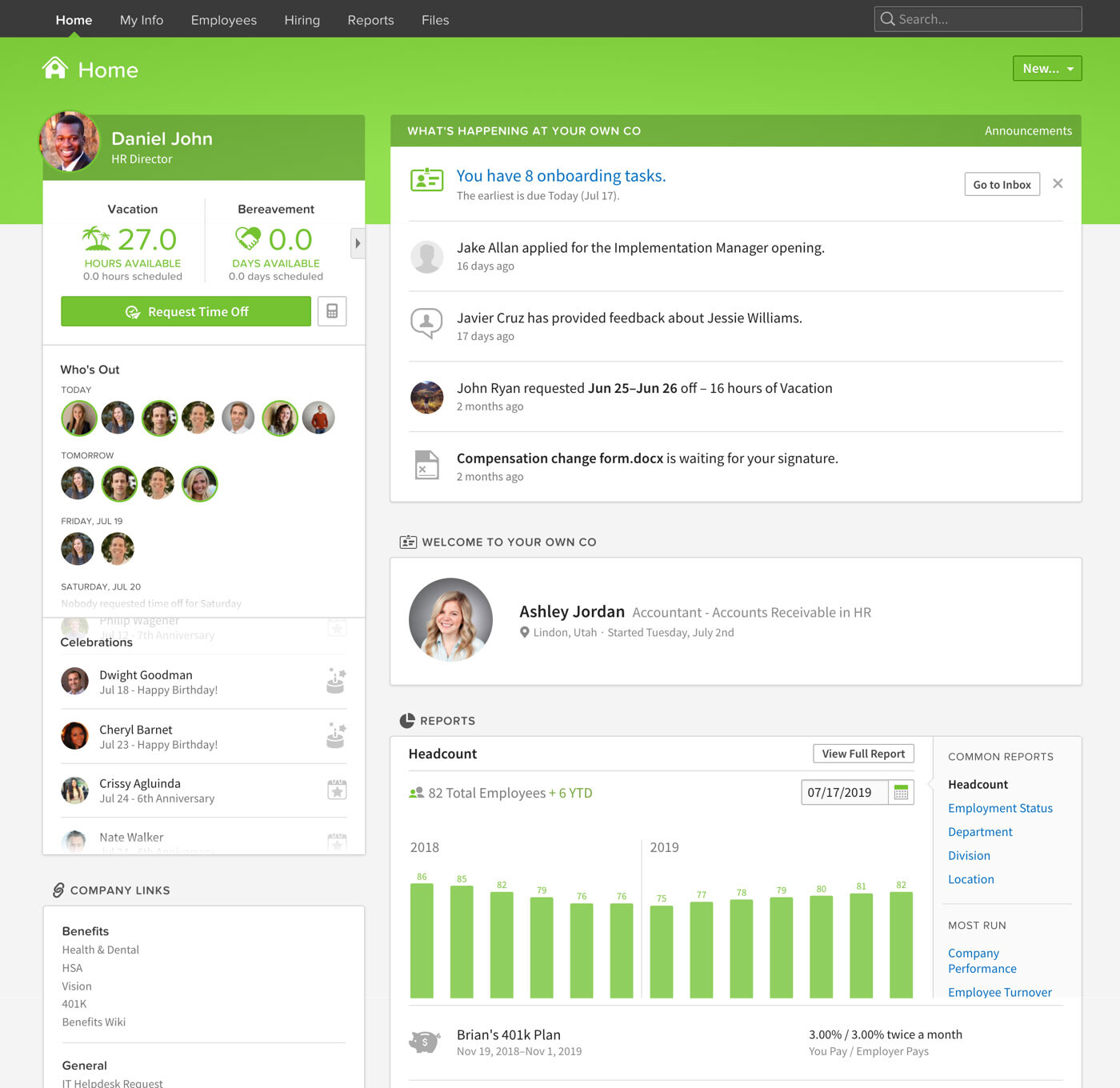
The breadth is now substantial. Core HR covers records, approvals, dashboards and reports. Hiring includes job posts, candidates, offers and onboarding. Time and attendance handles leave, timesheets, clocks, breaks and shifts. Pro and Elite layers add performance, employee experience, benchmarking and analytics. Payroll and benefits are integrated add-ons, and a marketplace supplies more than 150 connections, including Checkr, Greenhouse, Culture Amp, Remote and Human Interest.
02. The price is visible; the repair work is not
In 2026, BambooHR publicly listed its Core plan from $10 per employee per month, with automatic volume discounts. Pro, Elite and many add-ons require a quote. Bundling payroll and benefits could produce a 15 percent discount for eligible U.S. employees. That gives buyers a starting number, not a final bill.
Core starting price
per employee / month
The invoice is only half the calculation. Buyers should count duplicate entry, correction time, employee questions, implementation labor and the specialist systems they can actually retire.
A BambooHR customer called Repowered supplies the more revealing cost story. Its previous HR system cost three times as much and suffered recurring benefits failures. That was what failed first: not a glossy analytics screen, but the machinery that tells people what coverage they have. The payroll assistant had endured such a painful implementation that she resisted attempting another switch within a year.
What changed the organization’s mind was the gap between price and repair work. After moving, Repowered reported saving 10 hours a week on payroll and cutting time spent correcting time-tracking errors by 83 percent. The new system cost one-third as much as its predecessor. Those are customer-reported results, not a universal return calculator, but they reveal how sensible buyers evaluate HR software: the cost of the system plus the work the system creates.
“Our previous system cost three times as much, delivered far less, and was a pain to use.”Dara Strickland, HR Manager at Repowered
Other public customer stories rhyme. Avidbots reported $40,000 in annual savings after automating HR work. Swanson Russell said it removed more than 200 hours from compensation planning. New Moms traced $21,000 in staff-time savings over three years to lower turnover and more efficient hiring. The measurements vary, but the enemy is consistent: human beings acting as adapters between software.
03. Culture, with an expense line
BambooHR’s mission is to “set people free to do great work.” Corporate missions are easy to print and hard to audit. Its most memorable attempt at proof is Paid Paid Vacation, introduced in 2015. Eligible employees receive reimbursement for vacation expenses - published accounts have put the amount at $2,000 after six months - in addition to taking paid time off.
The policy is amusing because its name sounds like an accounting glitch. It is useful because it translates “Enjoy Quality of Life,” one of BambooHR’s three stated values, into a budget and a behavior. The other two values are “Grow from Good to Great” and “Make It Count.” Employees have called themselves Bambooligans, a word that should probably remain inside the building but at least proves somebody had fun naming the Slack channels.
This culture work also functions as product research. BambooHR sells tools for time off, employee wellbeing, feedback and recognition. Running conspicuous people programs internally gives the company examples, vocabulary and opinions. It does not guarantee perfect management. It does create a tighter loop between what the company preaches, what its employees experience and what its software encodes.
04. AI arrives with a key to the filing cabinet
In May 2025, BambooHR announced embedded AI, compensation benchmarking and native applications on a unified data model. In July 2026 it introduced Bamboo AI, describing a connected layer of assistants and agents built into the platform. Ask BambooHR can answer questions about workforce data and policies; newer integrations extend that context to global employment. The ambition is to progress from finding information to completing administrative work under an organization’s existing rules.
The expansion of the promise
The advantage is context. A generic chatbot knows language; an HR platform knows who reports to whom, which policy applies, whether leave is available and what a user is permitted to see. The danger is the same context. A mistaken restaurant recommendation is annoying. A mistaken answer about pay, leave or eligibility can become an employee-relations problem. The useful AI will be the one with narrow permissions, visible source material, approval steps and an audit trail - not the one with the liveliest prose.
05. The playbook - and the edge of the map
BambooHR occupies an increasingly crowded middle. Gusto approaches the customer through payroll. Rippling extends from workforce data into devices, apps and automation. HiBob leans into engagement and the modern employee experience. Paylocity, ADP and UKG bring payroll depth. Workday and SAP handle enterprise complexity. Newer global platforms such as Deel and Remote begin with cross-border employment.
BambooHR’s answer is not to imitate every rival. It combines breadth, an employee-friendly interface, service and an open integration layer. That formula works when a company has outgrown spreadsheets, employs a lean HR team, wants staff to serve themselves and can standardize most workflows around a shared record. It is especially persuasive when replacing several modest tools creates more value than buying the deepest tool in any one category.
What another operator can copy
- Choose one canonical object - the employee, property, account or shipment - and make its record trustworthy.
- Attach the next workflow where data is retyped. Expansion should remove a handoff, not merely add a tab.
- Make values operational. Give each one a budget, rule, ritual or product decision that an employee can point to.
- Publish the boundary. Keep an open API and marketplace for specialist jobs the core product should not swallow.
The formula weakens under different conditions. A multinational with many legal entities, union agreements, local payroll rules and elaborate approval matrices may need the configuration depth of an enterprise suite. A company whose recruiting, scheduling or compensation process is its competitive advantage may prefer best-of-breed software. Buyers should also test data migration, support response, payroll coverage and the true price of add-ons; simplicity on a sales demo does not eliminate implementation work.
BambooHR’s central achievement is not that it turned every HR specialty into one perfect product. It made the employee record a useful place to begin, then expanded wherever fragmented data produced obvious administrative drag. The test for its AI era is whether software that acts can remain as understandable as software that stores. The filing cabinet learned to talk. Now it needs impeccable judgment about which drawers it may open.