Payroll has a deadline. Employee wellbeing has a budget meeting. Plumm is trying to bring the two closer together: a people-management platform that sells the machinery of employment alongside access to mental health support. Holiday requests, hiring, performance reviews and therapy now share a product catalogue. It is an unusual route into HR software, and a revealing one.
The company began with mental health. Today its website leads with running HR through AI, with wellbeing among a much broader set of modules. The commercial idea is easy to understand. If employers already need software to manage their workforce, perhaps support for that workforce can earn a more durable place inside the purchase. The interesting question is whether the everyday administration is good enough to keep that arrangement worthwhile.
01Before the spreadsheets, there was his mother
Founder and chief executive Asim Amin has described a childhood shaped by his mother’s severe stress and depression. Therapy helped her recover; she subsequently became a therapist herself. In a 2022 TechRound interview, he connected that experience with his interest in technology. The business grew from seeing both the damage that mental ill health could cause and the difference that treatment could make.
The corporate record supplies a neat, three-part history. Healing Clouds Ltd was incorporated on 27 October 2017. It became Plumm Health Ltd in July 2021, then Plumm Limited in November 2023. Amin described the service as launching in 2018. The dates refer to different things: registering a business, launching its service and changing its name.
During the pandemic, the company moved from selling to individuals toward selling to employers. Amin told TechRound that the shift offered access to more users. By March 2022, he reported more than 100 organisational partners, over 20,000 employees covered and more than 10,000 one-to-one video sessions. Those were company-reported milestones, but they explain why the workplace became the centre of the proposition.

02The 30-day idea that took nine months
In his Bae HQ interview, Amin described the next problem: employers valued mental health support but cancelled benefits when money tightened. He initially resisted, then recognised that customers facing layoffs were protecting essential operating software. What gave way was the budget for a discretionary service.
Plumm’s response was to build an HR platform around its wellbeing offering. Amin recalled proposing a 30-day effort to his technical team; the work took nine months. He described the purpose as subsidising mental health through the wider product. The change also required persuading employees who had joined a mental health business to help build HR technology.
That is the useful business lesson here: investigate which purchase a customer can still justify when enthusiasm meets a spending freeze. Bundling makes sense only if the added product earns its place. A payroll buyer will eventually judge the payroll.
“we have to move from a good to have to a must have.”
Asim Amin / Bae HQ
03A working day inside the bundle
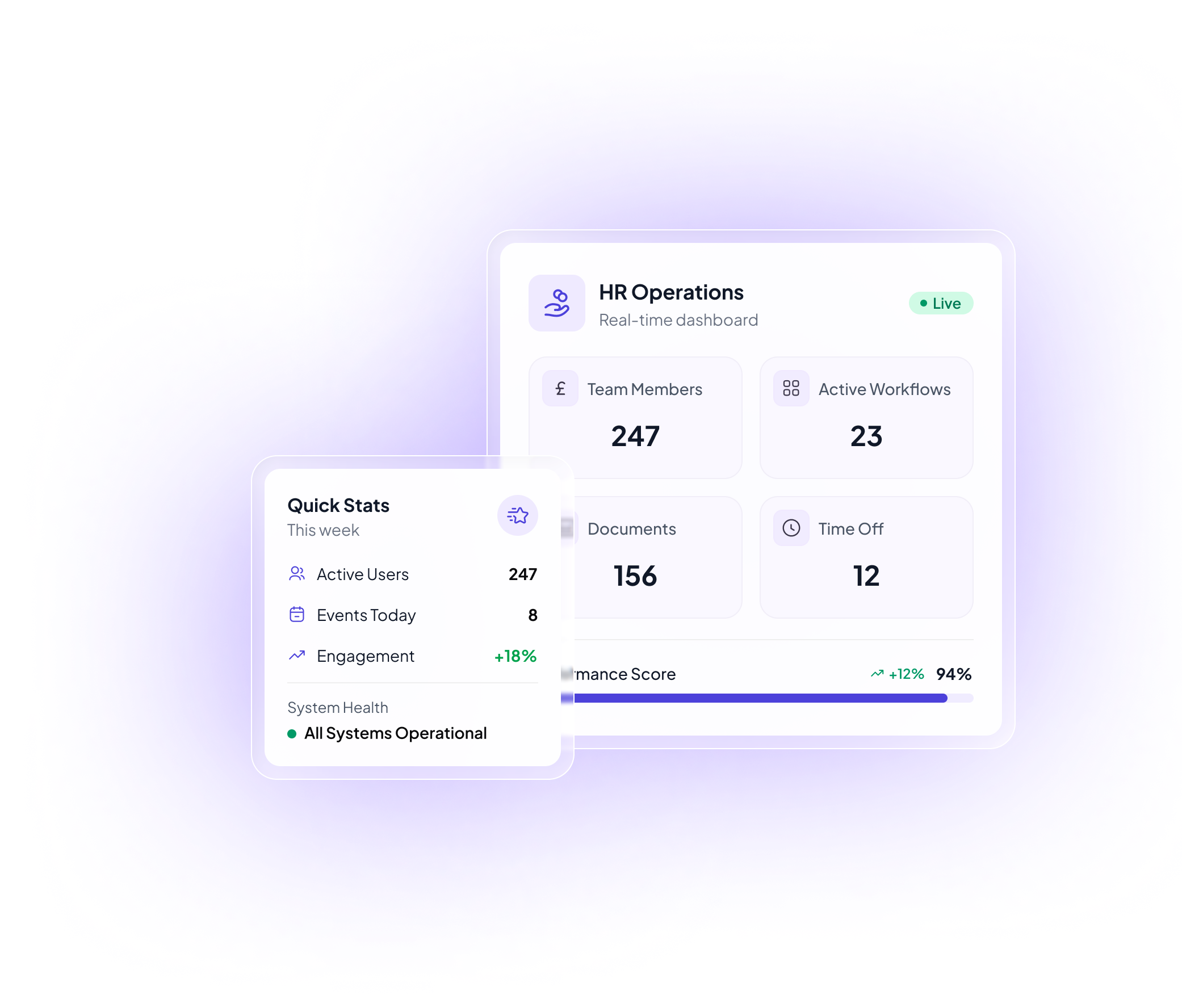
Plumm’s HR Core covers employee information, documents, tasks, time off and reporting. Its people-management tools add reporting lines, employee searches by attributes such as skills or location, and a place to schedule and document one-to-ones. The appeal is mundane in the best sense: less hunting for a record, a previous conversation or the person responsible for an approval.
Consider a growing employer that has outgrown its spreadsheet. A manager needs to review a team member’s goals, arrange a check-in and find the last review. Plumm groups those activities into a structured people system. That is a practical use case, rather than evidence that software alone improves management. The manager still has to hold a useful conversation.
Payroll brings a different kind of discipline. Plumm advertises UK payroll with tax calculations, approval workflows, payslips, P45s, P60s and submissions. Its payroll page lets buyers see the intended connection between people records and finance operations: changes, approvals and payroll tasks handled within the same environment. For a purchaser, the sensible demonstration is a complete pay cycle using the organisation’s own requirements.
Learning has its own machinery. Teams can assign courses, organise content, build learning paths and track completion. The catalogue includes leadership, compliance and clinician-led wellbeing programmes, alongside mental health first aid and continuing professional development training. That gives a people team somewhere to manage both the course and the record that somebody completed it.
The distinction matters. Offering a library and administering a training programme are different jobs. Plumm’s learning tools address the second as well as the first. An employer can structure learning around roles and revisit progress, rather than simply distribute a link and hope people open it. Completion records remain evidence of participation, however, not automatic proof that behaviour changed.
04The therapist and the chatbot have different jobs
The wellbeing offering includes access to more than 170 therapists and coaches, according to the current product page. Employees can use therapy or coaching, mood tracking, meditations, soundscapes and events. Employers can also buy managed wellbeing support covering planning, engagement campaigns, training and periodic reviews. There are people doing work behind the software.
Emma AI occupies the space between those activities, offering on-demand wellbeing support. Plumm separately markets an HR AI agent that can work with requests such as approving leave, arranging meetings or starting onboarding. One is oriented toward an employee’s wellbeing; the other toward operating the platform. The shared AI vocabulary should not obscure those different responsibilities.
The HR agent’s product page describes policy drafting and assistance with reports as well as task execution. The interesting ambition is to turn a written request into a completed workflow. A buyer should test the entire sequence: what information the agent uses, which permission applies, what requires confirmation and how the result appears to the affected employee.
Plumm’s June 2026 Trust Centre states that platform actions require explicit user approval. It also says employers cannot see individual therapy, coaching or Emma AI content, while aggregated and anonymised wellbeing insights may be available. That separation is central to the proposition. A product that administers performance reviews must make the boundaries around a private conversation understandable.
The company’s Clarity Statement draws another boundary: Plumm is not a crisis service, hospital or psychiatric service, and AI support is not a substitute for professional care. Access also depends on what an employer or partner has purchased or enabled. The relevant buying question is therefore specific: which support does this contract give this employee, and how do they reach it?
05Who signs the cheque?
Plumm’s partner programme identifies a particularly plausible customer: a growing business with roughly 20 to 250 employees, scattered records and increasingly awkward HR processes. Its website also markets to smaller teams and enterprises. The narrower description is more helpful. It points to an organisation large enough to feel administrative pain, with somebody available to take responsibility for the new system.
Its customer-story collection names people leaders and executives from City Relay, Annapurna, Dixa, Pollinate, Estuary, Innocent Drinks, Johns & Co., Mubadala Capital and LADBible. These are examples of customer relationships, not a claim that every company has adopted every module. A wellbeing engagement and a full HR replacement can be very different purchases.
In a testimonial published by Plumm, Innocent Drinks wellbeing and culture specialist Laura Thompson describes a team that had become comfortable discussing mental health and enjoyed its sessions. That is an account of workplace experience. It should be read on those terms, rather than turned into a numerical claim about retention, productivity or treatment outcomes.
The company sells subscriptions, with its published partner-service terms describing per-user monthly charges where specified in an order. Modules and services depend on the agreement. The live pricing route leads to a personalised demonstration. A useful cost comparison therefore begins with the proposed contract: eligible users, included support, optional services and the billing period.
There is an easily missed commercial detail in those terms. Unless the order says otherwise, the user-charge calculation takes the greater of the initial user count and the current count. Headcount growth can therefore increase a bill, while a subsequent reduction does not necessarily lower its baseline. That makes the order details worth reading alongside the product tour.
06Funding the move into a crowded aisle
In November 2023, Plumm received a £2.2 million investment from IW Capital. The stated plan was to expand partnerships, sales and marketing, and develop business in the UK and overseas markets including the EU, Middle East and United States. The announcement described a platform combining therapy, coaching, self-help resources and group learning.
Plumm’s current company page reports £4.1 million in total funding and more than 30,000 active users. Those are company figures, and the funding total is distinct from the single announced 2023 investment. The same page lists Nabil Ismail as co-founder and COO and Ramiz Khan as co-founder and CTO, alongside Amin and a wider leadership group.
Its stated internal values emphasise considering users, moving deliberately, communicating honestly and judging work by its effect on customers. That is the culture Plumm says it wants. Building administrative software while coordinating wellbeing services gives those commitments a practical test: the team has to understand both a broken approval process and a person seeking support.
Plumm explicitly compares itself with HR suppliers including HiBob, BambooHR, Personio and BreatheHR. Its chosen distinction is the combination of HR administration and direct wellbeing provision. The comparison is best treated as a purchasing choice between a bundled service and the particular tools an employer already uses. The presence of therapy does not settle a feature-by-feature HR comparison.
Distribution also reaches beyond direct sales. Plumm invites accountants, payroll providers, benefits brokers, HR consultants and fractional finance leaders to refer customers. Its published programme suggests commissions of 15%, 20% or 25% of net first-year subscription revenue for different levels of involvement, subject to agreement. That gives advisers a financial reason to introduce the product, and buyers a reason to ask how a recommendation is paid for.
From IW Capital, for commercial teams and geographic expansion.
07A bundle still needs an owner
Plumm itself says its partner offer is less suitable for businesses without an internal owner for implementation, or without a willingness to improve their people processes. That is a refreshingly concrete condition. Putting several workflows into one application cannot decide who approves leave, who keeps employee records accurate or who follows up on training.
The same practical test applies to its wider promise. Buyers can copy the discipline of connecting an employee benefit to a recurring operational need, then check the details before consolidating suppliers. Run a real workflow through the demonstration. Specify the support allowance. Make the privacy boundary easy for employees to understand. The appeal of Plumm is that these conversations can happen around one product; its test is whether the product makes the working day better.