An employee’s name is a modest piece of information. It ought to be possible to tell a computer once. Yet the ordinary business of choosing workplace benefits has often required people to repeat themselves across forms, plans and systems. The absurdity is small enough to escape a board meeting and large enough to consume somebody’s afternoon.
That was Ease’s opening. David Reid, an employee-benefits veteran, and Courtney Guertin, a software builder, started the business in 2012. The platform launched in 2015. They aimed at employers who needed insurance administration but lacked the machinery of a large HR department. A business with two employees was a customer worth designing for.
- Ease sells benefits software through insurance brokers serving small employers.
- Online enrollment is the front door; carrier connections do much of the work behind it.
- Employee Navigator acquired the company in April 2023.
- Ease’s announced read-only transition is July 1, 2027.
The broker already had the customer
A small employer does not necessarily wake up wanting a benefits platform. It wants the new hire enrolled, the deductions right and the renewal finished. It may already have a broker answering insurance questions. Ease treated that relationship as a route to market.
The agency buys the software and brings its employer clients onto it. The employer’s staff manage records and enrollment. Employees choose benefits and retrieve information. The broker remains part of the arrangement, equipped with technology that helps deliver the service. The product has several audiences, but the sales conversation begins with the agency.
There is an economical idea here. Selling separately to thousands of small firms means repeating thousands of introductions. An agency already has a book of business. Equip it to provide a digital enrollment experience, and the software arrives with someone the employer knows. Distribution and implementation share a doorway.
This also explains Ease’s place in the market. It is a benefits administration specialist with supporting HR tools. Its expertise lies in the practical intersections of brokers, employers, employees and carriers. Comparing it with an HR suite solely by counting features misses the reason the broker is in the picture.
“We’re solving that problem.”David Reid, on repeatedly filling out insurance forms, 2021
Reid’s short description is useful precisely because the problem is unglamorous. Nobody needs another grand theory of work to appreciate having fewer forms. Ease’s premise was that small employers deserved the same administrative consideration as companies that could afford dedicated teams.
The work beyond the screen
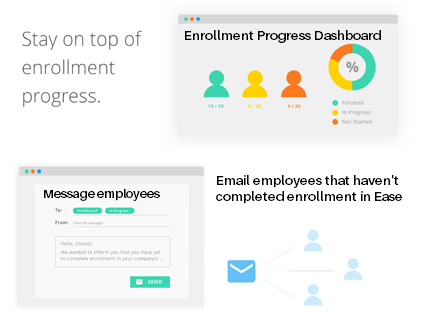
For an employee, Ease makes benefits visible in one place. Plans can be compared, costs examined by pay period, selections made and forms signed digitally. For an administrator, the value includes seeing who has completed enrollment and handling changes without treating every question as a fresh paperwork expedition.
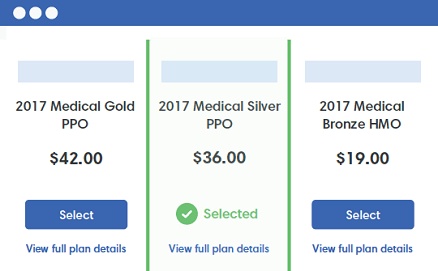
But selecting a plan on a screen does not finish the job. Enrollment information must reach the insurer. An attractive front end can leave an administrator doing the same old work behind the curtain. Ease’s carrier connectivity matters because it addresses that next handoff.
The company developed EaseConnect and EaseConnect+, offering self-service and managed connections. Its 2019 announcement named Principal, Guardian and Humana as early direct-connection partners. Guardian’s own description focuses on small groups, including those with two or more people, and on connecting dental, vision and worksite benefits.
Choose and sign
Manage the record
Receive enrollment
The handoff matters as much as the screen. Available connections depend on the carrier and group.
Payroll integrations extend the same logic. Employee details and benefit deductions can be synchronized with providers such as ADP Workforce Now, Paycor and Paylocity. Optional HR tools add time-off management and company directories. The employee app provides benefits access on iOS and Android. These are adjacent chores gathered around the benefits record, rather than unrelated features assembled for decoration.
Yet automation has an appetite: it consumes the data supplied to it. Employee Navigator’s October 2023 integration update identified shortcomings in Ease’s data validation and warned brokers against dummy Social Security numbers and dates. It also urged prompt recording of new hires and terminations. The awkward handoff was where errors could become carrier problems.
The practical lesson is easy to copy. Test the complete journey, including the receiving system. Give someone responsibility for accurate records and exception handling. Digitizing a form saves typing; digitizing a workflow requires knowing what happens when the form arrives.
A license for a book of business
Ease’s core subscription structure reflects the agency customer. The published Pro tier accommodates up to 2,000 employees and three agency users. Agency and Enterprise offer unlimited employees with six and ten agency users respectively. The core license is not a per-employee-per-month bill.
The distinction matters to an agency adding employer clients. Within the tier’s limits, growth in covered employees does not automatically create a new unit charge on the base subscription. More sophisticated reporting and access features belong to higher tiers. The buyer is purchasing capacity to service a book of business.
broker enablement / employer
per form, per year
per employee monthly
Ease website listings. Partner setup fees may apply; successor contracts can differ.
The extras restore some unit economics. An employer deciding what the software costs should separate the agency’s base license from optional HR services, reporting and partner integration charges. Otherwise, a tidy subscription pitch can disguise an untidy purchasing calculation.
Investors paid for the larger distribution proposition. A $6.5 million Series A in 2017 was followed by a $19 million Series B in 2019 and a $41 million Series C led by Spectrum Equity in 2021. The last round’s stated ambitions included expanding carrier relationships. The expensive part of simplicity was building enough connections for it to be useful.
The rival that bought the lesson
In March 2019, EaseCentral officially became Ease, the name customers were already using. The change came with a redesigned interface developed with MetaLab. Reid described expanding employer needs as a reason to move beyond enrollment into HR and compliance tools. Customers were asking for more of the work surrounding the original task.
By the 2021 investment announcement, Ease served more than 2,000 agencies and 75,000 employer clients. Its current website lists larger agency and employer figures, though those undated totals should not be mistaken for a fresh count of active users. The direction of the business was clear: the broker channel had carried the product to substantial scale.
Employee Navigator acquired Ease in April 2023. The announcement put the combined footprint above 150,000 businesses and 13 million employees. Those were combined-company figures, not Ease’s standalone customer count. George Reese, Employee Navigator’s founder, became chief executive of the combined company.
The revealing development followed that October. Reese acknowledged that Employee Navigator had concentrated on scaling integrations at the expense of some services brokers provided to small companies. Conversations with dozens of brokers changed his understanding. The acquisition brought a lesson about the work customers actually performed.
That is an instructive sort of competitive difference. A feature that appears minor in a platform comparison can matter greatly to the person administering twenty small employer accounts. Ease’s small-group attention was valuable enough for its owner to describe the gaps publicly and work to close them.
Two dates, and the work between them
In June 2026, Employee Navigator announced the schedule for retiring Ease as an active platform. It reported adding more than 300 features to Employee Navigator and said 95% of Ease companies were eligible to migrate without losing functionality at that point. The remaining gaps still mattered to the groups sitting inside them.
No new companies
New groups can no longer be added. Existing groups continue operating.
Read-only mode
Historical data and reporting remain accessible. Ease integrations and support end.
For brokers and employers, the useful question now is which groups are ready to move and when. Migration involves benefits configuration, employee records, documents and the people accustomed to finding them. The parent has provided migration tooling and training, but a transition still needs an owner inside the agency.
Ease’s approach suits an employer whose broker can configure the system and whose required carriers and payroll services fit the available connections. It offers less certainty when records are unreliable, a necessary integration is missing or a buyer needs a much broader HR system. The retirement calendar now adds another condition: an active Ease deployment needs a transition plan.
There is a durable business idea beneath that calendar. Find the person already trusted to solve the customer’s problem. Make that person’s work easier, follow the information through its least attractive handoffs, and price the product around how the customer earns a living. The insurance broker became the software department because somebody noticed the broker was already doing much of the job.
Keep following the paperwork
Ease website · Published pricing · Partner marketplace · 2027 transition announcement · Integration update
LinkedIn · X · Facebook · Ease blog · Watch: the employee enrollment experience