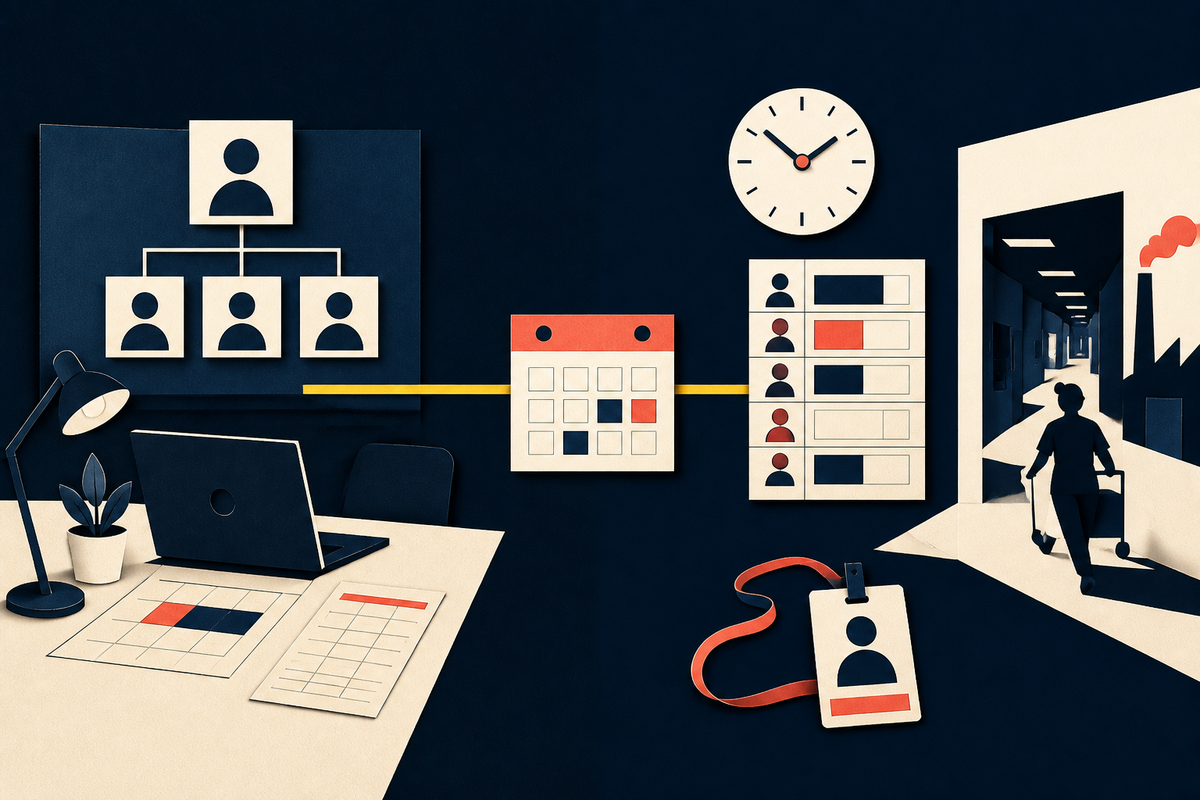
At 5:45 on a Tuesday morning, the HCM feature matrix has stopped being useful. A nurse calls out. A shift premium applies after a certain hour. The replacement is qualified but close to overtime. Somewhere else, finance is closing the quarter while HR models a reorganization across three countries. Both are people problems. They are not the same kind of people problem.
That is the useful way into Workday versus UKG. Both companies sell broad cloud suites spanning core HR, payroll, time, scheduling, talent, analytics, mobile access, and AI. On a procurement spreadsheet, the columns fill with reassuring checkmarks. In operation, however, their histories still shape where each product feels most at home.
Workday began in 2005 as a cloud platform for HR and finance. Its account base and reputation grew around large enterprises that wanted a shared model for people, money, planning, and organizational change. UKG arrived as a brand in 2020, when Kronos and Ultimate Software combined. Kronos brought decades of timekeeping and workforce-management experience; Ultimate brought cloud HCM and payroll. That ancestry is not destiny, but it is a useful clue.
The tie on paper is real
It would be lazy to call Workday the office system and UKG the time clock. Workday now markets time tracking, absence, scheduling, payroll, and workforce management inside its HCM suite. Its published customer list includes retailers, airlines, healthcare systems, manufacturers, and governments, not just software companies. UKG Pro, meanwhile, covers core HR, payroll, talent, employee experience, analytics, and workforce planning in addition to time and scheduling. It serves salaried as well as hourly workers.
The overlap matters because a simple category label can produce the wrong shortlist. A global retailer may value Workday's finance and planning connection. A professional-services company may still have intricate time, leave, and payroll rules that reward UKG's operational depth. The conventional split is a starting hypothesis. Your exceptions decide whether it survives contact with reality.
Those figures are not directly comparable. Workday says its total includes several acquired products and represents more than 80 million users under contract. UKG spans organizations from small businesses to global enterprises and says tens of millions use its solutions daily. Scale proves that neither is a niche wager. It does not tell you which one will handle your Thursday night payroll exception.
The expensive HCM mistake is rarely a missing feature. It is an everyday exception that sends people back to email and spreadsheets.
Workday starts with the enterprise model
Workday's strongest argument is coherence across the enterprise. HR, finance, planning, payroll, and workforce data can share a common platform and security model. For a company whose critical decisions run through headcount plans, organizational structures, skills, compensation, budgets, and financial reporting, that breadth can reduce reconciliation and give leaders a more consistent view of the business.
Its 2026 HCM materials emphasize a unified data core, real-time analytics, talent management, global payroll orchestration, contingent-worker visibility through VNDLY, and agent-assisted workflows. Workday reported fiscal 2026 revenue of $9.552 billion and said it delivered 1.7 billion AI actions during the year. The numbers suggest both reach and investment capacity, although they do not prove a particular customer's implementation will be simple.
The natural Workday buyer is often a large organization trying to standardize how people and money move together. A chief people officer may care about skills and mobility. Finance may want workforce plans tied to budgets. IT may prefer one extensible platform and a consistent permissions framework. Workday makes the most intuitive case when those cross-functional connections are the center of the project.
UKG starts where the shift gets messy
UKG's center of gravity is closer to the operating floor. Its workforce-management materials focus on real-time staffing, time and attendance, pay-rule enforcement, absence, scheduling, forecasting, mobile self-service, and dedicated time-clock hardware. It explicitly speaks to healthcare, retail, manufacturing, hospitality, logistics, public-sector, and other environments where coverage and compliance change hour by hour.
That focus comes from Kronos, but UKG is not merely Kronos under a new sign. Ultimate Software supplied a substantial HCM and payroll lineage, and the combined UKG Pro suite now presents HR, payroll, talent, workforce management, culture, and analytics as one environment. UKG says it serves more than 80,000 organizations across 150 countries.
The natural UKG buyer is often an organization where labor is scheduled, measured, and paid through dense rules. Think differentials, certifications, union agreements, rest periods, demand forecasts, transfers between locations, and managers filling open shifts from a phone. If a small failure can leave a ward uncovered or a store understaffed, workflow depth at the edge can outweigh elegance at headquarters.
Run the demo your worst day deserves
A polished vendor demo is theater unless it uses your rules, your roles, and your ugly data. The evaluation team should include HR, payroll, finance, IT, security, operations, and actual frontline managers. Give both vendors the same script. Score the number of steps, manual interventions, integrations, policy workarounds, and mobile dead ends.
The callout
A worker calls out shortly before a shift. Find an eligible replacement without breaking overtime, certification, availability, or fairness rules.
The bad punch
Correct a missed punch after approval and show every downstream effect on premiums, payroll, audit history, and manager workload.
The reorganization
Move a team across cost centers and countries, then trace permissions, reporting lines, budgets, open roles, and historical reporting.
The mobile minute
Ask a manager to approve time, fill a shift, and answer an employee question from a phone during an actual operating rush.
The global close
Reconcile payroll and workforce cost across countries, including where local engines or partners sit outside the core platform.
The audit trail
Explain who changed a schedule, timecard, pay rule, or worker record, why it changed, and what the system did next.

Implementation is part of the product
Neither platform is a weekend install. The software arrives inside an operating model: job architecture, pay policies, scheduling practices, security roles, integrations, data ownership, and manager habits. A buyer that treats those decisions as configuration trivia can spend heavily and still reproduce old friction in a new interface.
Ask for the implementation team, not only the sales team. Find out which modules are native, which require partners, how historical data will be handled, where payroll coverage depends on third parties, and how upgrades affect custom work. Demand references with your workforce shape, regulatory footprint, and labor agreements. Compare five-year cost, including implementation partners, integrations, support tiers, testing, internal staffing, and change management. Public list pricing is generally not the basis for a credible enterprise comparison.
Then measure adoption where work happens. An executive dashboard can look pristine while supervisors maintain shadow spreadsheets because the schedule takes too long to change. A self-service portal can technically exist while employees still call payroll. Product fit is the distance between the designed process and the one people use under pressure.
AI does not erase the old tradeoff
Both vendors now put AI at the center of their story. Workday talks about agents informed by HR and finance context. UKG describes Bryte AI and guidance drawn from workforce data. Useful applications are easy to imagine: filling open shifts, flagging compliance risks, drafting job descriptions, surfacing skills, answering policy questions, or explaining a payroll anomaly.
But AI amplifies the quality of the underlying system. A recommendation built on stale availability, inconsistent job codes, or incomplete pay rules is faster confusion. Buyers should ask what data produced an answer, which action requires human approval, how bias and errors are monitored, and whether an administrator can reconstruct the decision. The less visible the logic, the more important the audit trail.
The decision in one sentence
Choose Workday when the project's hardest problem is unifying enterprise HR, finance, planning, talent, and organizational data at scale, provided its workforce-management workflows pass your real scenarios. Choose UKG when time, attendance, scheduling, labor rules, and frontline execution carry the most operational risk, provided its broader HCM model and global architecture meet your enterprise needs.
For a mixed workforce, the answer may be less tidy. One vendor can be the core system while specialized tools or integrations cover gaps. That adds architecture and governance costs, but forcing every worker into a single compromise can cost more. The right outcome is not a logo. It is fewer payroll corrections, faster staffing decisions, cleaner data, and managers who can finish the work without opening another spreadsheet.
Frequently asked questions
What is the main difference between Workday and UKG?
Both are broad HCM platforms. Workday's center of gravity is unified enterprise HR, finance, planning, and talent data. UKG's Kronos heritage gives it a strong orientation toward time, attendance, scheduling, and complex frontline operations.
Is UKG only for hourly workers?
No. UKG Pro includes core HR, payroll, talent, analytics, and workforce management for salaried and hourly populations. Frontline depth is a differentiator, not a restriction.
Can Workday handle scheduling and time tracking?
Yes. Workday offers time tracking, absence, scheduling, payroll, and workforce-management capabilities. Organizations with complex labor rules should validate exact scenarios rather than assume every configuration is equivalent.
Which one is better for a global enterprise?
It depends on country coverage, payroll requirements, labor rules, workforce mix, and existing systems. Compare native coverage, partner dependencies, localization, data residency, and support in every relevant jurisdiction.
How should buyers compare the platforms?
Use scripted demos built from real exceptions. Score them with HR, payroll, finance, IT, operations, and frontline managers, then compare implementation effort and five-year operating cost alongside product fit.