- Humanity Schedule builds, fills and adjusts frontline shifts, then connects the result to payroll and HR systems.
- Its paid model starts at $2.75 per employee per month on an annual Essentials plan; forecasting and compliance begin higher up.
- The product works best when staffing is variable, rules are real, and a missed shift costs more than the software.
- The company’s best cautionary tale is internal: growth metrics can rise while customer quality quietly falls.
On a weekend sometime before 2009, Ryan Fyfe had two calendars. One belonged to the track. Fyfe, a Canadian middle-distance runner who had competed at national level, knew exactly when he was supposed to race. The other calendar belonged to whichever part-time employer happened to control his hours. That one was less cooperative. A schedule conflict could erase a competition, a social plan, or both. For an hourly worker, the rota was not office furniture. It was the border around the rest of life.
Fyfe eventually turned that irritation into ShiftPlanning, the product now sold as Humanity Schedule by TCP Software. The first version was, by his own later account, crude - a familiar calendar interface with basic scheduling functions, built in roughly four months and made commercially ready over the next two or three. It was not a grand theory of work. It was a better place to put Tuesday.
That modest beginning still explains the product better than its newer vocabulary does. Today Humanity talks about predictive demand, fit scores and AI-assisted backfill. But the unit of value remains recognizably human: a manager stops phoning down a list, an employee sees a change before arriving, and payroll stops retyping hours that another system already knows.
The grid is not the work
A schedule looks like colored rectangles. Behind each rectangle sits a person with availability, a pay rate, a location, perhaps a license, perhaps a school calendar, and very possibly an opinion. The manager has a budget and a coverage target. The law supplies meal breaks, rest periods, overtime limits and special rules for minors. Then someone calls out at 6:12 a.m.
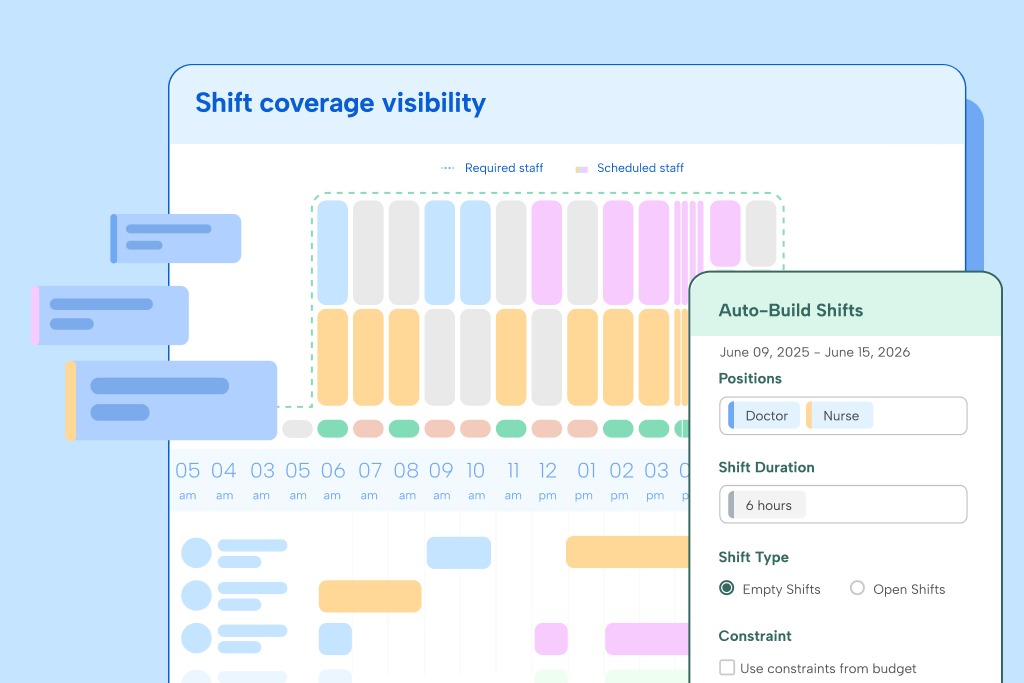
Humanity turns those constraints into a shared system. Managers drag and drop shifts, publish openings, check conflicts, track leave and compare scheduled labor with demand. Employees use the web or mobile app to see schedules, change availability, request time off, swap a shift or claim an opening. The app can also clock people in and out with geofencing. At larger organizations, data moves between Humanity and systems such as Workday, ADP, Oracle or BambooHR.
The newest expression of this logic is Backfill, introduced in 2026. It scores potential replacements using availability, pay, location, compliance rules and historical shift behavior, then contacts eligible workers either together or in sequence. The manager can see whom the system contacted and when coverage is accepted. This is a sensible use of automation because the machine is not inventing a staffing need. It is compressing the tedious search created by one.
“The schedules were important to you. It makes the difference between being able to hang out with your friends.”Ryan Fyfe, founder
Free first, patient second
Humanity had no paying customers for its first six months because Fyfe gave the software away. He pursued people already writing about small-business software, asked to appear in their lists, concentrated on the product and helped customers get started. The team would load a first schedule, enter staff profiles and train people through the trial. It was less a funnel than an escort service.
The motion was slow, then it was not. Fyfe later recalled annual growth climbing through 100 percent, 200 percent and eventually 500 percent. Reviews and word of mouth accumulated. In 2014, the renamed company raised a reported $3.2 million. In February 2015, a $9 million Series B led by MHS Capital followed, with Point Nine Capital, Klever Internet Investments, Team Builder Ventures and Boku chief executive Mark Britto participating.
Here is the transferable part: the company did not initially win by asking a small business to redesign itself. It accepted the familiar calendar, handled the first data entry and let staff use their phones. The old behavior had an obvious replacement. That approach is copyable when a product removes a recurring task and a customer can feel the difference inside one work cycle.
When the numbers lied
Then Humanity tried to manufacture more velocity. It built a larger sales development team, chased leads quickly and tilted the culture toward commissions and month-end results. For a while, the graph behaved beautifully. Underneath it, Fyfe said, representatives were closing customers who were not ready and overselling what the product could do. Some warm inbound leads were credited as outbound wins. In the ugliest example he described, a salesperson’s girlfriend entered a credit card to help complete deals.
The failure did not appear first in revenue. It appeared downstream, where support and customer-success teams inherited buyers who should not have been sold. Fyfe discovered the problems while a major funding round was approaching and concluded that sales metrics had been unreliable for some time. He let people go and returned the company toward the model he already knew: product education, careful onboarding, better lead scoring and different treatment for different customer sizes.
What another operator can copy
Watch the handoff after the sale. If support volume, onboarding friction and early churn worsen while bookings rise, the sales number is borrowing credibility from the rest of the company. Segment buyers before scaling headcount. A 50-person business can purchase quickly; an enterprise may need a pilot, security review and six-to-nine-month cycle. One funnel should not pretend they are the same.
That correction also clarified Humanity’s place in the market. A small business might use one tool for scheduling, time and basic HR. A 30,000-person enterprise already has a system of record. Humanity does not need to replace it. It can read employee data, solve the specialized scheduling problem and pass time or payroll information back. This narrower job is less theatrical than “all-in-one,” and more believable.
The price of a quieter Tuesday
The economics are easiest to defend where the mess has a price. OPTIONS, a Canadian nonprofit, moved vacation requests and schedules off paper and cut payroll processing from a full week to three days. Atrium Health’s Carolinas Simulation Center reported halving scheduling time. A Bayer manufacturing site said it reduced the time required to prepare the next day’s production schedule by roughly 75 percent. These are vendor-published customer results, not universal promises, but they reveal the buying logic: recovered administrative hours, fewer corrections and better coverage.
The conditions matter. A five-person shop with fixed hours may be perfectly served by a shared calendar. Forecasting will disappoint if historical demand is irrelevant or the underlying availability data is stale. Automation cannot compensate for missing skill records, ambiguous policies or a payroll integration nobody owns. And per-employee pricing becomes meaningful at scale, especially when advanced functions sit in higher plans or add-ons.
Humanity is different from lighter scheduling apps less because it has a calendar - everyone has a calendar - than because it treats exceptions as the main event. Demand changes. Certifications expire. Teenagers go back to school. A nurse needs a rest period. Someone wakes up sick. The software earns its place when these facts collide often enough that a neat spreadsheet becomes an expensive fiction.
A company named for the variable
TCP Software acquired Humanity in December 2020, when it said the product served more than 175,000 business locations. Humanity now sits beside TimeClock Plus and Aladtec in TCP’s workforce-management portfolio. It has gained demand forecasting, task tracking, minor-labor controls, integrations and Backfill. The product has traveled far from a runner’s weekend problem, though not away from it.
Every scheduling system is an argument about which inconvenience deserves to move. The old clipboard moved it onto the employee, who had to discover changes. The heroic manager moved it onto herself, making calls before dawn. Humanity’s wager is that software can absorb the repetitive part - sorting constraints, distributing updates, recording decisions - while people keep authority over the parts that need judgment. The grid is tidy. Life remains gloriously uncooperative.