The waiter had one job in this story: know about the basketball promotion. His restaurant’s general manager had rolled it out with headquarters and, naturally, wanted to hear how customers were responding. He asked the waiter. The answer was four wonderfully expensive words: “What promotion?” Somewhere between the conference room and the counter, the message had vanished.
Amir Nehemia, who co-founded Connecteam with Daniel Nuriel and Yonatan Nuriel, has described that restaurant exchange as one of the moments that changed the company. Their product then focused mainly on employee training. The promotion fiasco pointed to a much larger mess. Frontline employees did not merely need lessons. They needed schedules, updates, forms, tasks, reference material and a clean line back to the people running the place.
That observation became Connecteam’s real product: a mobile management layer for people who do not begin the day by opening a company laptop. Founded in 2016, the New York-headquartered, Israeli-rooted company now says more than 36,000 organizations in 80 countries use its software. Its trust center counts more than one million active users. The named customers range from SodaStream and Sodexo to Saint-Gobain and Berry Global, while its case-study library roams through security, cleaning, home care, transport, restaurants, fitness and hospitality.

01 / The product
The software drawer, compressed
A typical field manager’s “system” can be a spectacular junk drawer: shifts in a spreadsheet, hours on paper, announcements in WhatsApp, procedures in a binder, photos in somebody’s camera roll and payroll corrections arriving by text on Sunday night. Connecteam’s pitch is consolidation. Give each worker one app and each administrator one dashboard.
Operations
TIME CLOCK + GPS / JOB SCHEDULING / FORMS / CHECKLISTS / QUICK TASKS
Communications
CHAT / COMPANY UPDATES / DIRECTORY / SURVEYS / EVENTS / KNOWLEDGE / HELP DESK
HR & Skills
COURSES / QUIZZES / DOCUMENTS / TIME OFF / RECOGNITION / REWARDS / ONBOARDING
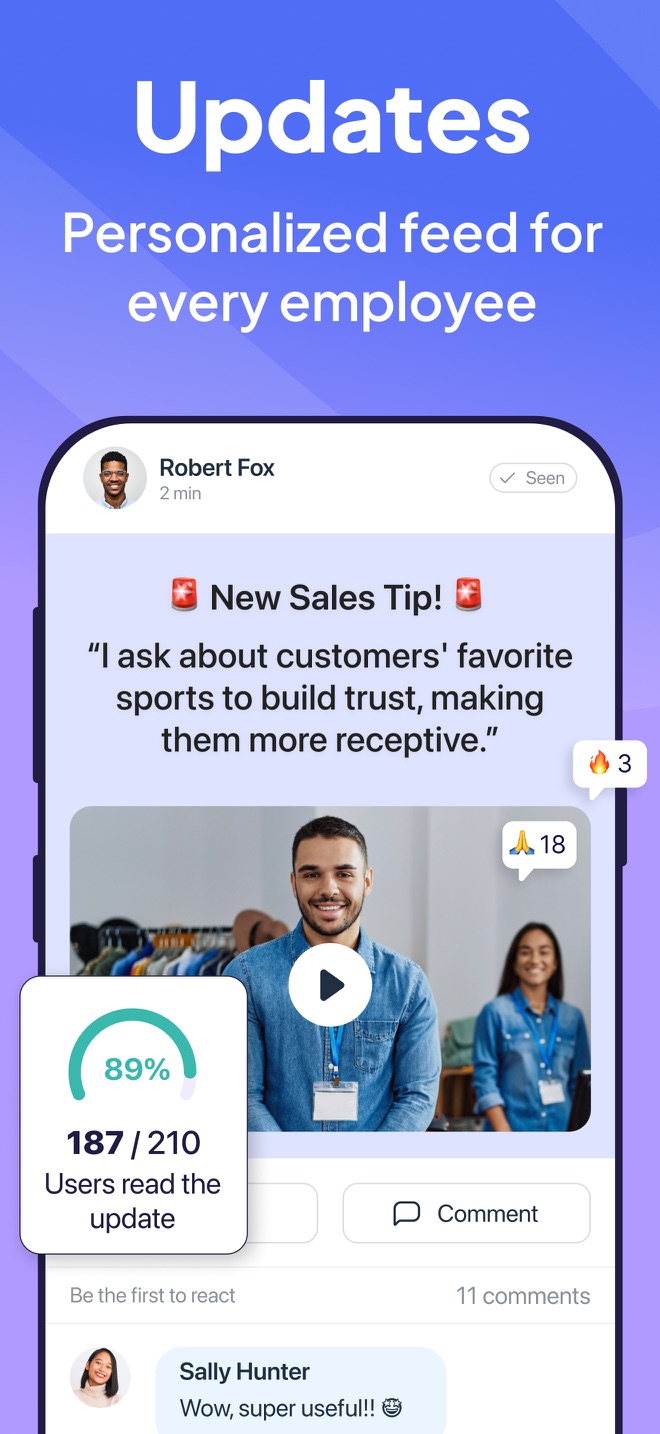
The Operations Hub handles the shift itself: a GPS-enabled clock, schedule, tasks and digital paperwork. Communications carries the memo that our waiter never received, with chat, announcements, read data, surveys, a directory and a knowledge base. HR & Skills starts where Connecteam itself started, with mobile courses and quizzes, then adds documents, time off, milestones and recognition.
The distinction matters. Slack can deliver a message. A scheduler can fill a shift. A time-clock app can record hours. Connecteam tries to preserve the chain among them: the person is assigned, notified, clocked in at the right location, given the checklist, shown the procedure and eventually exported toward payroll. That workflow is the moat, such as it is. The individual features are familiar; their proximity is the point.
“There is no need to have several apps.”Amir Nehemia, co-founder and CEO
02 / The market
The worker office software forgot
Connecteam calls its audience “deskless,” a term broad enough to include a nurse, line cook, security guard, cleaner, delivery driver, retail associate and construction crew. Their shared characteristic is an absence: no dedicated desk, often no work email, frequently no corporate device. Software designed around channels, tabs and hour-long onboarding sessions can feel like office cosplay in that setting.
The company’s best distribution claim is almost anti-enterprise. “You don’t require IT to implement Connecteam,” Nehemia told TechCrunch in 2022. That is a sharp promise for an owner-operator who is also writing next week’s rota. A free plan covers businesses with up to 10 users, and a 14-day trial gives larger teams the full tour without a credit card.
That published annual rate covers the first 30 users on a Basic hub. Advanced and Expert tiers cost more, extra users add a monthly charge, and Enterprise pricing is negotiated. A company buying all three hubs should price the bundle, not admire the entry number.
This modular model is clever and slightly mischievous. A small firm can pay only for Operations, or mix Expert Operations with cheaper Communications and HR tiers. Yet “all-in-one” is only all-in once the buyer has bought the relevant hubs. The $29 headline is real; so is the multiplication. For a team replacing four vendors, the arithmetic can still be attractive. For one replacing a single scheduler, it deserves a spreadsheet.
03 / The turn
What failed first, and what changed their minds
Mobile Lesson, the founders’ earlier training product, was not a cartoonish disaster. It solved a legitimate problem. Its weakness was scope. Training happened occasionally; operational confusion happened every shift. Conversations with customers showed that managers were duct-taping the lesson to a wider set of unresolved jobs. The waiter’s blank stare made that abstraction visible.
The founders widened the product around the worker’s day while keeping the phone at the center. The bet required capital. A disclosed $1 million seed round arrived in 2016. Insight Partners, O.G. Tech and investors from Wix leadership backed a $37 million Series B in April 2021, after Connecteam reported more than 400 percent customer growth in 2020. Eleven months later, Stripes and Insight co-led a $120 million Series C with Tiger Global, Qumra Capital and O.G. Tech participating. Contemporary reports put the valuation above $800 million.
What did that growth cost? At least $158 million in disclosed equity financing, plus an undisclosed credit facility recorded in 2025. Money bought product breadth, customer acquisition and headcount. It also raised the standard. A three-hub platform cannot merely be a prettier pile of tools. Each handoff has to work, administrators must understand permissions, and workers have to tolerate one more app on a personal phone.
04 / The edge and the catch
Broad enough to win, broad enough to wobble
Connecteam’s alternatives depend on which drawer a buyer opens. Deputy, Homebase, When I Work and 7shifts contest scheduling and hourly operations. WorkJam, Blink and Beekeeper chase frontline communication. Workstream leans into hiring; Microsoft Teams owns an enormous office beachhead. Specialist field-service and HR suites go deeper in their chosen lanes.
Connecteam wins when the real competitor is fragmentation. A multi-location operator that needs scheduling, GPS time, checklists, announcements and training can consolidate logins and employee records. Payroll integrations with ADP, QuickBooks, Gusto, Xero, Paychex Flex and others let approved hours leave the platform instead of forcing Connecteam to become the payroll engine everywhere.
Where it clicks
- Hourly or mobile teams share recurring shifts and procedures
- Managers want one employee directory across several locations
- Paper forms and personal group chats create costly handoffs
- The business lacks a large IT implementation team
Where it strains
- Complex native payroll or enterprise HRIS depth is essential
- Recruiting, succession planning or advanced analytics lead the purchase
- The workforce is desk-based and existing office tools already work
- Employees cannot reliably use phones or maintain connectivity
There is a human condition, too. GPS clocks, geofences, read receipts and activity logs can save honest payroll arguments or create a surveillance mood. The software cannot decide that policy. Employers need clear consent, restrained location rules and an explanation of what is tracked, when and why. A technically compliant rollout can still fail socially.
The product is also marching into gaps that once marked its boundary. In 2022, recruiting was explicitly missing. By March 2026, Connecteam had shipped hiring pipelines and guided onboarding; later releases moved candidate documents into employee files. Its AI agent gained usage analytics and custom instructions, while forms, scheduling and payroll visibility continued to deepen. The roadmap suggests a company determined to own more of the employee lifecycle without abandoning the shift.
05 / The copyable bit
Follow the broken handoff
The most useful Connecteam lesson is not “build an all-in-one.” That instruction has produced plenty of software cupboards with a search bar. The lesson is to watch where a specific user loses context. The restaurant promotion failed between headquarters and the counter. Once Connecteam found that seam, adjacent needs became legible: prove the update was read, attach the procedure, schedule the person, capture the checklist, reconcile the hours.
A five-step field note for builders
- Choose an ignored user, not a fashionable category.
- Observe the workday and mark every switch between paper, chat and software.
- Find the handoff where money, time or information disappears.
- Bundle adjacent jobs only when the same user and record connect them.
- Price the first useful workflow within reach of a manager who can buy it alone.
It will not work under every condition. Breadth becomes clutter when jobs share no common record. Mobile-first becomes mobile-only when a worker needs a large planning surface. Self-service breaks when regulations or integrations demand a lengthy deployment. And low entry pricing loses its charm if a buyer needs three top-tier hubs plus specialist systems anyway.
Still, Connecteam has identified a durable indignity in modern work: the people closest to the customer are often the last to get the memo. Its business turns that missing message into a schedule, a clock, a course, a form and a record. The waiter may never know he helped redraw a software company. One hopes he at least got the promotion.
Explore Connecteam