Payroll usually fails in the least cinematic way possible. A foreman texts a missing punch. A manager fixes a spreadsheet. Someone exports hours from one system and imports them into another. Then Friday arrives, and the owner discovers that one innocent typo has become everybody's emergency. Fingercheck built its company around that dull, dangerous gap between work performed and money received.
The Brooklyn software maker begins upstream of the paycheck. An employee clocks in by phone, browser or physical time clock. GPS, geofencing and optional photo verification can establish where the punch happened. A manager reviews hours, job codes, overtime and paid time off. Approved data then moves into payroll without a separate re-entry ritual. Taxes, direct deposit, year-end forms and employee records sit nearby. The point is less "all in one" than "do not make the same number travel by hand twice."
That matters most to the businesses Fingercheck courts: contractors, cleaners, property managers, healthcare facilities, manufacturers, restaurants and field-service companies. Their workers are distributed across shifts, buildings, job sites and sometimes state lines. Their owner may also be the finance department and the emergency scheduler. Enterprise HR systems often treat this kind of work as a complication. Fingercheck treats it as the main event.
The humble punch was the wedge
Founder Joel Kohn launched Fingercheck in 2013 with time and attendance. It was a sensible first product because a punch is frequent, necessary and close to money. Once the system knew who worked, where and for how long, the adjacent questions arrived naturally: What should the schedule have been? Which job absorbed the labor? How much tax is due? When can the worker access those wages?
Fingercheck followed that chain. It added automated payroll, hiring, onboarding, scheduling, team chat, benefits administration, workers' compensation tools, employee documents and Pay On-Demand. The latter lets eligible employees access earned wages before the regular payday. The company also sells physical time clocks, a reminder that "cloud software" still needs a door into warehouses and job sites where a shared terminal may beat another app.
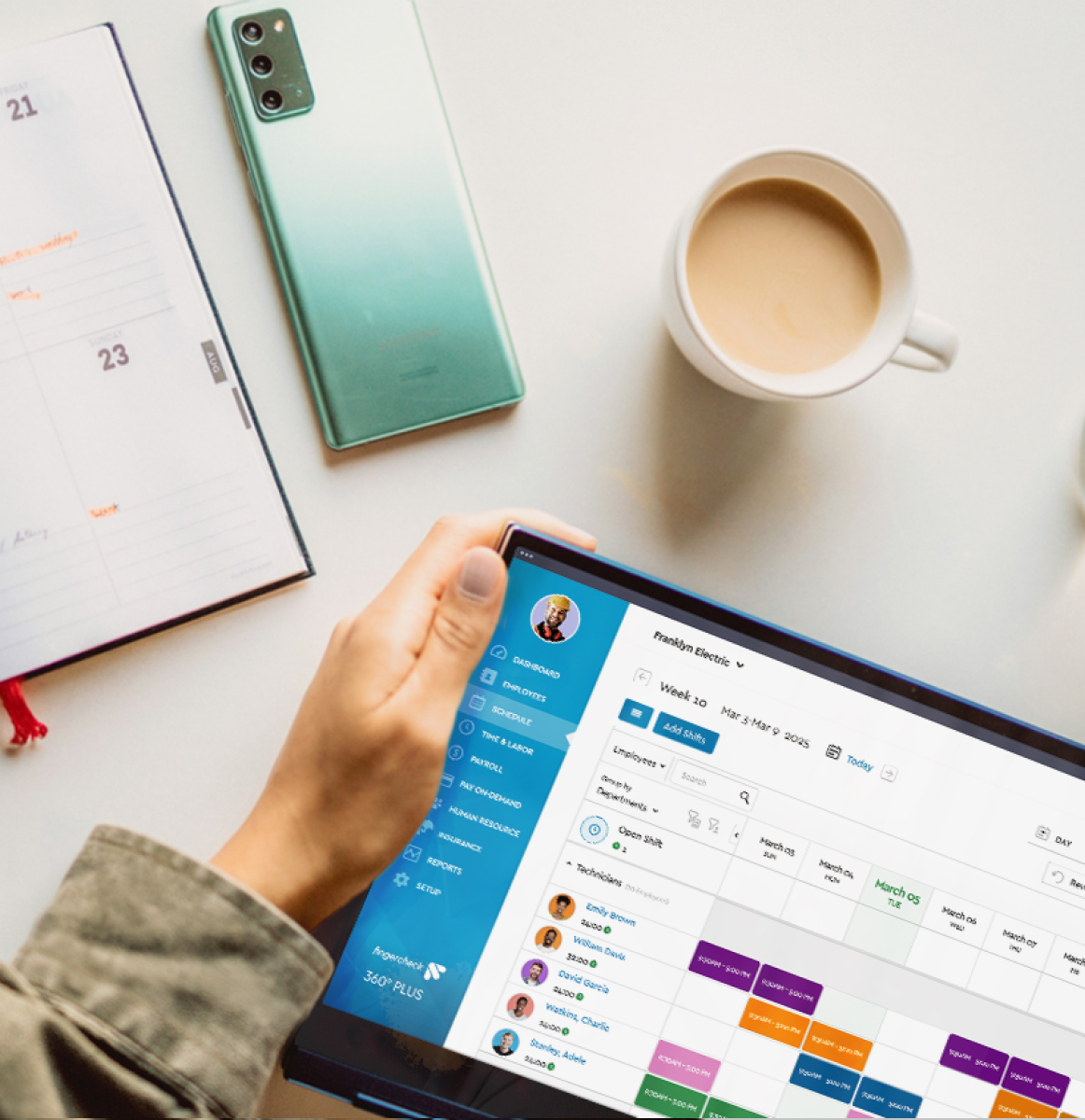
The handoff Fingercheck wants to delete
The copyable lesson is not "build a giant suite." It is nearly the opposite: own a painful event that happens constantly, make its data trustworthy, then expand one handoff at a time. Time tracking earned Fingercheck a place in the daily workflow. Payroll made that position valuable. Scheduling, onboarding and compliance deepen it because they reuse the same employee record.
“We’re doing our jobs right if you hardly ever think about us.”Fingercheck's stated vision
What $115 million bought - and changed
For its first decade, Fingercheck grew without a disclosed institutional round of this size. Then, in October 2024, Edison Partners led a $115 million growth investment alongside StepStone Group and Columbus Capital. KPMG advised Fingercheck. The transaction also changed the top job: technology executive Dan Kazan became chief executive, while Kohn moved into the chief strategy officer role.
The capital was earmarked for product development, technology, hiring and go-to-market expansion. The leadership change says as much as the check. A founder who had built an integrated product for thousands of companies was choosing a partner and an operator to pursue a much larger national market. Edison described Fingercheck as profitable, capital-efficient and growing organically. The Wall Street Journal reported annual growth above 25 percent and revenue in roughly the $20 million to $30 million range at the time of the deal.
What changed their mind? Kohn's comment to KPMG is revealing: as a first-time founder, he wanted a growth partner that shared the company's values and understood the path forward. This was not presented as rescue financing. It was the moment a bootstrapped-style operating rhythm met an expansion thesis. New metro markets, a larger sales effort and more product specialization would require more than the founder's existing playbook.

The proof is measured in Friday afternoons
Fingercheck's strongest evidence comes from customers who can name the time or money they stopped losing. Central Park Cleaning, a 40-person company, had common timekeeping and paid-time-off errors. Employees struggled to see hours and pay stubs. After adopting Fingercheck's mobile tools, the company reported a 25 percent improvement in operational efficiency and began referring other businesses.
Forestdale Apartments offers the cleaner before-and-after. Monthly payroll processing fell from as much as an hour to 15 minutes. Unplanned overtime declined about 10 percent. The property manager estimated annual savings of $5,000 to $10,000 and five to ten administrative hours returned each week. Focus Health Network, which runs skilled nursing and rehabilitation facilities in Pennsylvania, reported saving roughly two hours per day after bringing scheduling, payroll reports, onboarding and documents together.
Then there is Bickmore Construction, a 17-employee contractor. Its first failure was not a biometric clock or a fancy analytics module. It was trust. The previous payroll provider would not produce the reports Bickmore wanted or explain per-employee charges clearly. Fingercheck gave the company on-demand reports and visibility into cost by position. Bickmore says the switch saves $500 a month.
“Fingercheck has made a world of difference in our lives as a small company. Everything from the onboarding process to payday each week.”September Liller, operations manager, Bickmore Construction
These are Fingercheck case studies, so they deserve the same caution as any vendor-published success story. But the details are useful because they identify where value appears: fewer duplicate entries, earlier overtime visibility, self-service pay stubs, clearer bills and less waiting for a vendor to run a report. None requires a futuristic theory of work. The customer simply gets a few hours back and fewer payroll surprises.
A price tag designed around headcount
Fingercheck sells monthly subscriptions with a base fee and a charge per active employee. Its public entry plan for time and attendance starts at $29 a month plus $7 per employee. The 360 plan starts at $79 plus $10 per employee and adds unlimited payroll, tax calculations and filing. The 360 Plus plan starts at $129 plus $12 per employee and adds features including next-day pay, workflow automation and benefits administration. Standard plans have a minimum spend equivalent to five employees; optional services can add fees.
That makes a hypothetical 20-person company pay about $169 a month for time and attendance, $279 for 360 or $369 for 360 Plus before add-ons, hardware and year-end charges. The meaningful pricing choice is unlimited payroll runs. A restaurant or contractor with corrections, bonuses or off-cycle payments does not create a new fee every time it needs another run. Fingercheck also bills per active employee, a detail pitched to seasonal employers.
Distribution has its own economics. Accountants and bookkeepers can place multiple clients in a partner portal and receive recurring referral revenue. Published commission tiers run from 8 to 15 percent of a referred client's monthly subscription. That turns the professional already fielding payroll questions into both operator and sales channel.
Different by focus, not by feature count
Fingercheck competes with ADP, Paychex, Gusto, QuickBooks Payroll and Rippling, while time and scheduling specialists such as Homebase, Deputy and When I Work attack pieces of the same workflow. It also competes with the surprisingly durable stack of clock plus spreadsheet plus accounting software. Almost every rival can produce a long feature checklist. Fingercheck's distinction is the center of gravity: hourly and deskless work, where location, job costing, multiple positions and schedule exceptions are first-order product decisions.
Its same-cycle multi-state calculation is a good example. A worker who crosses state lines can create tax complexity inside one pay period. Fingercheck says it calculates the relevant state taxes in one payroll cycle rather than forcing separate runs. In construction, seven levels of job costing can tie labor back to sites, tasks and cost centers. In healthcare, newer tools track credentials, scheduling requirements and Payroll-Based Journal reporting. These are operational details, not generic HR database fields.
Strong fit
Hourly teams spread across shifts, job sites, facilities or states; managers who need time, job cost and payroll data to stay connected.
Think twice
Tiny salaried teams with simple monthly payroll, global workforces needing country-by-country employment infrastructure, or large enterprises requiring deeply bespoke HR systems.
The model also depends on clean setup and managerial discipline. Geofencing cannot repair a bad overtime policy. Automation can move an incorrect pay rate faster. Physical clocks need maintenance, mobile punches need worker adoption, and payroll taxes remain high-stakes even when the interface is pleasant. Businesses with only salaried office staff may find the time-and-job machinery unnecessary. Multinational employers or very large enterprises may need broader global coverage and customization.
The larger strategic risk is expansion itself. Fingercheck won attention by treating deskless SMBs as the whole market rather than a footnote. Growth capital encourages more markets, more verticals and more modules. The company must add without turning its neatly connected workflow into the same software junk drawer it set out to replace.
The unglamorous ambition
Fingercheck's stated mission is to give everyday businesses tools usually associated with enterprises. Its more memorable vision is quieter: it is doing the job correctly when customers hardly think about it. That is not false modesty. Payroll software becomes famous inside a company only when it is late, wrong or confusing.
The product's promise is therefore best understood as subtraction. Remove the export. Remove the mystery fee. Remove the hunt for a missing certification, a pay stub or a worker's current location. Make the clock-in carry enough context that every later step becomes easier. If Fingercheck can preserve that logic while spending $115 million on growth, its most impressive outcome may be the one its customers barely notice: payday arriving with nothing interesting to report.
Keep exploring