At Crisis, the homelessness charity, annual leave had become a months-long calculation problem. Working out entitlements and bank holidays for part-time staff took about two-and-a-half months, according to its customer account. A report customised with Ciphr reduced the final calculations to two-and-a-half hours. A small administrative epic had acquired a much shorter ending.
The telling detail is the report. This was a specific process rebuilt around the information the charity needed. In the same account, Crisis described connecting its HR and learning systems, then repeatedly testing the connection. The work happened in the plumbing: which record travelled where, whether it was correct, and whether people could use it. Crisis’s account.
Ciphr sells that sort of plumbing, along with the applications attached to it. Its cloud software covers employee records, pay, recruitment, learning and benefits. For a manager, the attraction might be approving leave without an email exchange. For HR, it might be getting a reliable answer without assembling another spreadsheet. The product has several audiences; the wasted effort often sits between them.
Reported time for manual leave calculations versus the final calculations using a customised report. A task-specific result, not a forecast for every implementation.
A British business with a very specific middle
Ciphr’s stated sweet spot is a UK organisation with 200 to 2,000 employees. That is enough people for awkward pay arrangements, multiple workplaces and serious reporting demands, yet still a scale at which an afternoon lost to checking data hurts. Its sector coverage includes charities, education, financial services and manufacturing. The unifying characteristic is operational complexity. Ciphr’s stated market.
Its customer names are unusually varied: the Natural History Museum, Crisis, Volkswagen Group UK and Lifetime Training appear in its public material. These are customers of different parts of a broad offering, rather than evidence that every organisation buys the same package. In December 2025, Ciphr put its group-wide customer base above 1,400 organisations. Its coaching announcement.
The company’s expertise rests partly in its UK focus. Payroll software needs to deal with the actual rules and routines of paying people here. Ciphr combines calculation and reporting tools with UK payroll specialists, and offers outsourced services for employers that want help running the process. The software purchase and the decision about who operates payroll are related but distinct choices. The payroll offering.
Follow the employee, lose the duplicate record
The central HR product holds employee information, absence, performance records and self-service functions. Recruitment software manages the earlier stages: vacancies, applications and the move toward onboarding. Together, they address a familiar weakness in office administration: the same person can become several separate records before their first morning at work. Inside Ciphr HR. Its recruitment tools.
With connected HR and payroll, a change should travel to the people responsible for pay without someone copying it over. Ciphr’s implementation description includes migration, configuration and parallel payroll testing before launch. That last step matters. A first live payroll run is an expensive occasion to discover what an imported field really means. The implementation approach.
Learning has its own operational rhythm. The LMS delivers courses and tracks completion; HR records supply the organisational context. Ciphr describes weekly implementation workshops and two readiness reviews, aiming to get LMS customers ready for launch in under eight weeks. It is a target with preparation attached, rather than an invitation to skip the homework. The LMS rollout.
Applicant→02
HR record→03
Pay + learn
One illustrative journey through the suite. Actual connections depend on the products and configuration selected.
The customer who gave the system a name
Lifetime Training called its HR and learning environment Milo. In Ciphr’s published account, the training provider had more than 1,200 staff and an HR team of 16. Its previous system had become largely an administrative store. The rollout began with familiar functions, then moved through self-service and other capabilities before talent management and learning.
Candidate details flowed from its existing recruitment platform into Ciphr, reducing manual entry. Sensitive onboarding documents could be collected in the system rather than arriving by email. The useful change was visible in everyday tasks, which gave the project a concrete purpose beyond replacing old software.
There was also a change of mind about buying support. “At first I was sceptical,” Delgado said of the additional service package. Access to training and consultancy proved useful for configuring the system. The lesson from this account is practical: budget for learning how to use the thing you have bought. Lifetime’s experience.
“At first I was sceptical”Delgado, Lifetime Training, on the additional Ciphr Service Package
Three acquisitions, three more parts of the working day
Ciphr’s expansion helps explain why its catalogue now covers so much ground. ECI Partners announced its investment in January 2021, identifying it as a 2020 transaction. The investor explicitly described growth through both the existing business and acquisitions. At the time, connecting proprietary HR software to customers’ existing tools was already central to the proposition. ECI’s investment announcement.
In April 2023, Ciphr bought Marshall E-Learning for an undisclosed sum. That added specialist training content and diversity and inclusion expertise. Founder David Marshall and his team joined the group. An HR database can tell an employer who has completed training; a learning-content business supplies something worth assigning in the first place. The learning acquisition.
Shape Payroll followed in June 2024. Its founders, Alex and Cheri Bartlett, joined Ciphr with their team. Shape brought a cloud payroll platform built around API connections and, at the time of the deal, used by 1,500 UK businesses. That transaction strengthened the payroll technology behind Ciphr’s wider ambitions. The Shape deal.
November 2024 brought Avantus, including the FlexGenius benefits platform and white-labelled MyWorkPal. It served more than 400 businesses at acquisition. The deal added a place for employees to view and manage benefits such as cover, discounts and salary-sacrifice choices. Ciphr could now address another regular exchange between employer and employee. The Avantus deal.

The learning business brings an unexpected creative department into the picture. Marshalls describes developers, illustrators, graphic designers and writers supporting its subject specialists. Its first course, developed with friends at ACAS, was called “Diversity in the Workplace.” Software expertise here includes explaining difficult workplace situations, as well as building the screen that displays them. The learning team’s history.
Read the footnote under £5
Ciphr sells subscriptions shaped by headcount, modules and support requirements. Its published HR starting price is £5 per employee per month, based on 125 employees and a three-year minimum term. At that illustrative scale, the arithmetic is £7,500 a year, or £22,500 across 36 months for the base subscription. Implementation and the full scope belong in the tailored quote. Published pricing.
That is a useful starting point for a buyer’s worksheet. Put the subscription beside the internal hours spent cleaning records, preparing migration and training administrators. Then identify the task that should become faster or disappear. A lower licence bill and a lower operating burden are different measures, and a purchasing team needs to examine both.
Base HR subscription arithmetic over three years. This is an illustration, not a full-suite quote.
Connected software is also a competitive field. BambooHR’s marketplace, for example, offers Flexspring integrations that move new-hire and employee changes into other systems. Ciphr’s case therefore rests on the fit of its UK offering, support and chosen connections, rather than integration being an exclusive invention. BambooHR’s integration listing.
Ciphr itself keeps specialist partners in the mix: Webexpenses for expenses, ShopWorks for workforce management and Vacancy Poster for job-board posting. An integrated suite does not make every specialist tool redundant. Buyers should bring their existing stack to the demonstration and follow the precise data they need to move. Ciphr’s partner directory.
Now the records can answer back
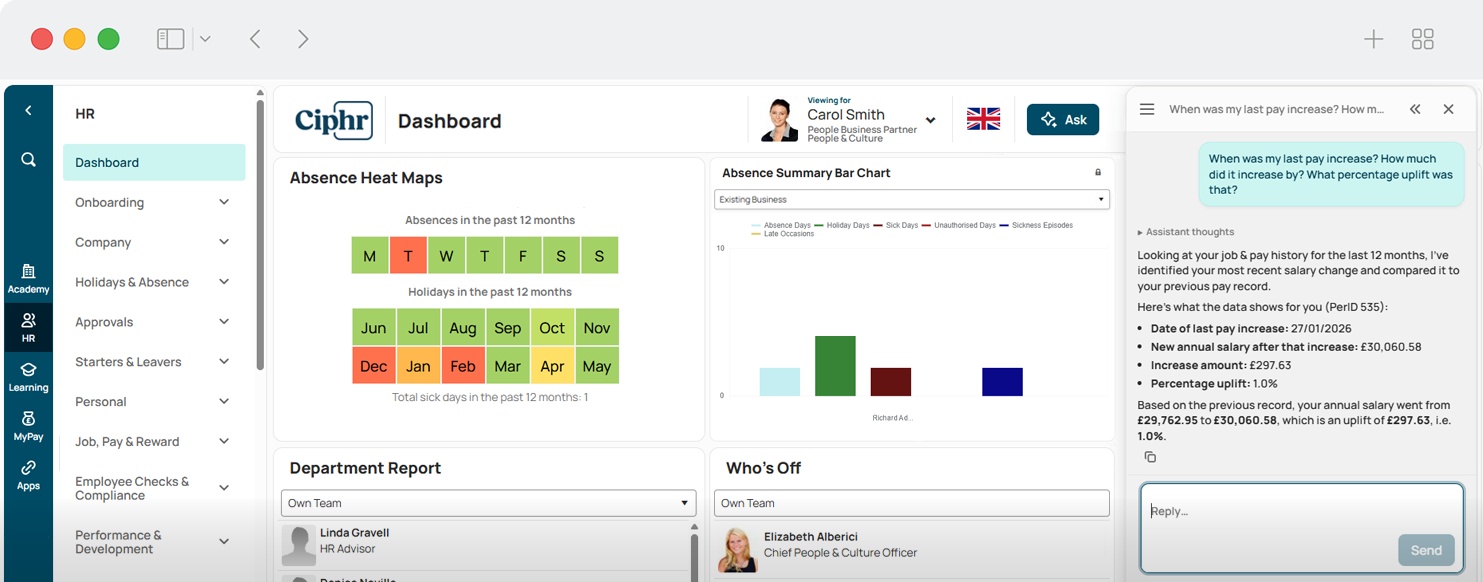
In May 2026, Ciphr announced the rollout of its HR AI assistant. Users could ask conversational questions about HR data, with access governed by existing role permissions. Employees could check holiday allowances and book time off. At launch, answers about organisational policies were described as forthcoming, a useful distinction between a released function and a roadmap. The assistant’s launch.
The December 2025 MyTeamBuilder joint venture added a different use of AI: personalised coaching based on psychology. These products address different jobs. Retrieving an employee’s leave balance has a specific answer; advising someone on a difficult conversation requires interpretation. A sensible evaluation treats those as separate exercises, even if both arrive with an AI label.
There is external recognition for the less conversational side of the business. The Chartered Institute of Payroll Professionals named Ciphr its 2025 Software Product of the Year. An award cannot describe every implementation, but it supplies a concrete achievement alongside the vendor’s own account of its products. The CIPP winners.
Someone still has to own the record
Ciphr’s August 2026 administrator guidance spells out responsibilities for configuring and maintaining HR, plus the separate sign-in area controlling authentication and global security. Automation leaves an employer with decisions about access, ownership and maintenance. A connected mistake can travel efficiently too. Administrator guidance.
The company advertises hybrid working, with office attendance varying by role and monthly anchor days for largely remote teams. Its careers pitch emphasises dependable releases and timely customer answers. Those priorities fit a product whose users need continuity: payroll does not postpone itself because a software team is busy. Life at Ciphr.
For a buyer, the repeatable approach is to pick one costly handoff, establish its current workload, assign a data owner and test the replacement with real exceptions. Ciphr’s UK focus may suit that exercise well; employers needing extensive overseas payroll or only a small leave tracker should test the fit carefully. The persuasive demonstration ends with less work on somebody’s desk.