A trivia game and a health-insurance form make peculiar neighbors. One invites you to stay for another question. The other offers a deductible, a deadline, and the faint hope that last year’s choice will do. Jellyvision built both kinds of experience into its history. The intriguing part is the skill that traveled between them: persuading a person to keep listening to a computer.
- The old craft: conversational games that held a player’s attention.
- The new customer: employers trying to explain complicated benefits.
- The engine: ALEX combines education with personalized decision support.
- The next move: ALEX Home brings guidance closer to enrollment and administration.
01A game-show skill looking for a new audience
Harry Gottlieb’s business began in educational media in 1989. You Don’t Know Jack arrived in 1995, making trivia feel like a conversation with an irreverent host. Then the market moved. As games shifted away from the CD-ROM business, the original company shut down in 2001; Jellyvision Lab emerged the following year to apply interactive conversation to business. The company’s history contains a useful distinction: the benefits business and the games studio that became Jackbox share roots, but have different jobs.
The first thing to fail was the old market. A talent for holding attention still had somewhere to go. In a 2016 interview, Amanda Lannert discussed the move into B2B, its first customers, and how the product evolved. That sequence matters. A new market could reward the team’s old skill if it addressed a problem someone would pay to solve.
Jellyvision dates its benefits opportunity to 2008. By 2017, the idea had become a recurring-revenue software business substantial enough for Updata Partners to invest $20 million. Updata named more than 800 customers, including Adobe, Best Buy, and Medtronic. Those are historical numbers. They show that a skill developed for entertainment could earn a place in enterprise procurement.
02The question behind the questionnaire
ALEX is software for people choosing and using workplace benefits. Employers buy it; employees encounter the guidance. HR teams, brokers, carriers, and technology partners form the surrounding market. Jellyvision’s LinkedIn profile says more than 1,500 organizations use ALEX. The business sells access to an explanation that can be repeated without making an HR specialist repeat herself.
Its decision-support offering has two recognizable routes. ALEX Benefits Counselor supplies a longer interactive conversation. ALEX Go supplies a quicker, mobile-friendly text experience in English or Spanish. The subjects extend from medical plans to voluntary benefits, HSA contributions, and retirement. The choice of format is itself a product decision: a person with five minutes and a person who needs patient explanation deserve different entrances.
Behind the conversational surface is a recommendation problem. Which plan fits this household’s likely spending, preferences, and circumstances? Jellyvision’s January 2023 acquisition of Picwell brought AI-generated decision support and predictive analytics into that equation. The acquisition joined a business practiced in explanation with one practiced in estimating benefits needs.
My reading of that combination is that a calculator and a comedian have complementary weaknesses. A calculation can lose its audience. A pleasant explanation can leave the calculation unresolved. Jellyvision tries to put both in the same encounter. The buyer’s question should be whether employees understand the recommendation well enough to act on it.
03A university with no single office hour
DePaul offers a more revealing example than an abstract engagement percentage. Its professors, food workers, and janitorial staff work varied hours. A lean HR team had to explain benefits to people who were not necessarily available at the same time. In Jellyvision’s DePaul case study, Dr. Stephanie Smith, the university’s HR leader, framed the problem as a question:
“How do we get that extra set of arms?”Dr. Stephanie Smith · DePaul University
The university used ALEX to provide guidance around the clock, explain its high-deductible plan with an HSA, and support virtual open enrollment. The practical appeal is easy to grasp. An employee can investigate a choice when the question arises, rather than waiting for someone’s office hours.
DePaul case study · Reported intentions, not verified deposits.
The distinction in that caption is consequential. An intention is evidence that a conversation changed someone’s thinking. It does not prove the money arrived in the account. A careful buyer would follow the next step: what people actually selected, contributed, or asked HR afterward. Good storytelling should survive that extra question.
04The price of being understood
This is a software licensing business. Current ALEX Decision Support pricing is quoted according to package, benefits complexity, contract length, and user count. A public contract offers a more tangible, if historical, look at the purchase.
A 2016 Tennessee procurement record lists $232,000 in then-current fiscal-year expenditures. A proposed amendment would increase maximum contract liability from $240,000 to $523,000, extending the term and adding modules. Those figures describe that buyer’s scope and period; they are not today’s rate card or a universal per-employee price.
The state’s explanation of its selection is unusually useful. It had received five proposals and valued a comprehensive tool, ease of use, and access without a separate login or data transfer. Procurement was buying the chance that people would reach and understand the guidance. The convenience of the entrance belonged in the evaluation alongside the contents of the room.
Distribution helps explain Jellyvision’s position. Its integration options include APIs, embedded experiences, and single sign-on. PlanSource partnered with Jellyvision in 2018; Benefitfirst followed with an announced partnership in 2024. An employer can encounter ALEX through an existing benefits system, making the explanation part of a familiar workflow.
05The counselor wants a home
On January 13, 2026, Jellyvision launched ALEX Home, a year-round platform connecting benefits information, eligibility rules, and company policies. Its conversational AI is intended to answer questions using the employer’s benefits context. The launch announcement emphasized guardrails against invented answers and unjustified confidence. That is a design claim, rather than evidence that errors are impossible.
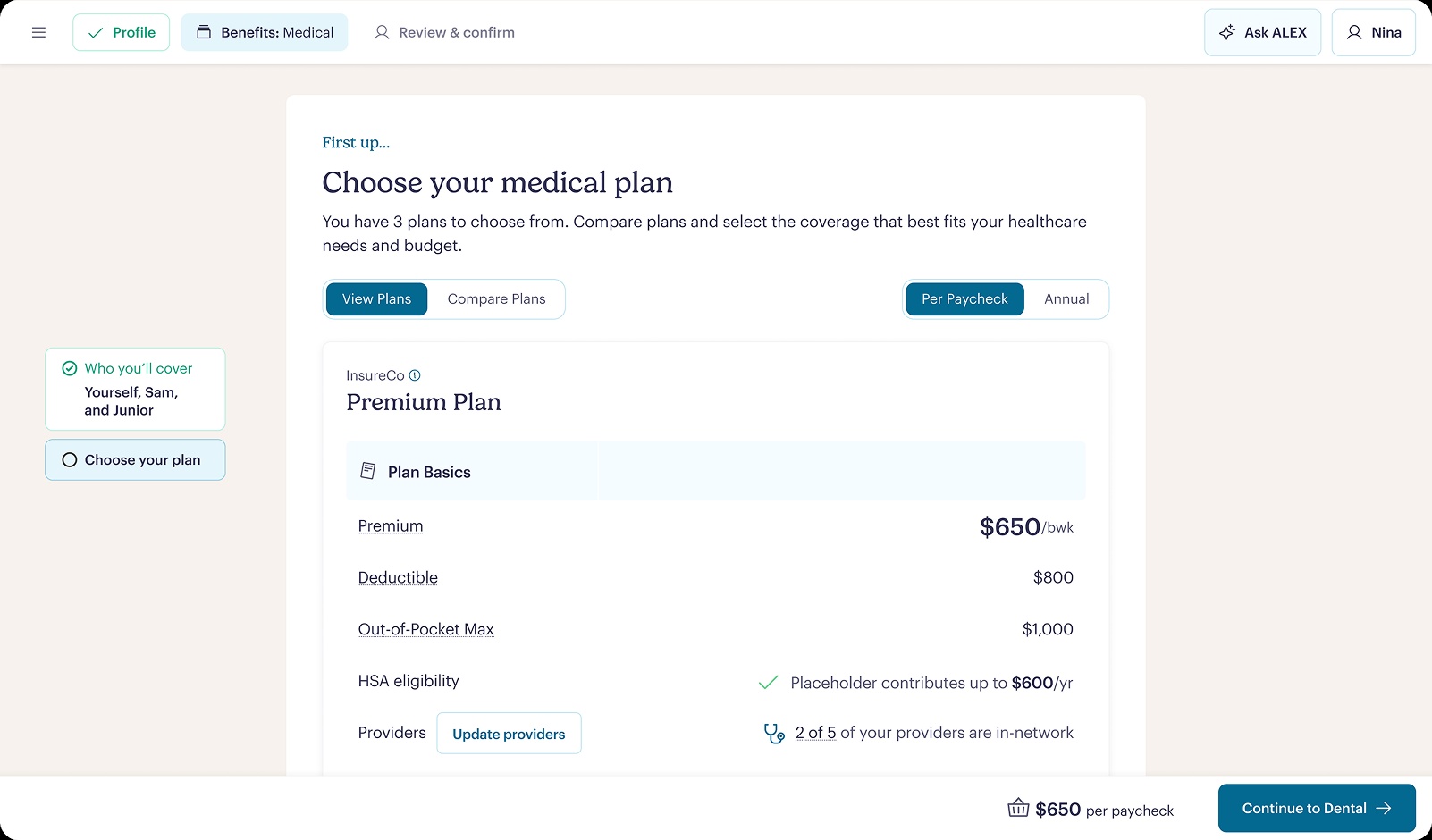
The current administration offering goes further: enrollment, eligibility, payroll connections, communication, and reporting. This changes the company’s place in the market. The guide that could accompany someone else’s enrollment system now also offers a connected administrative route. Employers need to evaluate the specific offering they intend to buy.
Competition also has a conversational turn. Nayya markets an AI health-and-wealth adviser, including actions beyond recommendations. AI language alone therefore provides little differentiation. Jellyvision’s more distinctive claim is its accumulated craft in explaining decisions, paired with benefits modeling and a history of employer distribution. Whether that combination wins depends on the work a buyer needs done.
Its other extensions follow recognizable points of confusion. ALEX Medicare won a Chicago Innovation Award in 2023. In May 2025, Jellyvision introduced leave management developed by Aidora. Paylocity acquired Aidora in July 2026. That last development belongs in the picture: a partner’s ownership can change while an earlier product announcement remains online.
06Copy the questions before the jokes
The useful lesson for a product builder is quite specific. Start with a decision someone must make. Ask for the information that changes the answer. Explain unfamiliar terms when they become relevant. Offer a shorter route for the person who does not need the whole performance. Make the next action easy to find.

There is a limit to what that approach can accomplish. Clear explanations cannot make an unsuitable benefits package suitable. A recommendation needs accurate plan details and assumptions that fit the person. A pleasant interaction can still leave a provider-network question unresolved. These are practical implications of a decision-support product, not a verdict about any particular ALEX customer.
The culture Jellyvision describes is consistent with work that needs both writers and technical specialists: remote flexibility, honest feedback, debate, and creative problem solving. Its careers page makes room for employee communities and a company band. Those details are amusing because the subject is insurance; they are useful because explanation requires people who care how a sentence lands.
Jellyvision’s second act suggests a good question for any company whose first market disappears: what were customers really getting from you? Here, the answer seems to have been a conversation worth continuing. Health insurance supplied a new reason to continue it.