The boys had been to coding camp. Renée La Londe wanted to go, too. At thirteen, her reasoning was refreshingly free of a five-year strategy: they had learned something she wanted to learn. She kept asking her mother until the answer became yes. A career in technology would follow. First, somebody had to find the money.
Her mother paid for the University of Texas camp at a time when the family’s finances were tight. La Londe was the only girl there. She discovered that she liked programming, and the discovery became useful quickly: she later helped pay her way through university by writing and integrating software for local businesses. Curiosity had acquired a business model.
Today she leads itD, the technology consultancy and software engineering company previously known as iTalent Digital. She also founded Girls Leadership Academy Meetup, or GLAM. Its programs introduce girls to coding, business planning, and leadership. Attendance is free. That last detail carries a family history inside it.
The fee her mother found
La Londe’s early education in business began at home. Her father was an entrepreneur who involved his children in his businesses. She remembers learning about leadership from him, and remembers that his expectations made no distinction between his daughters and his son. Ambition was available to all three.
The coding camp gave that permission a practical outlet. There is a pleasing absence of mysticism in the next step. She learned a skill, found businesses that needed it, and earned money doing the work. The University of Texas at Austin’s alumni record identifies her as a 1993 Bachelor of Arts graduate. Programming helped finance the education; it did not have to appear on the diploma to matter.
Her later work would concern much larger organizations. Yet the early arrangement is worth keeping in view: someone has a problem, someone else knows how to solve it, and software connects the two. It is a more durable starting point for a technology career than trying to guess which fashionable word will be on next year’s conference banners.
University of Texas BA
Founds iTalent Digital
Co-authors Social Knowledge
Founds GLAM
A customer with a complaint
Before starting her company, La Londe worked inside large technology businesses, including Apple, Cisco, and NetApp. At Cisco, she contributed to the shift of business transactions from paper to online systems. At NetApp, her work included transforming the support organization. These were encounters with technology at the scale where a promising idea must contend with actual operations.
They also gave her a customer’s view of consulting. She found firms charging substantial fees without the agility she wanted, and saw gaps in the range and depth of expertise available. Her account of founding itD begins with that dissatisfaction. She wanted to build the supplier she had struggled to find.
That is a particular education for a founder. A customer learns how a proposal looks after the sales meeting, when a team has to live with the result. The complaint behind itD concerned the working relationship as well as technical capability: how a consultancy understood the people using its services, and how its own teams operated.
Her public company biography dates the founding to 2005. The business now combines consulting with software engineering and products. Its name, itD, expands to “innovate transform Deliver.” The capitals are the company’s choice; the underlying assignment remains practical. A client needs something to work better.
“Customer Satisfaction is the soul of our business.”
Renée La Londe
The answer was already in the company
In 2014, La Londe co-authored Social Knowledge: Organizational Currencies in the New Knowledge Economy with Kenneth E. Russell and Fred Walters. The subject was how organizations share what they know. A company can employ knowledgeable people and still make their knowledge remarkably difficult to reach.
She took those ideas into a 2015 Conference Board session alongside Cisco’s Aparna Singhal. The agenda paired the book’s approach with examples from finance transformation. Knowledge was being considered as something that travels between colleagues, teams, and communities. An answer is more valuable when the person who needs it can get to it.
A few years later, that problem had a recruiting application. MojoRank, announced in November 2019, grew out of work for iTalent Digital’s own recruiting team. The system matched candidates with jobs inside an existing database. The company reported that its use reduced time to hire by 30%. That was an internal result reported at launch, with a specific setting behind it.
The pitch was straightforward: recruiters should spend less time searching through records and more time considering suitable people. The product also offered candidate anonymization as a way to address unconscious bias. It sat at a familiar intersection in La Londe’s work, where a workflow problem meets a question about whose abilities get noticed.
ChaMa addressed another kind of organizational confusion. Publicly launched in January 2020, it was designed to help companies see and coordinate change across projects and portfolios. Its name combines “change” and “management,” a small act of linguistic efficiency in a field rarely accused of it. Alongside Intelligent Content Syndication, these products extended the company’s work beyond consulting engagements.
Match candidates with jobs.
See initiatives across the organization.
Bring relevant content to users.
Product directions at the 2019-2020 launches. A conceptual guide, not a performance comparison.
Eight-year-olds with business plans
GLAM, founded in 2016, gives La Londe a different audience for the relationship between ability and opportunity. Its participants are eight to twelve. The curriculum puts coding beside creativity, strategy, teamwork, entrepreneurship, and pitching. A business plan belongs in the same weekend as a first programming exercise.
By the fourth annual workshop in July 2019, almost sixty girls had gathered at eBay’s San Jose headquarters. The agenda included the three Ps of business plans: product, passion, and profit. The vocabulary gave the girls a way to discuss an idea as a business, with customers and money to think about alongside enthusiasm.
The combination matters. A child can discover that she enjoys building something and still need practice explaining why anyone should care. GLAM gives her an audience. At the June 2024 program on Cisco’s San Jose campus, more than sixty girls worked in nine teams and presented business pitches to judges and adults. La Londe served among the session leaders and pitch judges or facilitators.
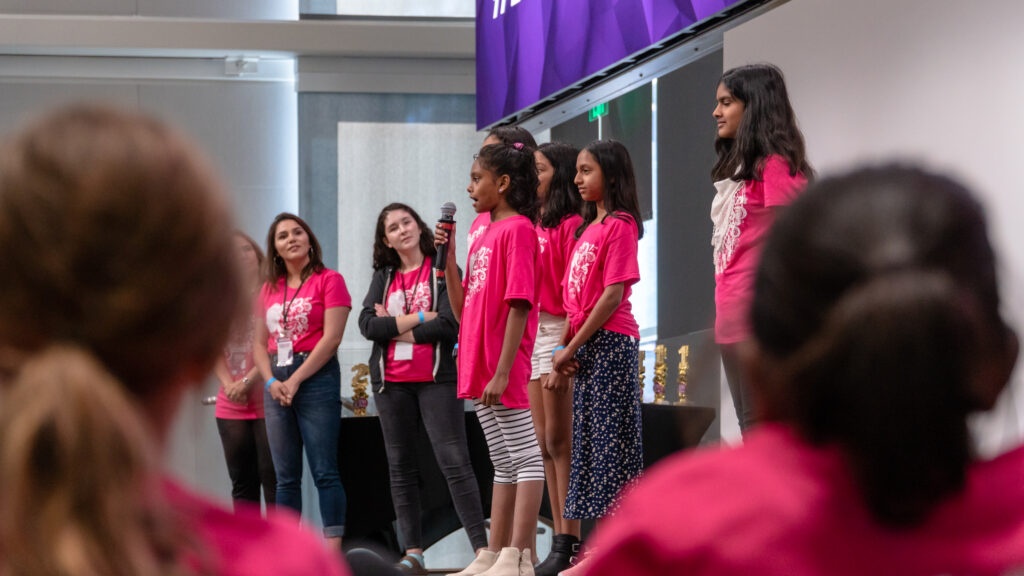
The stage gives the exercise consequences without requiring a child to have a company ready for incorporation on Monday. Teams received trophies and honorable mentions. One participant received an award recognizing growth and courage in public speaking. There was room to acknowledge the act of speaking as well as the quality of the proposition.
Another program, delivered online with eBay’s Seattle office in October 2024, brought together thirty-seven girls from twelve cities in three countries. They prepared recorded pitches for professional judges. By December, GLAM reported that its programs had reached more than 1,200 girls and sixty mentors across twenty-three countries. Those are the organization’s figures for that point in time.
Who owns the company?
La Londe’s interest in the girls’ business ideas has a sharper purpose than making them comfortable around executives. She wants more women to start companies. In a 2020 essay, she recalled receiving a note from a participant who wanted to become a founder after hearing her speak. That was precisely the possibility she hoped to open.
Her argument extends the discussion of representation to ownership. Women can join a business, lead teams, and reach senior positions; she also wants them to imagine establishing the business itself. A program that ends with a pitch gives that ambition something to do before it becomes a career choice.
The distinction changes the lesson being offered. A girl is invited to propose a product, decide how to describe it, and persuade somebody to listen. She gets to rehearse authority. Nobody needs to declare her a future CEO for the experience to have value. She has already had a turn at making the case.
La Londe’s own view of executive authority leaves space for other people. She has argued that leaders need capable colleagues, different perspectives, and a willingness to share credit. As she put it, “no one is an expert at everything.” A useful admission for anyone running a business, and a considerable relief for everyone else in the meeting.
A bigger room
The same concern about participation appears in her comments on artificial intelligence. She has argued for development teams that include a wider range of cultures, beliefs, and approaches to problems. Her point is about the people making decisions inside the technology. Their range of experience helps determine whom the result can serve.
In 2024, she was named to Inc.’s Female Founders 250. The recognition joined her company’s software and consulting work with her commitment to educating girls in STEM. The company’s announcement also reported revenue growth of 54% over the preceding three years. The business and the teaching program appeared in the same account of her work.
GLAM’s ambition continues beyond a single workshop. It has committed to showcasing 10,000 women in STEM, business, and leadership by 2030. That is a stated goal, with time still to run. The logic is accessible even to someone who has never written a line of code: let girls see more women doing work they might want to do.
La Londe once wanted to join the boys at camp. Now the program she founded gives girls a chance to make a plan and present it in their own names. The family investment that started her story has become an organizational decision. The girls get the workshop. Their families do not get the bill.