The trouble with an artificial-intelligence pilot is that it can succeed in a room where the business does not exist. The sample is tidy. The prompt behaves. The executives lean toward the screen. Then the demonstration meets a real company: customer records with three spellings of the same name, permissions built for another decade, a procurement queue, a legal review and hundreds of employees who already have a way of doing the job. This is the territory Artefact chose to occupy.
Founded in Paris in 2014, the firm now describes itself as a global data and AI consultancy, with about 2,500 employees in 27 countries. It sells no single magic application. It sells the connective tissue - strategy, data engineering, cloud platforms, machine-learning systems, marketing measurement, operating-model redesign and training. The bet is that enterprise AI is less a model problem than a coordination problem.
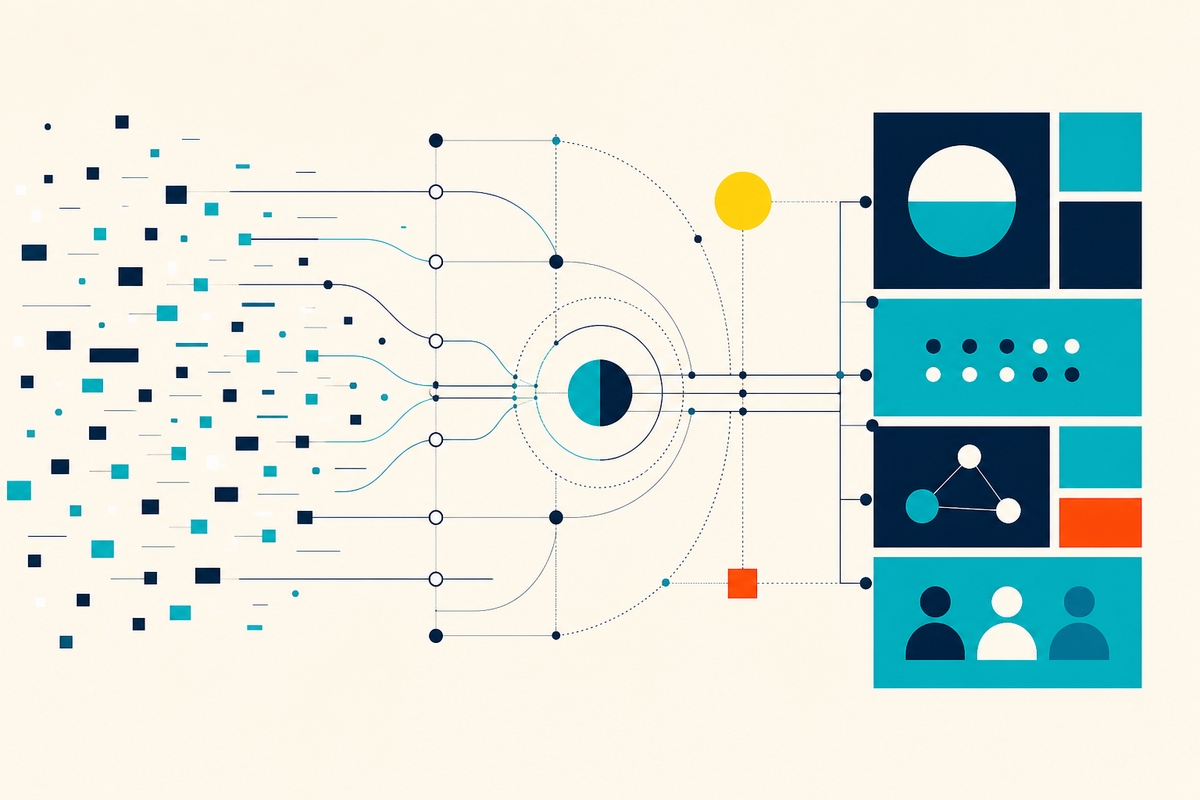
Three founders, three kinds of headache
Artefact's origin story is almost too neatly arranged. Vincent Luciani, Guillaume de Roquemaurel and Philippe Rolet studied at École Polytechnique. Luciani had worked at McKinsey and understood organizational problems. De Roquemaurel brought experience from Google and digital marketing. Rolet brought advanced computer-science research. The mix gave the young company three lenses on the same assignment: will the business value it, can the technology do it, and can anyone prove the result?
The company first developed a reputation in data-driven marketing, where attribution and return on advertising spend make vague claims uncomfortable. That heritage still matters. A classic strategy consultancy may stop after a roadmap; a systems integrator may begin with the platform; an agency may focus on the customer journey. Artefact tries to keep all three in frame. Its stated mission is to accelerate data and AI adoption. The revealing word is not AI. It is adoption.
“If not used, it is useless.”One of Artefact's published operating values
The line has the bluntness of a sticky note left on an expensive server. It also exposes the commercial logic. A model in production is not automatically a model in practice. Somebody must trust its output, know when to override it and fit it into a process whose incentives may need to change. Artefact therefore treats hackathons, executive education, role-based academies and its School of Data as part of delivery rather than the farewell gift at the end.
The product is a chain, not a box
Artefact organizes its work across the enterprise. Strategy teams assess maturity, choose economic priorities and define governance. Platform teams clean and connect data, move workloads to the cloud and build analytics foundations. Data scientists and engineers develop forecasting systems, recommendation engines and generative or agentic applications. Marketing specialists work on audiences, media, customer data and measurement. Change teams train users and redesign work.
The result is a services business, not conventional software-as-a-service. Clients pay for projects, recurring programs, managed marketing, engineering and training. Reusable accelerators and Artefact's Skaff technical-product incubator can shorten delivery, but the assignment is usually shaped around a client's industry, data estate and operating reality. The firm benefits when the fashionable model changes because the underlying integration work remains.
What the work looks like on Monday
At Carrefour, the practical object was Copilot Expansion, a conversational agent for evaluating possible store locations. The retailer said market research that once took months could be compressed to two minutes, while revenue-prediction accuracy improved by 15 points. The eye-catching number is the speed. The deeper change is that an analytical process, previously scarce and slow, can appear inside an ordinary expansion conversation.
Months of location research, compressed into a conversation
The agent brings market signals and revenue forecasting closer to the person considering a store, instead of leaving the analysis in a distant queue.
Bpifrance offers a different lesson. Working with Artefact and the French platform Dust, the public investment bank evaluated an agent platform with 100 people, put legal, compliance, security and procurement governance in place, then rolled 500 licenses across the organization. In under a year, employees had created more than 1,500 individual agents. Here the interesting product was permission: a controlled environment in which business teams could invent useful tools without waiting for a central laboratory to imagine every use case.
Other published cases sketch the range. VINCI Airports has used forecasting across a network of 70 airports. Bouygues Telecom introduced a generative sales assistant. Legrand built tools to improve product information for employees and customers. Heineken Brazil used a data-factory method as a revenue-generation center. Nissan worked on search efficiency. The customer list moves from retail and consumer goods to finance, telecoms, transport, healthcare, luxury and manufacturing. The recurring problem is not lack of data. It is data stranded from the decision it should improve.
The chart is a conceptual map, not Artefact's accounting. It makes a useful point: the interface is the part everyone sees, but data quality, access control, process ownership and behavior consume much of the work. This is why cloud and platform partnerships matter. Artefact has worked with Google Cloud for close to a decade and was named its 2025 Artificial Intelligence Partner of the Year for EMEA. It joined the AWS Partner Network in 2023 and has formalized work with Informatica around data governance and integration. These alliances supply infrastructure; Artefact supplies the translation into a client's business.
A specialist in the crowded middle
The competitive field is broad enough to be awkward. Accenture, Capgemini and Deloitte can mobilize enormous implementation teams. McKinsey, BCG and Bain have boardroom access and rapidly expanding AI units. Publicis Sapient and agency groups understand digital customers. Software vendors now surround their platforms with advisory services. Regional data boutiques can be sharper and cheaper in a local market.
Artefact's defense is focus. It is large enough to follow a multinational client across markets but still defines itself almost entirely through data, AI and measurable digital work. Its teams mix consultants, engineers, scientists and marketers instead of sending the job across four separate companies. That can reduce translation loss, though it also gives Artefact a wide promise to keep. End-to-end is attractive precisely because every weak link becomes the consultant's problem.
Buying the missing pieces
Since Ardian led a take-private transaction in 2021, Artefact has expanded through a deliberate string of acquisitions. Arca Blanca strengthened the UK. Effixis added generative-AI talent in Switzerland and Belgium. Brain Food Consulting opened more of Latin America. AdvanceGuidance added a South African team. Explorate AI brought German training and change-management capability. In June 2026, Amsterdam-based OFI Services added more than 130 specialists in process intelligence and hyperautomation. Belgian consultancy Agilytic followed in July.
The pattern is more interesting than the shopping list. Each deal adds either geography or a discipline required after pilots: training, process analysis, local delivery, industry knowledge. OFI is especially telling. Process intelligence examines event logs to show how work actually moves through an organization, including the loops and bottlenecks that a tidy process diagram conceals. Combine that view with AI agents and automation, and the consultant can choose targets by operational evidence rather than novelty.
The risk is familiar. Specialist cultures can blur as headcount grows, and a firm built around cross-functional intimacy can become the same collection of handoffs it was designed to replace. Artefact's 2030 target, announced with a governance change in 2025, is €600 million in revenue. Édouard de Mézerac became group CEO, while co-founder Luciani moved to executive chairman and de Roquemaurel focused on mergers and acquisitions. Scale is now part of the product test.
The useful question
A buyer should not ask Artefact, or any AI consultancy, whether it can build a clever system. The useful questions are less cinematic. Which decision will change? Who owns it? What data is permitted? How will performance be measured against today's process? What happens when the model is wrong? Which employees must behave differently for the economics to appear?
Artefact's best idea is that these questions belong in one assignment. The company fits between the strategic promise of AI and the operational burden of making it ordinary. Its work can help an enterprise prioritize use cases, modernize a data estate, deploy forecasting or agentic tools, improve marketing returns and teach teams to build safely. None of that guarantees transformation. It does make the hidden work visible.
The AI market still rewards spectacle, but enterprises eventually keep score in slower units: fewer returns, faster research, better forecasts, reduced handling time, more useful customer conversations. Artefact has arranged its business around those units. The demo gets the meeting. Monday morning decides whether the project was worth having.