The most revealing moment in a shopping trip can occur after the customer has decided to buy. The basket is full. The merchant has done its work. Then the payment gateway arrives, dressed like an entirely different business. It is a small visual jolt with an expensive possible consequence: a customer who hesitates at the last step.
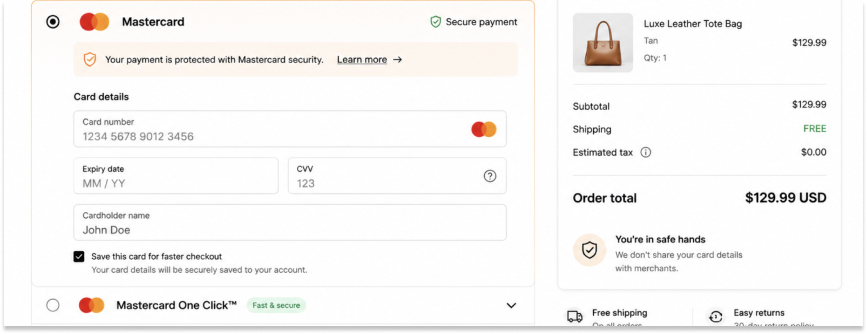
That break was the starting point for a 24-week assignment that DOASTRA describes for Mastercard. The company says it mapped the shopping journey, built a library of reusable themes, and engineered a payment experience that could adapt to a merchant’s brand and transaction context. The public case study reports less visual friction and abandonment, though it gives no numeric before-and-after measure. The useful observation is simpler: checkout is part of the product even when a different system owns it.
- DOASTRA, previously TALKD, sells discovery, design, product engineering, data and AI work to enterprises.
- Its published projects range from Mastercard checkout to donor scheduling, factory safety and energy retail.
- Its signature method, ASTRA, puts problem framing before a build team and a prototype.
- Its public case studies describe project duration and outcomes, but do not disclose fees.
The problem before the problem
DOASTRA is a technology consultancy and engineering company founded in 2011. Its listed headquarters are in Fremont, California, with locations in Pune, Chicago, London and Dubai. Its earlier identity, TALKD, still appears on old pages and company posts. The present site calls the firm an AI-native product engineering partner. The changes in language are substantial, but the old framework explains what the company is trying to sell: a sequence of decisions, not a pile of developers.
The framework is called ASTRA. Its letters stand for Analyze, Showcase, Team-up, Rapidly Prototype and Augment. The first two verbs matter most. They require someone to identify the people affected, examine the current workflow and make an idea visible before asking an engineering pod to make it permanent. This is a method for reducing the cost of being confidently wrong. It is also a practical sales argument: a client can buy discovery and design before committing to a larger system.
The company’s current menu includes digital product and SaaS engineering, modernization of older platforms, data pipelines, AI copilots and agents, experience design, and dedicated cross-functional pods. Those pods can combine product, design, engineering, data and quality assurance. For a client, the arrangement is an alternative to buying one specialist at a time and then managing every handoff internally. It is also a competitor to the in-house team, the conventional consultancy and the design agency. DOASTRA’s claim is that the same group can define, build and maintain the thing.
“Data is the nucleus. AI is the accelerator. Experience is the outcome.”DOASTRA’s stated formula
A donor has an appointment, not a dashboard
The clearest published numbers come from an assignment for an unnamed life sciences company. Donor scheduling and eligibility checks were manual; no-shows and compliance risk were the stated problems. DOASTRA says it built a donor app and a staff web platform with screening, appointments and loyalty features in 14 weeks. It reports a 55 percent reduction in no-shows and 40 percent higher donor retention after three months. These are company-reported results, not an independent study. Still, the shape of the intervention is instructive: the app attends to both sides of the appointment. A donor must be able to show up; a collection center must know that the visit is valid and manageable.
DOASTRA case study; 14-week project. Baseline and sample size are not published.
The same logic applies in the company’s heavy-engineering case study, where the awkward seam lay between paper permits, incident reports, spreadsheets and plant leadership. Its proposed answer was a web and mobile safety system covering permit approvals, incident reporting, compliance dashboards and ESG reporting. Here, a pretty screen would be a sideshow. What matters is whether a frontline worker can report a near miss and whether a supervisor can act on it with an audit trail.
What the company charges for
There is no public price list. DOASTRA appears to make money from scoped consulting and engineering projects and from longer-running teams assigned to a client’s product or technology work. Its energy retail case study describes an ongoing relationship covering outlet operations, EV charging, analytics, audit automation and maintenance. That breadth makes the business model legible: win trust on a defined problem, then remain close enough to the operating system to work on the next one. The exact cost of any published engagement is undisclosed.
Who buys this? Enterprise technology and business leaders who have a service to redesign or a platform to modernize, and global capability centers that need more engineering capacity. The named Mastercard engagement establishes a payments example. The life sciences, manufacturing and energy accounts show range but leave clients unnamed. The site displays other client logos; a logo alone does not tell us what was built for each one.
The current AI pitch is deliberately operational. DOASTRA says an AI initiative should be tied to a workflow, a measure and an owner, supported by governed data, evaluations, observability and human review. This is a more demanding test than producing a persuasive demo. The company’s offer now spans readiness assessments, data foundations, copilots, agents and platforms. Whether an individual AI system pays back its cost depends on the client’s data, adoption and controls; the published material does not supply a universal return figure.
The small idea worth stealing
A reader need not hire DOASTRA to borrow its best habit. Pick one journey that crosses a boundary: cart to payment, donor to collection center, worker to safety officer. Bring every owner of that journey into a room. Write down what each person believes is happening. Draw the actual steps, including the delays, duplicate entries and ambiguous approvals. Only then choose which part deserves a prototype.
That approach has limits. A workshop cannot repair a system that no one will fund, data that cannot be accessed, or a decision nobody is willing to own. A pod cannot create an internal sponsor by force. Yet those conditions are exactly why the early questions are valuable. The expensive mistake is discovering them after the code has shipped. DOASTRA’s work is most interesting at that moment of restraint, when a company with engineers on hand chooses to ask what problem the software is supposed to solve.