Phil Walsh came to marketing by way of the customer. Long before the dashboards, the AI vocabulary and the chief marketing officer titles, there were pharmaceutical sales calls, medical technology products and international accounts. It is a useful origin for an executive now charged with explaining an engineering company to the world. The customer was never an abstract persona. The customer was a person on the other side of the table, deciding whether a complicated thing could solve an expensive problem.
That commercial apprenticeship has followed Walsh through more than 25 years of work. He has marketed hospital automation, healthcare software, global technology services and artificial intelligence. In March 2026, he joined EPAM Systems as Chief Marketing Officer and Senior Vice President, taking responsibility for the company's global marketing organization. The assignment joins brand strategy, market positioning and demand generation to a company whose work ranges from software engineering to digital transformation and AI.
Walsh describes the task in the language of systems. Marketing, sales and delivery should not pass a customer from one silo to the next like luggage at an airport. They should share data, coordinate decisions and shorten the distance between an early signal and useful action. It is less a sequence of campaigns than a living commercial circuit.
The education of a commercial operator
Walsh studied biological sciences at Clemson University, graduating in 1998. His first professional roles were in pharmaceutical sales, followed by sales and product management at Physcape. In 2003 he joined Baxa Corporation, a maker of pharmacy technology, as a territory account manager. Five years later he was directing international sales.
The work carried a concrete promise. When Baxa announced a distribution agreement in China in 2009, Walsh spoke about bringing pharmacy automation into a market where many preparations were still made manually. It was marketing at its least ornamental: distribution, product utility and local adoption had to meet. In 2010, the Stevie Awards named him a finalist for Sales Director of the Year.
Baxter International acquired Baxa in 2011, and Walsh moved from international sales into global marketing and market development. Along the way he earned an MBA from Wingate University. His LinkedIn record lists a 3.91 GPA, membership in the Delta Mu Delta business honor society and an award associated with the top student in his graduating MBA class.
By 2015 he was CMO of TriZetto Healthcare Products, the healthcare software business Cognizant had acquired the year before. Then the aperture widened. At Cognizant he led marketing for healthcare and life sciences, became CMO for North America and ultimately served as vice president and global head of field marketing. The field organization extended across more than 30 countries and included more than 200 marketers.
- Pharmaceutical sales, then sales and product management at Innovex and Physcape.
- Baxa and Baxter roles spanning territory sales, international sales and global market development.
- CMO and field marketing leadership across TriZetto and Cognizant.
- Chief marketing roles at AKASA and Turing, both centered on artificial intelligence.
- Chief Marketing Officer and Senior Vice President at EPAM Systems.
The invisible majority of the buyer journey
The scale at Cognizant sharpened a belief Walsh has repeated since: most of a buyer's journey takes place before a sales representative enters the conversation. Search results, essays, videos, websites, social posts and events accumulate into an opinion. By his estimate, roughly 60 to 70 percent of the journey is already complete before the formal handshake.
The pre-conversation journey
Illustrative midpoint of Walsh's stated 60-70% estimate. It describes his operating belief, not an independent market statistic.That observation changes the CMO's remit. If buyers are forming trust before sales knows their names, marketing cannot be merely a lead factory. It owns the quality of the environment in which an opinion forms. It must understand what people seek, which messages help, what behavior signals intent and where a human conversation becomes valuable.
Walsh wrote about this problem in a 2018 series on digital business transformation. His frame divided a business into the visible front, the operational middle and the technological back. Customer experience could not improve if only the front received attention. The systems behind the screen mattered too. Years later, the same idea appears in his description of marketing technology: infrastructure that connects digital and in-person behavior into a legible journey.
“One hundred percent of marketing is data-driven.”Phil Walsh, on measurement and experimentation
The line sounds absolute, but Walsh pairs it with an important qualifier. Data only matters if someone acts on it. Earlier in his career, a campaign could run for months before meaningful feedback arrived. Digital channels compress that delay to seconds. Opens, clicks and visits show up quickly, allowing a team to test a hypothesis and choose whether to invest again. The speed is useful. The decision is the work.
He also refuses to reduce marketing to measurement. Creativity remains part of the practice because a perfect feedback loop cannot supply the original idea worth testing. Walsh wants creative thinkers, not attendants for a dashboard. The resulting philosophy holds evidence and invention in the same hand: propose something interesting, watch carefully, learn quickly.
AI enters the operating model
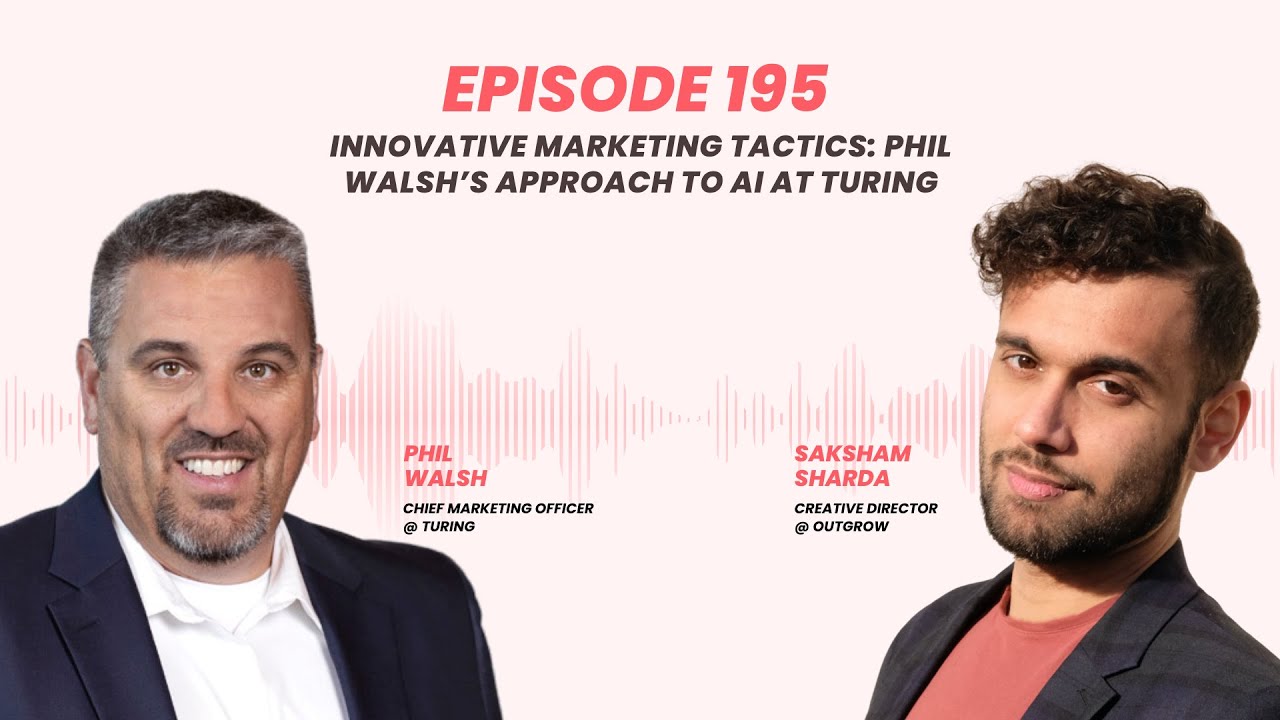
Walsh moved into AI-focused companies before generative AI became compulsory boardroom conversation. He joined AKASA as CMO in late 2021, when the company was applying machine learning to healthcare operations. In May 2023, he became Turing's first CMO, overseeing brand, product marketing, communications and marketing operations.
Turing sat at an intersection that suited his background: a technology services business using an AI system to source and match technical talent, then expanding its work with frontier AI labs and enterprise customers. Walsh helped recast its story around AI research acceleration, training data and what the company called “Proprietary Intelligence” - systems tuned with an organization's own data, expertise and workflows.
His bylined work at Turing stressed that access to a powerful model was not, by itself, an enterprise advantage. Domain experts had to define evaluations, probe edge cases and guide improvement. Governance needed to be designed into the workflow. Leaders had to connect model capabilities to measurable outcomes rather than admire a pilot from a safe distance.
Make expertise visible → turn it into a testable system → measure behavior and outcomes → let people judge the edge cases → feed the learning back into the next decision.
At EPAM, that thinking moves inside a larger engineering organization. Walsh says marketing and sales are now on the front line of AI transformation. His stated focus is an AI-native internal marketing organization that can own the intelligence layer, coordinate growth applications, govern their use and measure outcomes. Brand does not disappear into automation. It becomes a source of commercial memory and a constraint on what the machine should ship.
This is where Walsh draws a useful border. Machines are good at producing, processing and adapting at scale. People must still discriminate between what is merely available and what is worth saying. After attending Cannes Lions in 2026, he wrote that discernment matters more in the AI era, not less. A CMO must separate strong work from bland volume and understand that appearing inside an AI answer does not automatically create preference.
“I want people who are creative thinkers.”Phil Walsh, on the part of marketing that remains human
Participation is a growth technology
For all the operating-system language, Walsh's advice to people is pleasingly low-tech. Asked what a new remote hire should do, he said: network. The office once manufactured chance encounters. Distributed work requires people to manufacture them for themselves. Turn on the camera. Participate. Listen, but do not remain a blank square. Offer a point of view so colleagues can learn how you think.
It is the human-scale version of his marketing model. Information that never enters the system cannot improve it. Data without action is wasted. Expertise that stays private cannot teach a model or a colleague. A buyer who encounters only generic output has little reason to trust the company behind it. Participation creates the signal.
Walsh's off-hours preferences fit his Denver base neatly: golf in summer, snow skiing in winter. They are modest details, but useful ones in a career otherwise described through global teams and enterprise systems. He has also written from the perspective of a frequent traveler, once noting that he logged more than 100,000 miles in a year before considering robot co-workers in hospitality. The observer of systems remains a customer moving through them.
His career has moved from selling products to building the environment in which products are understood. The scale increased. The feedback became faster. The technology grew more capable. Yet the durable pieces stayed recognizable: know the customer, connect the functions, make the data usable, give creative people room, and insist that someone with judgment remains accountable for what reaches the world.
At EPAM, Walsh now has a chance to test those ideas on the company that must market both engineering craft and AI transformation. The aspiration is not mysterious. It is to make marketing behave with the speed and sophistication of the technology it represents while keeping trust, taste and responsibility in human hands. A machine can accelerate the loop. Someone still has to decide where it should go.