The sales profession has no shortage of weather systems: quotas blow in, forecasts cloud over, and somebody always promises that a new tool will make the rain stop. Michael Labate’s response has been less meteorological. He measures what people actually do. In one year-long comparison he discussed publicly, cold calls produced a 0.15 percent success rate, generic automated emails reached 0.3 percent, highly personalized email climbed to 1 percent, and LinkedIn outreach landed around 2.5 to 3 percent. The lesson was not that every executive should sprint toward a social platform. It was that received wisdom could be tested.
That instinct supplies the through-line in a career of changing titles and changing technologies. Labate has run a software-development outsourcing company, spent 14 years in sales and marketing leadership at SAP, opened a North American chapter for Intellias, held chief revenue posts, advised companies and investors, and now leads revenue and marketing at Growth Acceleration Partners, better known as GAP. The nouns have progressed from outsourcing to digital selling to transformation to AI. The verbs are steadier: listen, train, measure, adjust.
Before the dashboard, a builder
Labate’s commercial education began close to the machinery. In the early 2000s, he co-founded and led ThinkBuildDeploy, a software-development outsourcing company. The company served mid-market and large organizations including Citrix, Motorola, JM Family Enterprises, Firehouse Subs and Toyota. A decade at that scale gives a leader an unusually practical view of promises. The elegant pitch eventually meets a deadline, a budget and a working application.
He was already moving into SAP while that chapter wound down. Over 14 years at the enterprise-software company, his remit expanded through digital sales and marketing, ecosystem sales and global sales transformation. The crucial subject was social selling, a phrase that could sound suspiciously like corporate perfume. Labate treated it as operations.
“We had to establish baselines to see how well we were actually doing.”Michael Labate, on changing sales behavior
SAP’s program reached 15,000 employees. The company built internal indices around conversion, speed to close, average deal size and other performance signals. Sellers below a benchmark received training; those above it could teach their methods to colleagues. This was not a campaign pasted onto a sales force. It was a feedback loop. The work was linked to more than €2 billion in marketing and sales pipeline, with an average four-percentage-point improvement in pipeline value.
The philosophy underneath those metrics was disarmingly human. Labate urged developers and product owners to build personal brands in the industries they knew. Their expertise could invite people into a conversation. Customer contact was an opportunity to establish credibility, not an ambush in business casual. Trust was the asset; the software merely helped observe how it moved.
One year of outreach, compared
Success rates Labate shared in a 2021 conversation. LinkedIn is shown at the midpoint of his reported 2.5% to 3% range.
A social seller who distrusted noise
In 2021, while serving as Intellias’s North America president, Labate explained that social selling was “broader than just social.” The distinction saved the idea from becoming a platform trick. Smaller clients and enterprise accounts behaved differently. Social channels could drive important cross-border conversations with smaller businesses, while the opening move in a large enterprise sale often happened elsewhere. Channel followed context.
He was equally blunt about referrals. Salespeople under quota pressure could default to “spray and pray” because searching for a warm route felt slow. His alternative was signal-based outreach: identify intent data, find patterns, connect the data to a sequence, tailor the message to a known problem and follow up personally. In his reported results, that method cost 50 percent less while producing twice as many inbound responses. Hyper-personalized messages to people showing a relevant need could add another one or two percentage points.
The vocabulary may be funnels and signals, but the etiquette is closer to a good dinner guest: notice the room before beginning your monologue. Labate’s advantage was to pair that social intuition with the habits of an analyst. Personality met spreadsheet. Neither had to apologize.
The title gets larger; the operating idea stays small
ThinkBuildDeploy
Co-founder and CEO of a software-development outsourcing company serving enterprise clients.
SAP
Fourteen years across digital sales, marketing, ecosystem sales and global transformation.
Intellias
President of North America and advisory board member, charged with expanding the region.
FROM: Vision to Victory
Chief Revenue Officer, advisory board member and investor.
Growth Acceleration Partners
Chief Revenue & Marketing Officer, integrating the commercial strategy around software, data and AI.
Intellias appointed Labate president of North America in October 2020. He joined the executive team as the Ukrainian-rooted engineering company sought more business in the United States and Canada. A Boca Raton office became the headquarters for North and Latin America. His pitch emphasized engineering talent, industry expertise and personal dedication, three assets that cannot be made interchangeable without losing the sale.
The role also widened his geography. Public colleagues later praised his grasp of Latin American market dynamics and his ability to adapt social-selling programs to local culture. That detail matters. A system built to scale can become imperial if it mistakes consistency for sameness. Labate’s work suggests the better version: common measures, locally intelligent behavior.
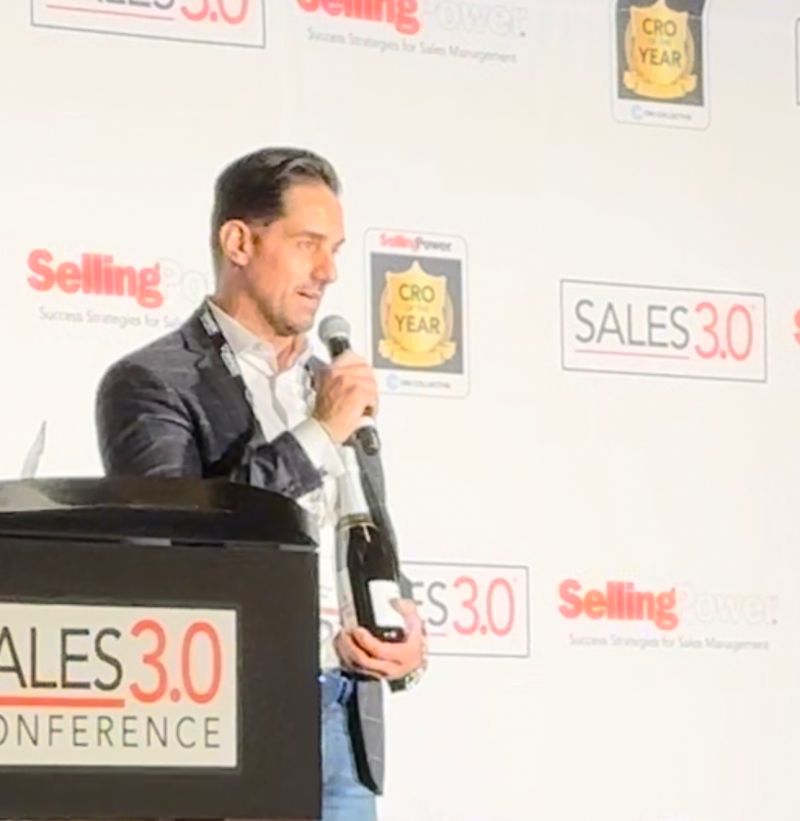
Recognition arrived in Las Vegas. In September 2023, Labate wrote that he was “humbled and honored” to receive a CRO of the Year award at the Sales 3.0 Conference. His thank-you list began with the employees who had partnered with him over the years, then named Gerhard Gschwandtner for friendship and mentoring and Elay Cohen for friendship and an onstage reflection. The trophy belonged to one person. The acceptance was plural.
Now the product can talk back
In April 2025, Labate joined Growth Acceleration Partners as Chief Revenue & Marketing Officer. GAP builds and modernizes software and data systems. His brief combines sales and marketing, aligns commercial strategy across services and asks technology to produce a business outcome, not merely a handsome architecture diagram. CEO Joyce Durst described his combination of strategic insight and executional rigor. CTO Paul Brownell emphasized clarity, cadence and a business-first approach.
Labate’s own explanation was more revealing. He said GAP offered a chance to work “at the intersection of growth and innovation,” attracted by its client-first culture, engineering talent and ability to modernize software and data with AI at the core. His focus, he said, would be solving the right problems, at the right time, with the right solutions. Three uses of “right” may be the least fashionable sentence in AI, where possibility tends to arrive before selectivity. It is also the operator’s sentence.
By 2026, his published work had moved into autonomous software engineering, agent development companies and forward deployed engineers. The subjects sound new because they are. The commercial test is old. Can an agent work inside real systems, reach trustworthy data and survive contact with operating constraints? Can a technical partner build inside a client team rather than toss a prototype across the wall? What does the buyer gain, and how will anyone know?
“My focus is on executing a bold commercial strategy by partnering with clients to solve the right problems, at the right time, with the right solutions.”Michael Labate, joining GAP in 2025
There is an appealing symmetry to the journey. Social selling asked a large company to hear individual buyers amid the market noise. Enterprise AI asks a large company to identify useful work amid the technological noise. Both shifts tempt leaders to buy tools before establishing behavior. Labate’s public playbook starts in the opposite order: find the baseline, train the people, follow the signal, inspect the result.
He holds a business degree from Penn State and an MBA from Northwestern University’s Kellogg School of Management, where his public profile notes that he was elected a cohort ambassador. He lives in South Florida with his wife, Rachel, and their two children. In 2026, he was named among the Miami Titan 100 honorees, placing the local executive inside a regional cohort of leaders.
A career in revenue is usually narrated as a sequence of bigger numbers. Labate’s is more interesting as a sequence of better instruments. The early software business taught him where a promise lands. SAP offered a laboratory large enough to measure trust at scale. Intellias made the problem geographic. GAP has made it computational. Through every chapter, the task remains stubbornly human: notice what matters, create a reason to believe, and make the evidence legible.