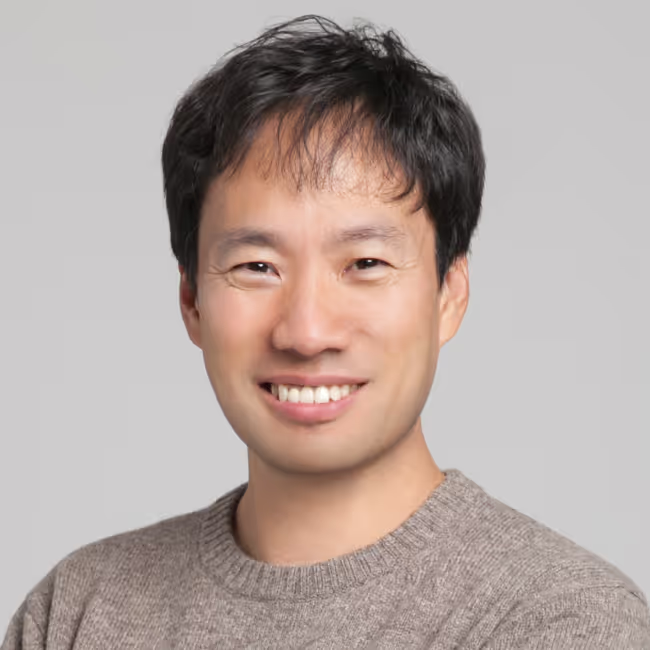
Origin Story
Before anyone called it AI, he called it obvious
In 1996, while studying computer engineering at Daegu University in South Korea, Sung Kim wrote Kkachine - the country's first automated search engine. This wasn't a research project. It was a practical response to a real problem: information on the Korean internet was impossible to find. He was 20. Google wouldn't exist for another two years.
That same instinct - see a gap, build the thing - has driven every major move he's made since. It's why he left a tenured professorship at one of Asia's most prestigious engineering schools. It's why he walked away from running Naver's entire AI organization. And it's why Upstage, the company he co-founded in October 2020, built a frontier language model that beats GPT-4.1 using one tenth the compute budget.
His academic path took him from Daegu to the University of California, Santa Cruz, where he earned both his master's and PhD in computer engineering by 2006. His dissertation focused on adaptive bug prediction through software history analysis - an early form of applying machine learning to code behavior, long before "ML engineer" was a job title. He then spent time at MIT's Program Analysis Group before landing a faculty position at HKUST (Hong Kong University of Science and Technology) in 2009.
"Most companies have large amounts of data and IT infrastructure but struggle to apply AI technology to their businesses."
Sung Kim - Upstage Founding Story, 2022The Professor Phase
Winning four ACM awards before TikTok was invented
At HKUST, Kim became a fixture in software engineering research - specifically the intersection of machine learning and how software fails. He won the ACM SIGSOFT Distinguished Paper Award four times (ICSE 2007, ASE 2012, ICSE 2013, ISSTA 2014), plus two Ten-Year Most Influential Paper Awards. The research community noticed. Industry noticed differently.
What actually spread his name globally was a YouTube channel. Kim started posting deep learning lectures in Korean, aimed at making the field accessible to students and professionals who couldn't attend Stanford or MIT. The series, "Deep Learning for Everyone," accumulated over 6 million views. In Korean tech circles, watching his lectures became a rite of passage - the equivalent of taking Andrew Ng's course, but in a language more developers in the region actually spoke.
Microsoft noticed, handing him Software Innovation Awards in 2010 and 2011. Google followed with a Faculty Research Award in 2011. He collected these accolades while continuing to teach, research, and post videos. Then Naver came calling.
"Deep Learning for Everyone" - 6 million views, one Korean professor, zero marketing budget. The best AI education is the kind that doesn't sound like AI education.
YouTube Series, launched 2017
The Industry Pivot
Building Naver Clova from three people to an AI ecosystem
In 2017, Sung Kim became the Founding Head of Naver Clova AI - Naver being South Korea's dominant internet company, roughly analogous to Google in its market position. He took a team of three and built it to 150 in a single year. Then he kept going, expanding Clova's AI capabilities into more than 30 product areas: visual AI, OCR, speech recognition, synthesis, natural language processing through the Papago team.
The leaders he recruited during that period became his founding team at Upstage. Hwalsuk Lee (Stan Lee), who ran Clova's Visual AI and OCR division, became Upstage's CTO. Lucy Park, who led Naver's Papago modeling team, became CSO. The Korean press later nicknamed the Upstage founding team the "AI Avengers" - each member had run a major AI division at either Naver or Kakao before joining.
The observation that drove them to leave was specific: they watched companies with perfectly good data and solid engineering teams fail to extract any value from AI. The gap wasn't technical - it was translation. Someone needed to bridge enterprise problems with AI capabilities. Upstage was the answer to that specific observation.
Building Upstage
Kaggle gold, solar models, and the unicorn moment
Upstage launched in October 2020. Within 18 months, the team had won 10 Kaggle gold medals - the competitive machine learning platform where the world's best data scientists fight over datasets. This wasn't an accident. Kim used Kaggle performance as a recruiting signal: if you could win on Kaggle, you could ship product. It was proof-of-capability at scale, public and verifiable.
In December 2023, Upstage released Solar - a 10.7 billion parameter language model. The model's design philosophy was efficiency: comparable performance to larger models, deployable at a fraction of the compute cost. Enterprise customers, particularly in highly regulated industries like finance, healthcare, and legal, could run it on-premises without sending data to American cloud providers.
Solar Pro 2, released in mid-2026, pushed this further. It scored 58 points on the Intelligence Index, outperforming GPT-4.1 by 5 points. The underlying technique - Depth-Up Scaling - achieves this by using only 10% of the AI chips required by comparable-performing frontier models. This isn't just a benchmark story. It's an economics story: enterprises that couldn't afford to run a frontier model can now do so.
Solar Pro 2 vs. Competitors
Intelligence Index Comparison
Source: Upstage / Solar Pro 2 announcement, 2026. Depth-Up Scaling enables frontier-level performance at a fraction of the compute.
Funding Journey
From bootstrap to $1B valuation in five years
The March 2026 Series C closed at $120M for the first tranche, pushing Upstage past the $1 billion valuation threshold and making it South Korea's first generative AI unicorn. The company is now targeting a KOSPI listing - Korea's main stock exchange - as its next capital milestone.
"2026 is the inaugural year for the commercialization of artificial intelligence and AI agents."
Sung Kim, Seoul Economic Daily, February 2026The Bigger Play
Sovereign AI and the AMD meeting in Seoul
In March 2026, Sung Kim met with AMD Chair and CEO Lisa Su in Seoul. The agenda: a potential purchase of 10,000 AI chips and the broader question of sovereign AI infrastructure for South Korea. The meeting wasn't a courtesy visit - AMD and Upstage subsequently announced an expanded strategic collaboration for exactly this purpose.
"Sovereign AI" is the term the industry has settled on for a country's ability to run AI models domestically, on domestic chips, without depending on American cloud providers or foreign model APIs. For regulated industries - government, healthcare, finance, defense - this isn't a preference, it's a compliance requirement. Upstage, with its on-premises deployment model and its Solar models' efficiency, is positioned directly in this gap.
Upstage became Korea's first government-approved generative AI provider in December 2024, when it was registered on the Public Procurement Service Digital Service Mall. This gave it access to government contracts that competitors were locked out of. The AMD infrastructure partnership is the next layer of the same strategy.
Kim's declared thesis for 2026: AI agents that "don't just talk but think, reason, and act." The Solar models are the substrate. The enterprise document intelligence products - OCR, structured data extraction, financial document parsing - are the near-term revenue layer. The agents are where the multi-year bet is placed.
Recognition
The scorecard
4x ACM SIGSOFT
Distinguished Paper Award - ICSE 2007, ASE 2012, ICSE 2013, ISSTA 2014
10 Kaggle Gold Medals
Won in 18 months post-founding - a deliberate recruiting strategy
CB Insights AI 100
Named to the 2025 list of most promising AI companies globally
Korea's First Gen AI Unicorn
Upstage crossed $1B valuation in March 2026 Series C
2x Influential Paper Award
Ten-Year Most Influential Paper recognition in software engineering
Government Approved
First generative AI provider on Korea's Public Procurement Service (Dec 2024)
The Details That Define
What the resume doesn't say
Kim's GitHub handle is "hunkim" - not Sung, not SungHunKim, not anything corporate. His preferred name in professional settings is Hun Kim. His email at Upstage is hunkim@upstage.ai. This isn't a minor detail: it reflects a consistent pattern of someone who operates at the intersection of deep technical credibility and pragmatic execution. The handle is approachable. The research record is not.
He is technically still on leave from HKUST - meaning his professorship is formally held. Whether he returns is genuinely unclear. What is clear is that the academic rigor shows in how Upstage evaluates its models. The company doesn't just release benchmark numbers. It publishes methodology. The Solar Pro 2 announcement included details on how Depth-Up Scaling works and why it achieves the efficiency it does. That's the professor talking through the CEO.
His online course "Deep Learning for Everyone" drew students from across Southeast Asia and the Korean diaspora globally. Before he had a unicorn to his name, before the Series C, before the AMD partnership, he was the guy whose YouTube lectures explained attention mechanisms to people who had no other access to that knowledge. That pedagogical instinct - make it clear, make it accessible, trust the audience - runs through Upstage's product philosophy too.
Side Notes
The details worth clipping
Built Korea's first automated search engine (Kkachine) as an undergraduate in 1996 - two years before Google launched.
Co-founded his first tech company (Nara Vision, which built KkebiMail - one of Korea's first webmail services) in 1995, the same year Amazon went online.
Still technically holds his HKUST faculty position - on leave. Two careers running in parallel, one paused mid-sentence.
Upstage's company name is a direct statement of intent: to "upstage" the current AI hierarchy. The branding is not subtle.
His YouTube deep learning series became so widely watched in Korea that it was considered a prerequisite for AI job applications at major tech firms.
Spoke at the Milken Institute Global Investors' Symposium in Hong Kong in 2026 - the same venue where sovereign wealth funds debate where to deploy the next decade of capital.
Further Reading
Go deeper
Official Profiles
- upstage.ai - Upstage AI official site
- LinkedIn: hunkimup - Professional profile
- X/Twitter: @hunkims - Personal account
- GitHub: hunkim - Code and projects
- YouTube: hunkims - Deep learning lectures, 6M+ views
- HKUST Faculty Page - Academic profile, on leave
Key Reads & Watches
- Upstage Founding Story - Why they left Naver
- Solar Pro 2 Announcement - Korea's first frontier model
- AMD x Upstage Partnership - Sovereign AI infrastructure
- Seoul Economic Daily Interview - AI agents in 2026
- KSC2022 Keynote (YouTube) - "No-Code AI is eating the World"
- 2025 Upstage Career Talk (YouTube) - Solar and the future of AI
- Milken Institute 2026 Profile - Global Investors' Symposium speaker