The cloud company that didn't build a cloud. It found the one already sitting idle - and rented it back to you for a fraction of the bill.
Somewhere right now, a certified data center has racks running at half capacity. A GPU farm has cards idling between jobs. A decentralized storage network has petabytes nobody is reading. The infrastructure of the internet is, quietly, over-provisioned - and most of it is invisible to the developer who just wants a machine to train a model on tonight.
NodeShift's whole thesis is that you don't need to pour more concrete to fix that. You need a switchboard. The company aggregates excess compute, GPU and storage from independent data center operators and web3 networks like Akash and Filecoin, then hides all of it behind one simplified dashboard and a single API. You click. It finds the cheapest qualified machine. You ship.
The founders are blunt about the payoff. Compared with the big three clouds, they say, the same workload runs 70 to 80% cheaper - because you're paying for capacity that already exists rather than capacity someone has to finance, build and depreciate.
"If you compare it to traditional cloud providers, we're talking about prices that are 70 to 80% cheaper." - Mihai Marcuta, Co-founder
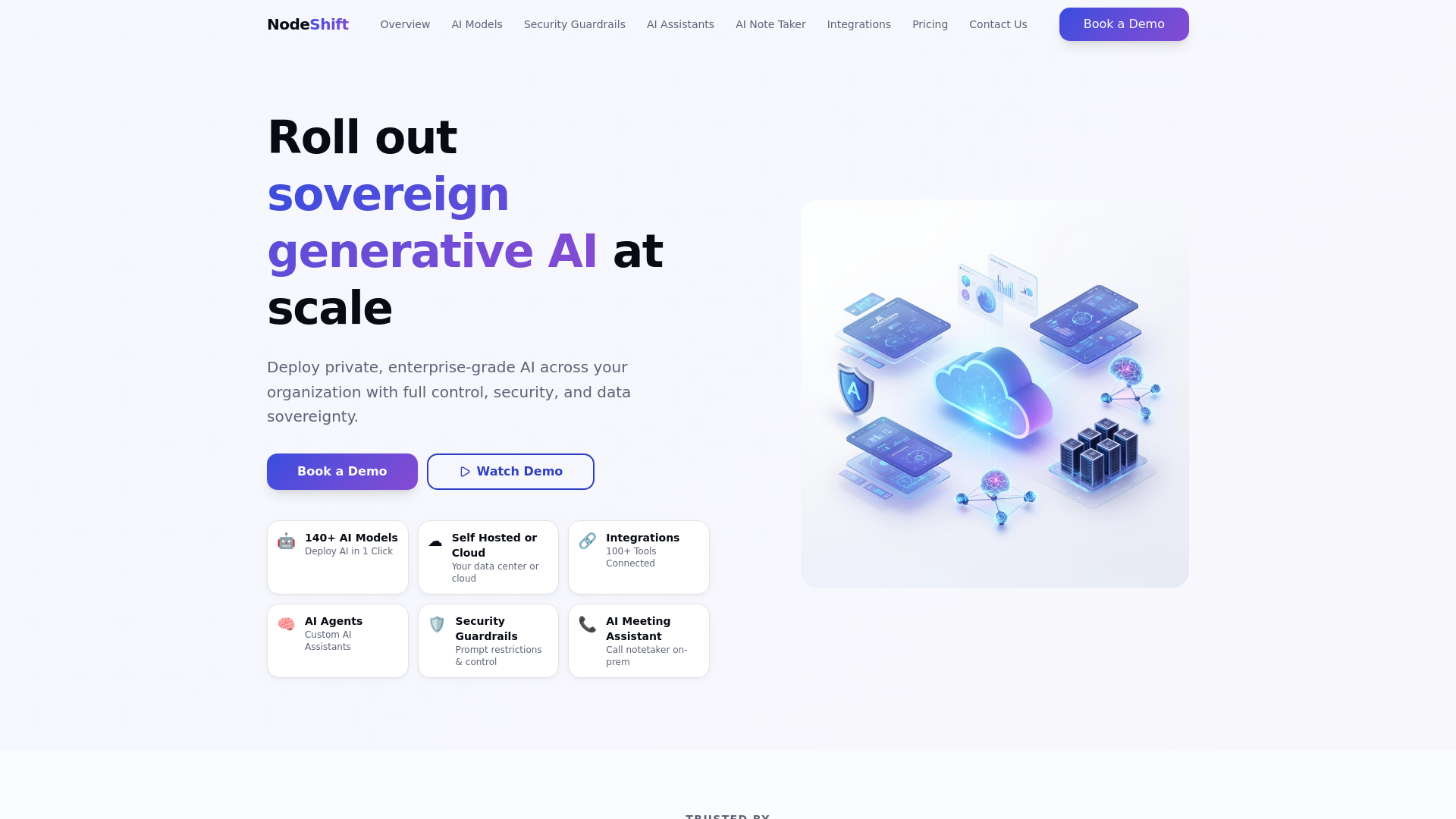
NodeShift sits in the middle - part broker, part translator - turning a messy supply of independent and decentralized capacity into something that behaves like a normal cloud.
Nvidia A100s for serious training, RTX 4090s for budget-friendly inference, rendering, gaming and video editing.
Virtual machines from independent and certified data centers, spun up across 200+ locations from one screen.
Traditional and decentralized storage drawing on a pool described as ~28 million terabytes.
Managed orchestration is on the roadmap - containers and clusters on borrowed iron.
A rough illustration of NodeShift's core claim - relative cost for the same workload. Lower is cheaper.
Andrey Surkov and Mihai Marcuta met as Cisco interns in 2016. The idea for NodeShift, by their own telling, surfaced on a trip to Turkey - reportedly proposed in a recovery room. Cloud history is rarely tidy.
Stayed on at Cisco after the internship and later spent time in crypto - bringing the decentralized-infrastructure instinct that sits at NodeShift's core.
Logged time at Microsoft Azure, Twitter and Epic Games before co-founding NodeShift - hyperscaler experience, turned against the hyperscalers.
NodeShift's seed round was led by Central-and-Eastern-Europe-focused Inovo.vc, with a roster that mixes enterprise SaaS pedigree and gaming firepower.
There's a tidy logic to Epic Games writing an angel check into a company selling cheap GPUs - rendering and real-time graphics are exactly the kind of workload NodeShift wants to win. The company was also picked for Intel's Ignite accelerator out of more than 600 funded deeptech startups.